dvanced Electronics
Semiconductors are becoming strategically important for India’s future economy.
They are essential for artificial intelligence, automobiles, telecommunications, defence, healthcare, consumer electronics and digital infrastructure.
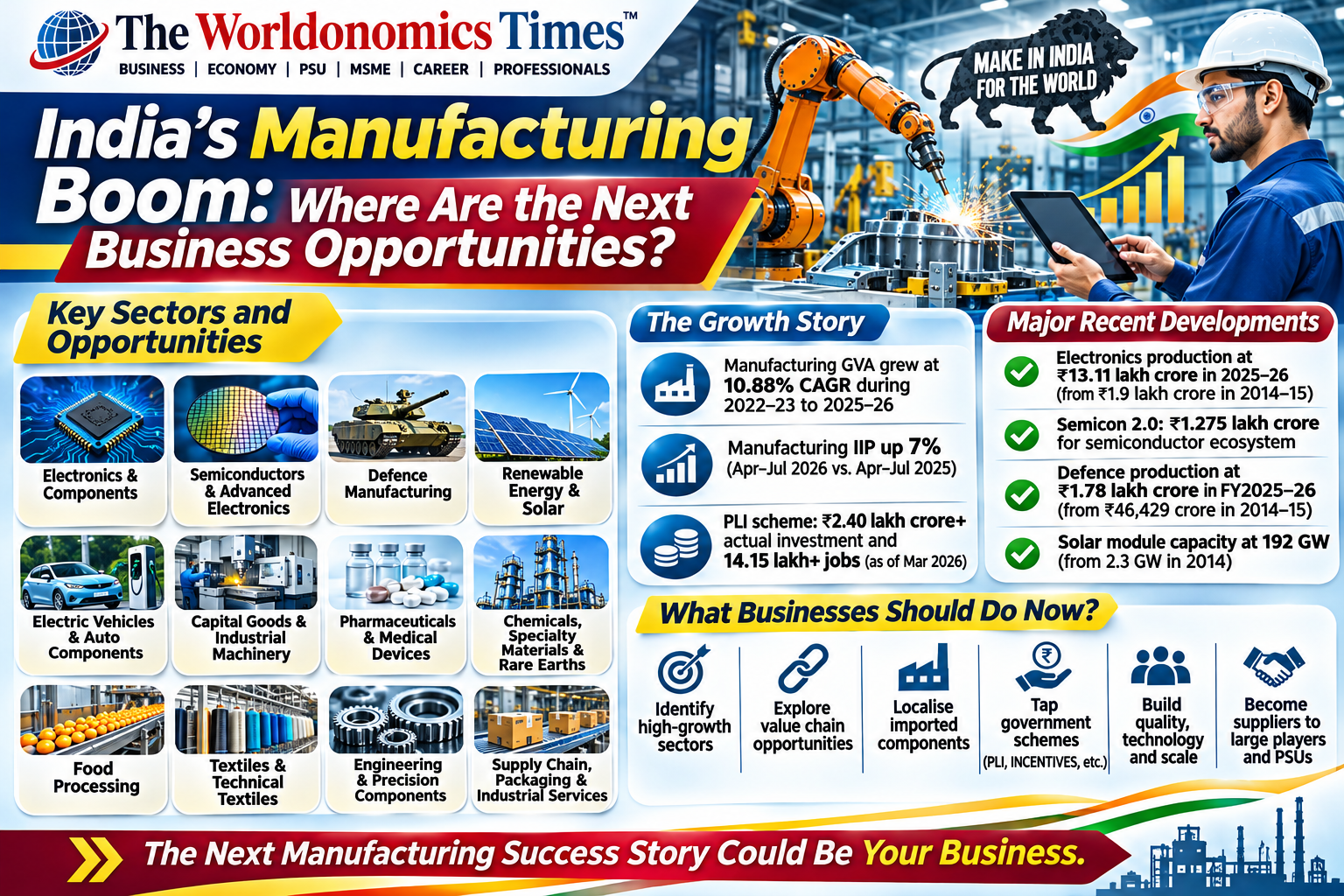
India’s semiconductor ecosystem is expanding into fabrication, packaging, testing, design and related technologies. The government approved Semicon 2.0 in July 2026 with an outlay of ₹1.275 lakh crore aimed at supporting the broader semiconductor ecosystem.
This creates potential opportunities not only for large semiconductor manufacturers but also for companies providing specialised equipment, materials, testing, design, engineering and industrial services.
3. Defence Manufacturing
Defence manufacturing represents another significant opportunity.
India’s indigenous defence production reached a record ₹1.78 lakh crore in FY2025-26, compared with ₹46,429 crore in 2014-15.
As domestic production expands, opportunities can emerge across aerospace components, electronics, precision engineering, drones, defence systems, software, maintenance and specialised manufacturing.
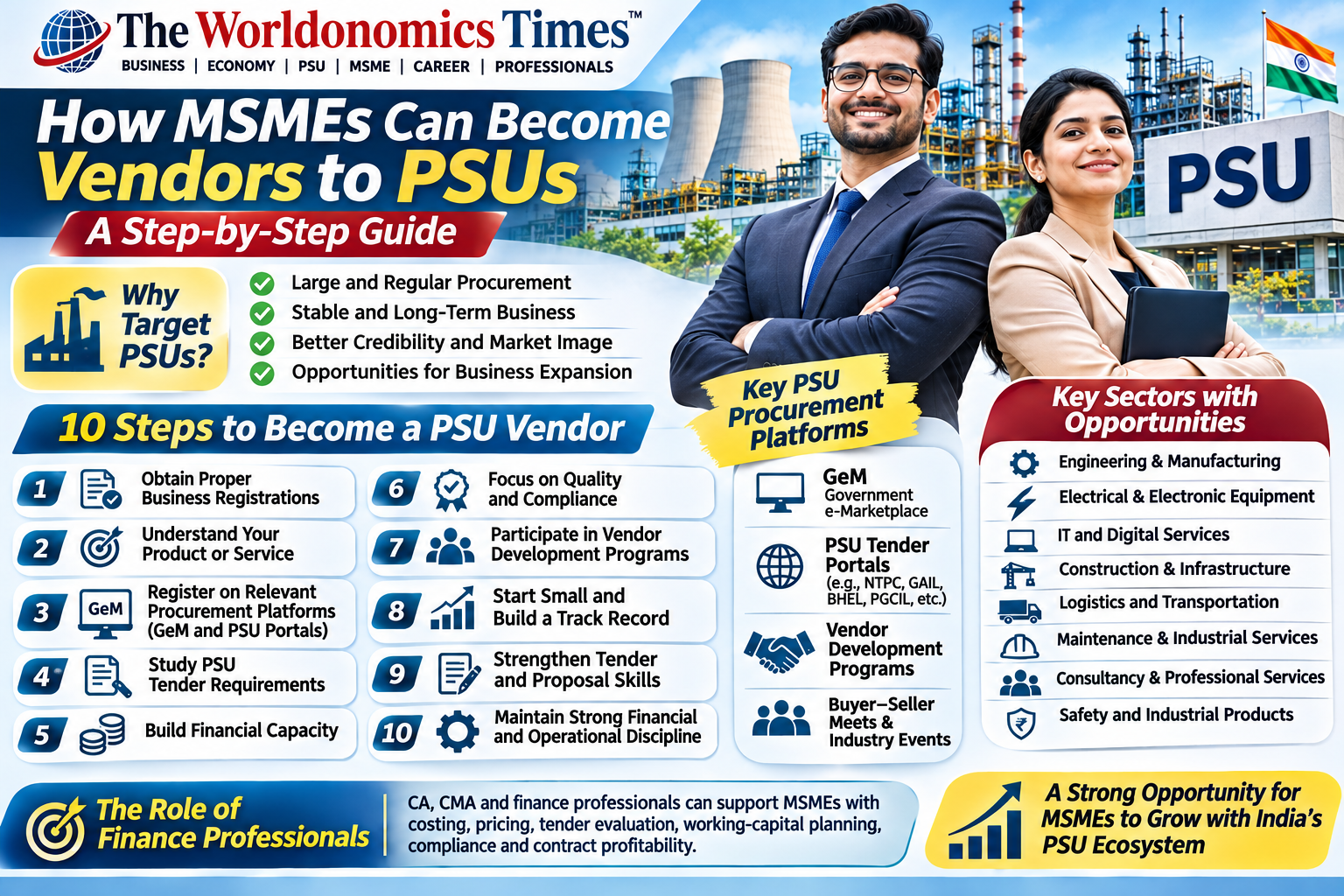
For MSMEs, becoming suppliers to larger defence companies and PSUs could become an important route into the defence manufacturing ecosystem.
4. Renewable Energy and Solar Manufacturing
India’s renewable-energy transition is creating demand for manufacturing capacity across solar, energy storage and associated equipment.
Solar module manufacturing capacity increased from 2.3 GW in 2014 to 192 GW as of June 2026, while solar-cell capacity reached around 30 GW.
The opportunity is not restricted to solar panels. Manufacturing businesses can explore areas such as solar components, power electronics, mounting structures, cables, inverters, energy-storage systems and specialised machinery.
5. Electric Vehicles and Auto Components
India’s automotive industry is undergoing another major transformation driven by electric mobility, connected vehicles and advanced electronics.
The opportunity extends well beyond vehicle manufacturers.
Battery systems, motors, power electronics, charging equipment, sensors, software, thermal-management systems and specialised components could create new business opportunities.
The Production Linked Incentive framework already covers automobiles and auto components as one of the sectors targeted for manufacturing expansion.
6. Capital Goods and Industrial Machinery
One of the most important opportunities could be the machinery behind manufacturing itself.
India’s capital-goods and heavy-engineering production increased from ₹2.87 lakh crore in 2019-20 to ₹5.70 lakh crore in 2024-25.
This includes opportunities in machine tools, mining equipment, heavy electrical equipment, food-processing machinery, textile machinery and industrial equipment.
As manufacturing capacity expands, demand for domestically produced machinery and industrial services can increase alongside it.
7. Pharmaceuticals and Medical Devices
India already has a strong pharmaceutical manufacturing base, but the next phase may involve greater domestic production of complex products and medical technologies.
Pharmaceutical turnover reached ₹5.09 lakh crore in 2025-26, while domestic medical-device manufacturing has also expanded significantly.
Opportunities may emerge in medical equipment, diagnostics, specialised components, pharmaceutical machinery, packaging and healthcare technology.
8. Chemicals, Specialty Materials and Advanced Manufacturing
Chemicals, specialty steel, rare-earth materials and advanced industrial inputs are becoming increasingly important as India seeks deeper domestic value addition.
A particularly notable development is the government’s scheme for manufacturing sintered rare-earth permanent magnets, with an allocation of ₹7,280 crore to establish 6,000 MTPA of integrated manufacturing capacity.
Such developments can create opportunities for technology providers, component manufacturers, engineering companies and specialised MSMEs.
9. Food Processing and Textiles
Traditional sectors should not be overlooked.
Food processing and textiles continue to offer significant opportunities because of India’s large domestic market, agricultural base and export potential.
PLI schemes already cover food products and textiles, alongside electronics, pharmaceuticals, automobiles, solar PV and other sectors. As of March 2026, the 14 PLI schemes had attracted more than ₹2.40 lakh crore of actual investment and generated more than 14.15 lakh direct and indirect jobs.
10. The Biggest Opportunity May Be the Supply Chain
The next manufacturing boom may not come only from companies producing final products.
It could come from thousands of businesses supplying components, machinery, software, packaging, logistics, testing, maintenance, engineering and professional services.
This is particularly important for MSMEs.
A small company does not necessarily need to build a large factory to participate in India’s manufacturing growth. It can become a specialised supplier within a larger value chain.
What Should Businesses Do Now?
Businesses looking to participate in India’s manufacturing expansion should identify sectors where demand is growing and then examine the complete value chain.
The key questions should be:
- What components are currently imported?
- Which manufacturing processes can be localised?
- What products have growing domestic demand?
- Which sectors offer export potential?
- Can the business become a supplier to a large manufacturer or PSU?
- What technology and quality standards are required?
- What government incentives or industrial infrastructure are available?
The focus should be on competitive manufacturing, quality, technology and reliable supply, rather than simply entering a fashionable sector.
India’s Next Manufacturing Opportunity
India’s manufacturing story is increasingly moving from “Make in India” to “Make in India for the World.”
Electronics, semiconductors, defence, renewable energy, electric mobility, pharmaceuticals, capital goods and advanced materials are among the sectors showing significant potential. NITI Aayog has identified 12 priority sectors—including automobiles, electronics, steel, capital goods, defence and drones, chemicals, solar PV, textiles, pharmaceuticals and medical devices, telecom equipment, leather and footwear, and food processing—for strengthening India’s global manufacturing position.
For entrepreneurs, investors and MSMEs, the opportunity is clear: the next manufacturing success story may not necessarily be the company that makes the final product, but the company that supplies the critical component, technology, service or capability behind it.
India’s manufacturing transformation is creating a much larger ecosystem—and businesses that identify their place in that ecosystem early could be among the biggest beneficiaries of the country’s next growth phase.