From registration and compliance to tender participation and vendor development, MSMEs have significant opportunities to become suppliers to India’s Public Sector Undertakings.
India’s Public Sector Undertakings (PSUs) operate across critical sectors such as energy, infrastructure, defence, mining, transportation, engineering, banking and manufacturing. Their large-scale operations require a continuous supply of products and services from thousands of businesses.
For Micro, Small and Medium Enterprises (MSMEs), becoming a PSU vendor can create opportunities for stable business relationships, larger orders and long-term growth.
However, entering the PSU supply chain requires more than simply finding a tender. MSMEs need proper registration, financial discipline, documentation, quality standards and a systematic approach to procurement.
Here is a practical step-by-step guide for MSMEs looking to become PSU vendors.
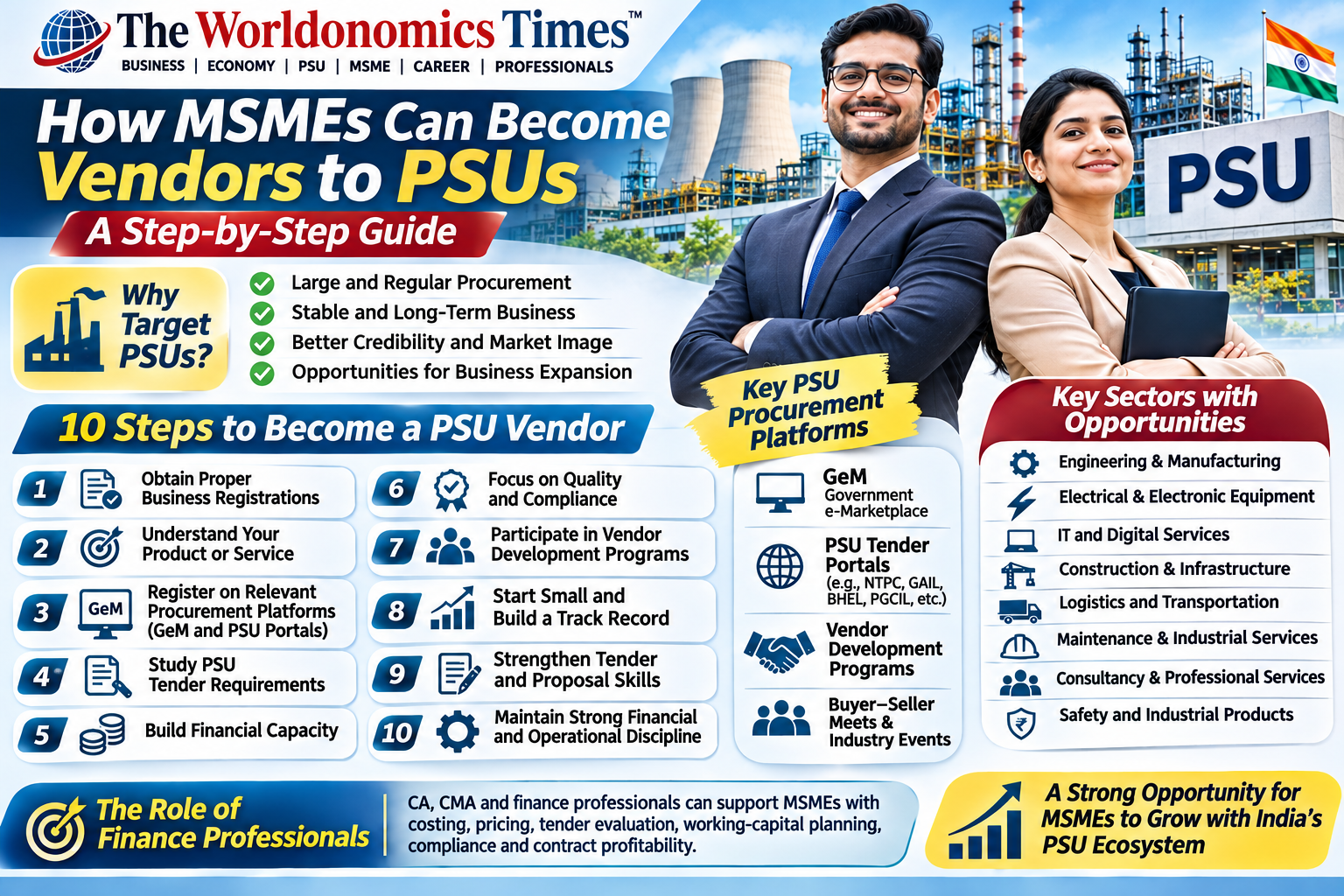
1. Obtain Proper Business Registrations
The first step is to ensure that the business has all relevant registrations and statutory documents.
Depending on the nature of the enterprise, these may include PAN, GST registration, bank account, Udyam Registration and other applicable licences or certifications.
An MSME should ensure that its business information is consistent across government and procurement portals.
Proper documentation creates credibility and reduces difficulties during vendor onboarding.
2. Understand Your Product or Service
Before approaching a PSU, an MSME should clearly identify what it can supply.
Products and services should be mapped to specific industries and potential buyers.
For example, an engineering MSME may target PSUs involved in power, railways, oil and gas or infrastructure, while an IT services company may focus on technology requirements across different government organisations.
Understanding the PSU’s procurement requirements is essential.
3. Register on Relevant Procurement Platforms
Government procurement increasingly takes place through digital platforms.
MSMEs should understand platforms such as the Government e-Marketplace (GeM) and relevant PSU tender portals.
Depending on the procurement category, businesses may need to register as sellers or vendors and complete product, service and company information.
A professional and accurate online vendor profile can improve visibility.
4. Study PSU Tender Requirements
Finding a tender is only the beginning.
MSMEs should carefully study eligibility criteria, technical specifications, turnover requirements, past experience, financial conditions, delivery schedules, security requirements and other terms.
A business should avoid submitting bids simply because the product appears relevant.
The real question is: Can the MSME meet every requirement of the tender?
A systematic tender-screening process can prevent unnecessary expenditure and failed bids.
5. Build Financial Capacity
PSU orders can sometimes require working capital before payment is received.
MSMEs should therefore assess their cash-flow position before accepting large contracts.
Finance professionals can play an important role by evaluating working-capital requirements, margins, payment cycles, bank guarantees and project profitability.
Businesses should understand the difference between revenue growth and profitable growth.
Winning a large contract is useful only when the enterprise has the financial capacity to execute it successfully.
6. Focus on Quality and Compliance
PSUs generally have strict technical and quality requirements.
Depending on the product or service, certifications, testing standards, quality systems and technical documentation may be required.
MSMEs should develop a culture of documentation and quality control rather than treating compliance as a one-time requirement.
Strong quality performance can improve the possibility of repeat business and strengthen the vendor’s reputation.
7. Participate in Vendor Development Programs
PSUs and government organisations periodically conduct vendor development programmes, buyer-seller meetings, exhibitions and MSME outreach initiatives.
These platforms can provide valuable opportunities for MSMEs to understand procurement requirements and interact directly with procurement teams.
For a new PSU vendor, relationship-building and understanding buyer requirements can be as important as submitting tenders.
8. Start Small and Build a Track Record
New vendors do not necessarily need to target the largest contracts immediately.
Smaller orders can provide an opportunity to understand procurement procedures, delivery requirements, documentation and payment processes.
A successful track record can help establish credibility and provide references for future opportunities.
The objective should be to build a sustainable PSU business rather than chase every available tender.
9. Strengthen Tender and Proposal Skills
Tendering is a specialised business skill.
MSMEs should develop internal capabilities for reading tender documents, preparing technical responses, calculating pricing, submitting required documents and responding to clarifications.
Where necessary, businesses can seek professional support for complex tenders.
However, the MSME should always understand its own commercial position and contractual obligations.
10. Maintain Strong Financial and Operational Discipline
Once an MSME becomes a PSU vendor, execution becomes critical.
Timely delivery, quality, documentation, invoicing and contract compliance can influence future business opportunities.
Businesses should maintain proper accounting records, monitor receivables and track contract profitability.
A strong finance function can help management identify cost overruns and cash-flow pressures before they become major problems.
Opportunities for MSMEs in the PSU Ecosystem
PSU procurement can create opportunities across multiple sectors, including:
- Engineering and manufacturing
- Electrical and electronic equipment
- IT and digital services
- Construction and infrastructure
- Maintenance services
- Logistics and transportation
- Consultancy and professional services
- Safety and industrial products
- Facility management
- Technical and specialised services
The opportunity is therefore much broader than traditional manufacturing.
The Role of Finance Professionals
CA, CMA and other finance professionals can play an important role in helping MSMEs enter the PSU ecosystem.
They can support businesses with costing, pricing, working-capital planning, tender evaluation, financial documentation, contract profitability, compliance and risk assessment.
For CMAs in particular, accurate product costing and margin analysis can help MSMEs avoid underpricing while remaining competitive.
Building a Long-Term PSU Business
Becoming a PSU vendor should not be viewed simply as winning one tender. It should be treated as a long-term business development strategy.
MSMEs that combine quality, competitive pricing, financial discipline, compliance, technology and reliable execution can gradually build strong relationships within the PSU ecosystem.
India’s expanding infrastructure, manufacturing and public procurement ecosystem presents significant opportunities for smaller businesses.
For MSMEs willing to prepare properly and understand the procurement process, becoming a PSU vendor can be an important step towards larger markets, stronger credibility and sustainable business growth.