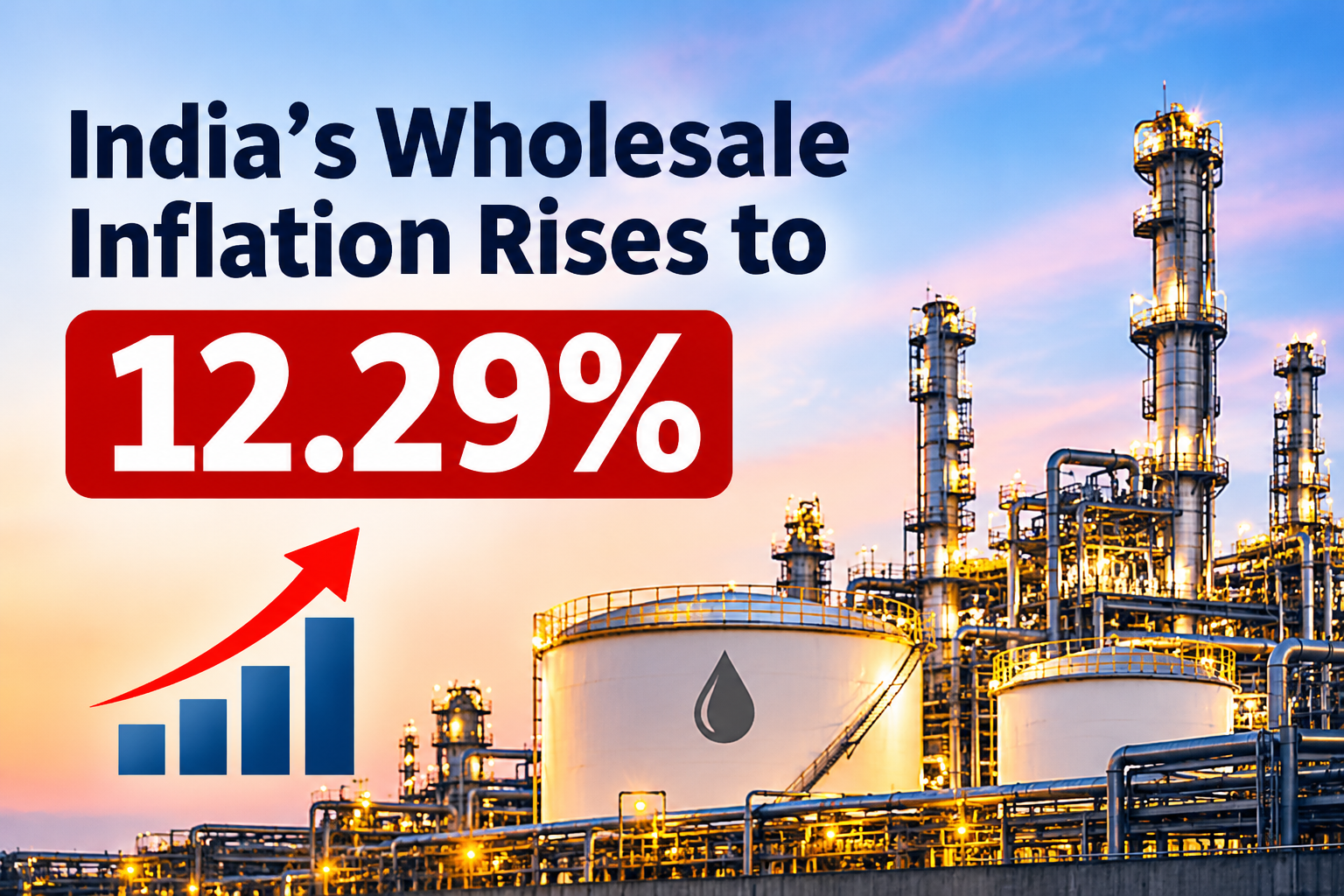
India’s wholesale price inflation (WPI) accelerated to 12.29% in October 2026, compared with 11.39% in September, driven primarily by rising fuel and power prices. Inflation in crude petroleum and natural gas reached 70.8%, highlighting growing cost pressures across the Indian economy.
India’s inflation concerns have intensified following the latest wholesale price index data released by the Ministry of Commerce and Industry. Wholesale inflation increased to 12.29% in October 2026, exceeding market expectations of 12.1% and marking an increase from the previous month’s 11.39%.
The latest reading highlights the growing pressure on manufacturers, distributors, businesses and other participants in the supply chain. While retail inflation reflects the prices consumers pay for goods and services, wholesale inflation captures price movements at an earlier stage of the supply chain.
The sharp increase in wholesale prices is particularly significant because energy and petroleum products influence transportation, manufacturing, logistics, agriculture and several other economic activities. Reuters
Wholesale Inflation Rises to 12.29%
According to the latest WPI data, India’s wholesale inflation accelerated by 90 basis points between September and October 2026.
The October reading represents the highest inflation rate under the current WPI series, which was introduced with a revised base year of 2022-23 in June 2026.
The increase indicates that businesses are experiencing higher input costs, particularly in energy-intensive sectors.
Wholesale inflation is an important economic indicator because sustained increases in input prices can eventually influence the prices of finished products and consumer goods.
Fuel and Power Inflation Emerges as the Biggest Contributor
Fuel and power prices were the principal drivers of the October inflation increase.
Inflation in the fuel and power category rose to 32.84% in October 2026, compared with 25.85% in September.
Crude petroleum and natural gas prices recorded an especially sharp increase of 70.8%.
Higher energy prices can affect almost every major segment of the economy. Industries dependent on petroleum, electricity and transportation may experience increased production and operating expenses.
For example, higher diesel prices can increase freight costs, while rising petroleum input costs can affect chemicals, plastics, fertilisers and other industrial products.
The increase also creates challenges for companies that operate with limited pricing flexibility. Reuters
Manufacturing Inflation Shows a Different Trend
While fuel and power inflation accelerated, inflation in manufactured products eased slightly during October.
This indicates that price pressures were not uniform across all components of the wholesale price index.
Manufacturing companies face different cost structures depending on their dependence on energy, imported raw materials, transportation and domestic supply chains.
Although moderation in manufactured-product inflation offers some relief, sustained increases in energy costs could eventually create additional pressure on industrial production and profitability.
Wholesale Food Inflation Remains Elevated
Wholesale food inflation edged down marginally to 8.58% in October 2026 from 8.66% in September.
Despite the slight moderation, food prices continue to remain an important concern for India’s overall inflation outlook.
Food inflation affects household purchasing power and can also influence input costs for restaurants, food processors, retailers and agricultural businesses.
The difference between wholesale food inflation and retail food inflation also highlights how price pressures can vary across different stages of the supply chain.
Impact on Indian Businesses and MSMEs
Rising wholesale inflation can have significant implications for India’s business environment, particularly for MSMEs.
1. Higher Manufacturing Costs: Industries using petroleum, chemicals, plastics and other energy-intensive inputs may face increased production expenses.
2. Transportation and Logistics: Higher fuel costs can increase freight charges, warehousing expenses and distribution costs.
3. Pressure on Profit Margins: Businesses may find it difficult to transfer the entire increase in input costs to customers, particularly in competitive markets.
4. Working Capital Requirements: Higher raw material and operating costs can increase working capital requirements for small businesses.
5. Consumer Prices: If higher wholesale costs persist, businesses may eventually pass some of the additional expenses to consumers, potentially increasing retail inflation.
WPI vs CPI: Understanding the Difference
Wholesale Price Index (WPI) and Consumer Price Index (CPI) measure inflation at different stages of the economy.
| Parameter | WPI | CPI |
|---|---|---|
| Measures | Wholesale prices | Consumer prices |
| Economic focus | Producers and suppliers | Households |
| October 2026 inflation | 12.29% | 6.09% |
| Major concern | Fuel and input costs | Household purchasing power |
The difference between the two indicators suggests that wholesale price pressures are substantially higher than the inflation currently reflected in consumer prices.
However, WPI increases do not automatically translate into equivalent CPI increases. The extent of pass-through depends on demand, competition, margins, government policies and supply conditions.
What Does This Mean for RBI Monetary Policy?
The latest wholesale inflation figures come at a time when India’s retail inflation has also crossed the RBI’s upper tolerance limit of 6%.
The combination of elevated wholesale and retail inflation presents a challenge for monetary policymakers.
Higher inflation can influence interest-rate decisions, borrowing costs, investment activity and overall economic sentiment.
However, the RBI primarily targets CPI inflation under its flexible inflation-targeting framework. WPI is an important supplementary indicator rather than the direct policy target.
The central bank will need to assess whether rising energy costs are temporary or likely to create persistent inflationary pressures across the economy.
Outlook: Energy Prices Remain a Key Risk
The outlook for wholesale inflation will depend significantly on international crude oil prices, energy-market developments, domestic fuel pricing and global supply-chain conditions.
According to Reuters, elevated fuel and power prices remain the primary concern, although moderation in international oil prices could provide some relief in the coming months. Reuters
For Indian businesses, particularly MSMEs, controlling input costs, improving operational efficiency and strengthening supply-chain management will remain important.
Conclusion
India’s wholesale inflation reaching 12.29% in October 2026 highlights the growing importance of energy prices in determining the country’s economic outlook.
While manufactured-product inflation showed some moderation, the sharp rise in fuel and power costs presents challenges for businesses, manufacturers and policymakers.
The coming months will be important in determining whether these wholesale price pressures translate into broader inflationary challenges for the Indian economy.
Source: Ministry of Commerce and Industry, Government of India; Reuters.
The Worldonomics Times | Economics & Business News