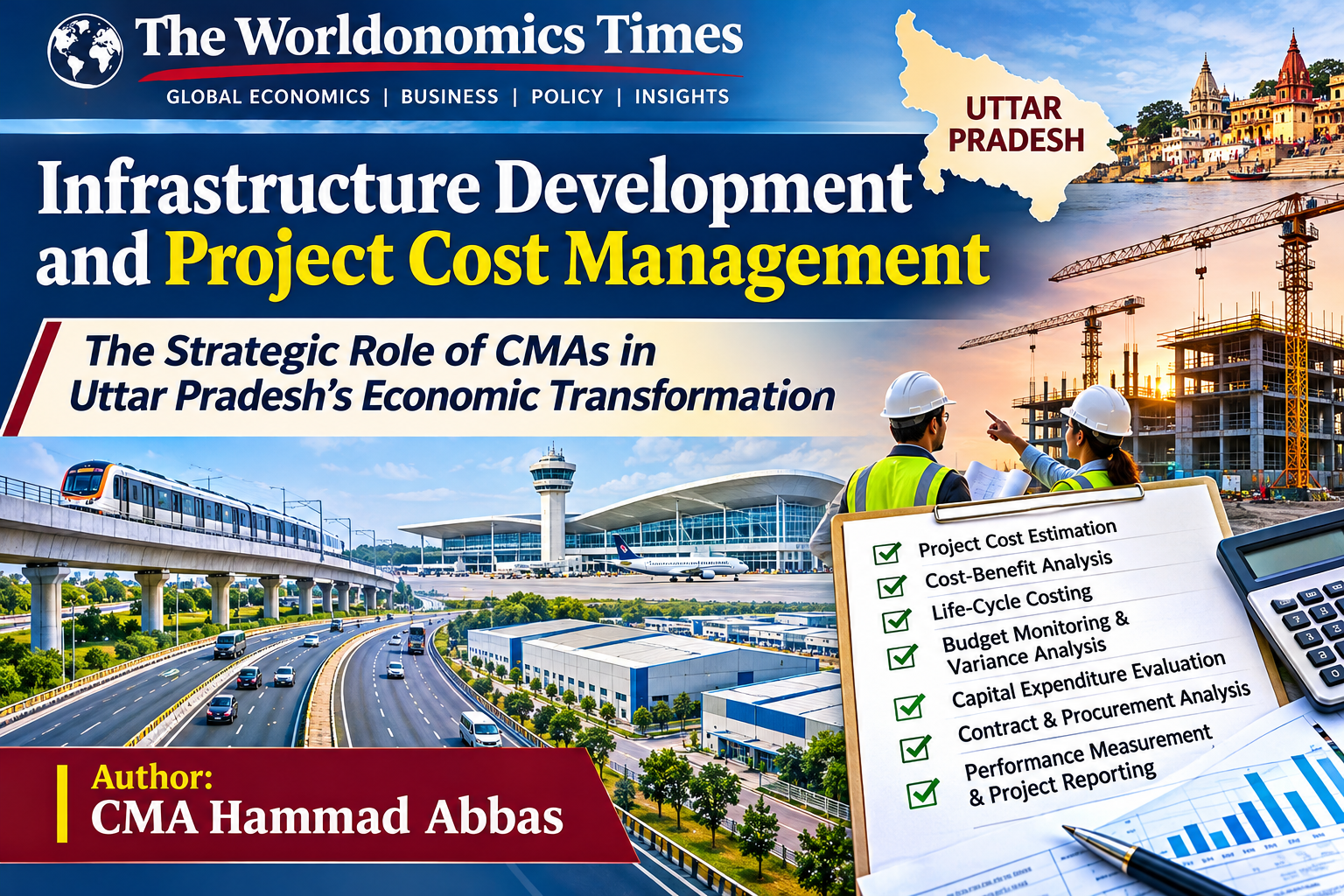
Infrastructure Development and Project Cost Management: The Strategic Role of CMAs in Uttar Pradesh’s Economic Transformation
Author: CMA Hammad Abbas
Introduction: Infrastructure as the Engine of Economic Growth
Infrastructure development is one of the most important drivers of economic transformation. Roads, expressways, airports, industrial corridors, logistics parks, metro networks, power infrastructure and urban development projects create the foundation for industrial expansion, employment generation, investment attraction and regional connectivity.
Uttar Pradesh is witnessing significant opportunities in infrastructure development. Its strategic geographical location, large population, expanding industrial ecosystem and improving connectivity make it an important destination for infrastructure investment.
The Uttar Pradesh Budget 2026-27 reflects this development-oriented approach. The state has proposed capital outlay of approximately ₹1.78 lakh crore, highlighting the importance of asset creation and infrastructure-led economic growth.
However, infrastructure development is not simply about allocating funds or completing construction projects. The real challenge is ensuring that every rupee invested generates maximum economic and social value.
This requires effective project planning, scientific cost estimation, financial discipline, expenditure monitoring and performance evaluation.
This is where Cost and Management Accountants (CMAs) can play a strategic role.
1. Infrastructure Projects Require Scientific Cost Management
Large infrastructure projects involve substantial financial commitments and multiple cost components, including land acquisition, construction materials, labour, machinery, transportation, technology, consultancy, environmental compliance and maintenance.
Poor cost estimation or inadequate financial monitoring can lead to project delays, budget overruns, inefficient resource utilisation and financial pressure.
Scientific project cost management helps organisations understand the complete financial requirements of a project before its commencement and throughout its execution.
CMAs can assist project authorities in:
- Preparing detailed project cost estimates.
- Identifying direct and indirect project expenses.
- Evaluating material and labour requirements.
- Assessing machinery and equipment costs.
- Preparing project budgets and cash flow forecasts.
- Monitoring actual expenditure against approved budgets.
- Identifying cost overruns and recommending corrective action.
A systematic costing framework can improve the financial viability and execution efficiency of infrastructure projects.
2. Role of CMAs in Project Cost Estimation
Accurate cost estimation is the foundation of successful infrastructure planning.
Whether an organisation is developing an expressway, airport, industrial park, railway facility or power project, the initial cost estimate determines its financial requirements and investment decisions.
CMAs can contribute by examining:
Material Costs: Estimating the quantity and cost of cement, steel, aggregates, bitumen, electrical equipment and other construction materials.
Labour Costs: Analysing manpower requirements, wage rates, productivity and labour deployment.
Machinery and Equipment Costs: Evaluating equipment purchase, hiring, fuel consumption, depreciation and maintenance expenses.
Administrative and Consultancy Costs: Assessing project management, technical consultancy, supervision and administrative expenditure.
Contingency Planning: Providing for reasonable financial contingencies and potential cost escalations.
Professional cost estimation enables project authorities to develop realistic budgets and reduce the possibility of financial surprises during execution.
3. Cost-Benefit Analysis and Financial Feasibility
Infrastructure investments should not be evaluated solely on their construction costs. Their long-term economic and social benefits must also be assessed.
For example, an expressway may require significant initial investment, but it can reduce transportation time, lower logistics costs, improve market connectivity and encourage industrial development along its route.
Similarly, an industrial corridor can attract manufacturing investment, create employment opportunities and support regional economic development.
CMAs can contribute through cost-benefit analysis and financial feasibility studies.
These assessments may include:
- Initial capital investment.
- Estimated operating and maintenance costs.
- Expected revenue generation.
- Projected cash flows.
- Internal Rate of Return (IRR).
- Net Present Value (NPV).
- Payback period.
- Sensitivity and risk analysis.
- Long-term economic benefits.
Such analysis helps decision-makers evaluate alternative investment proposals and select projects that offer sustainable financial and economic value.
4. Life-Cycle Costing: Looking Beyond Construction
One of the major challenges in infrastructure management is the tendency to focus primarily on initial construction costs.
However, infrastructure assets require continuous expenditure throughout their useful lives.
Roads need periodic maintenance, bridges require structural inspections, power infrastructure requires equipment replacement, and airports and metro networks involve substantial operational expenditure.
Life-cycle costing considers the total cost of an asset from planning and construction to operation, maintenance, rehabilitation and eventual replacement.
CMAs can help project authorities evaluate:
- Initial capital expenditure.
- Annual operating expenses.
- Preventive and corrective maintenance costs.
- Energy and resource consumption.
- Equipment replacement requirements.
- Rehabilitation and renovation expenditure.
- Long-term asset disposal costs.
This approach enables infrastructure developers to make decisions based on the total economic cost of ownership rather than simply selecting the lowest initial construction price.
5. Project Budget Monitoring and Variance Analysis
Infrastructure projects frequently operate over several years. During this period, material prices, labour costs, project timelines and technical requirements may change.
Consequently, approved budgets must be monitored continuously.
CMAs can establish project budget monitoring systems that compare planned expenditure with actual expenditure at regular intervals.
For example, if the approved budget for a road construction project is ₹1,000 crore but actual expenditure reaches ₹600 crore when only 50% of the physical work has been completed, management must investigate the reasons for the variance.
The reasons could include:
- Increase in raw material prices.
- Changes in project specifications.
- Delays in execution.
- Inefficient contractor performance.
- Unplanned expenditure.
- Poor resource utilisation.
Through variance analysis, CMAs can identify the underlying causes and recommend corrective measures.
This helps project authorities take timely decisions rather than discovering financial problems after the project has suffered significant cost overruns.
6. Contract Management and Procurement Cost Analysis
Procurement and contract management are critical components of infrastructure project expenditure.
Construction projects involve multiple contractors, suppliers, consultants and equipment providers. Inefficient procurement practices can increase project costs and affect delivery timelines.
CMAs can support procurement and contract management through:
- Comparative cost analysis of supplier quotations.
- Evaluation of tender pricing.
- Analysis of contract cost structures.
- Monitoring of contractual payments.
- Examination of escalation clauses.
- Identification of procurement inefficiencies.
- Evaluation of contractor performance.
- Cost analysis of variations and additional work.
Their expertise can help organisations improve financial transparency and strengthen cost controls throughout the procurement cycle.
7. Cost Management in Public Sector Infrastructure Projects
Public sector undertakings, development authorities, government departments and infrastructure agencies undertake several major projects across Uttar Pradesh.
These organisations must ensure that public resources are utilised efficiently and that project expenditure remains aligned with approved objectives.
CMAs can contribute to better public financial management through:
Capital Expenditure Monitoring: Evaluating the utilisation of approved capital budgets.
Performance Budgeting: Linking financial expenditure with measurable project outcomes.
Internal Financial Controls: Strengthening financial procedures and expenditure monitoring.
Cost Audit and Compliance: Supporting applicable statutory and regulatory cost-accounting requirements.
Management Information Systems: Developing regular project cost reports for management and administrative authorities.
Financial Accountability: Providing reliable cost information to support informed decision-making.
Professional cost management can strengthen transparency, accountability and financial discipline in public infrastructure development.
8. Infrastructure Development and the Uttar Pradesh Growth Story
Uttar Pradesh’s infrastructure expansion has the potential to transform its industrial and economic landscape.
Expressways can improve connectivity between major economic centres. Airports can strengthen passenger and cargo transportation. Industrial corridors can attract manufacturing investment. Logistics parks can reduce supply chain costs, while metro networks and urban infrastructure can improve the quality of life.
However, the success of these initiatives will depend significantly on their financial sustainability and execution efficiency.
The state must focus not only on increasing infrastructure investment but also on ensuring that projects are completed within realistic budgets and generate measurable economic benefits.
CMAs can help bridge the gap between financial allocation and actual project performance.
By introducing scientific costing, financial feasibility assessments and continuous expenditure monitoring, they can support better utilisation of public and private capital.
9. Emerging Opportunities for CMAs in Infrastructure Management
The expanding infrastructure ecosystem creates significant professional opportunities for Cost and Management Accountants.
CMAs can contribute in different capacities, including:
- Infrastructure Cost Consultants.
- Project Finance Analysts.
- Financial Controllers.
- Cost Auditors, where applicable.
- Project Budgeting Specialists.
- Contract Cost Analysts.
- Infrastructure Investment Advisors.
- Risk Management Professionals.
- Public Sector Financial Management Specialists.
The increasing adoption of project management software, ERP platforms, artificial intelligence and data analytics will further expand the scope of CMA professionals.
Modern infrastructure projects require integrated financial and operational information. CMAs can help transform this information into meaningful insights for project directors, financial managers and policymakers.
10. A Way Forward: Strengthening CMA Participation in Infrastructure Development
To strengthen the contribution of CMAs, greater collaboration can be encouraged between professional institutions, government departments, infrastructure companies, public sector undertakings and private developers.
Some possible initiatives include:
CMA Infrastructure Advisory Network: Connecting qualified CMAs with infrastructure development agencies and project developers.
Project Cost Management Workshops: Training infrastructure professionals in project costing, budgeting and variance analysis.
Infrastructure Cost Benchmarking: Developing sector-specific cost benchmarks for roads, power, transportation, urban development and industrial infrastructure.
CMA–Industry Collaboration: Encouraging infrastructure companies to utilise professional management accounting expertise.
Capacity Building in Project Finance: Developing specialised skills in financial modelling, public-private partnerships, project evaluation and life-cycle costing.
Such initiatives can create professional opportunities while strengthening the financial management framework of infrastructure projects.
Conclusion: Every Infrastructure Investment Must Deliver Maximum Value
Infrastructure development is essential for Uttar Pradesh’s journey towards becoming a leading economic powerhouse. Roads, airports, industrial corridors, logistics parks and power infrastructure will create the foundation for future industrialisation, employment and investment.
However, the success of infrastructure development must be measured not only by the amount of money invested or the number of projects announced, but also by the efficiency with which resources are utilised and the economic value generated.
Cost and Management Accountants can play an important role in this transformation through scientific project costing, financial feasibility analysis, life-cycle costing, budget monitoring, procurement analysis and performance evaluation.
Their professional expertise can help reduce inefficiencies, strengthen accountability and improve the financial sustainability of infrastructure investments.
Infrastructure creates the foundation for growth, but effective cost management ensures that growth delivers maximum value.