How accurate inventory valuation can influence product costs, profitability and managerial decisions
For many businesses, inventory is one of the largest components of working capital. Yet, behind every inventory figure lies an important question: Are we measuring the true cost of the goods we hold?
An incorrect inventory valuation can distort product costs, affect reported margins and influence management decisions. It can also make comparisons between production periods less meaningful.
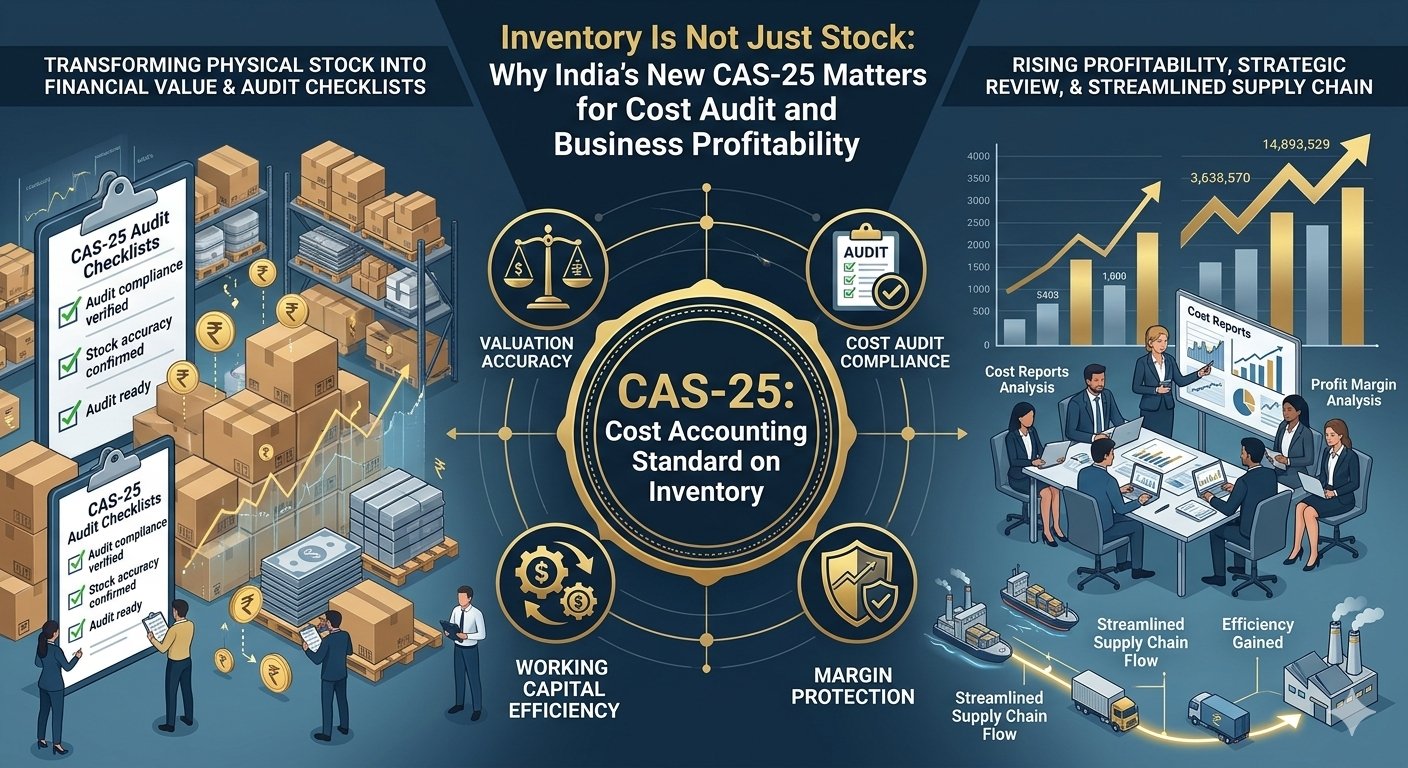
Recognising the importance of consistency in this area, the Institute of Cost Accountants of India (ICMAI) introduced Cost Accounting Standard 25 (CAS-25) – Valuation of Inventory, effective from 12 February 2026 for the preparation and certification of Cost Accounting Statements.
Why was a dedicated inventory valuation standard needed?
Inventory is not limited to finished goods waiting to be sold. It includes:
- Raw materials and components
- Work-in-progress
- Finished goods
- Stores, spares and consumables
- Packing materials and other production supplies
Each category has a different role in the production cycle. Inconsistent valuation methods can therefore affect the reliability of cost information.
CAS-25 aims to bring greater uniformity and consistency to the principles and methods used to determine inventory value.
The connection between inventory valuation and profitability
Consider a manufacturing company that produces and sells a product.
If the cost assigned to closing inventory is inaccurate, the cost of goods sold may also be affected. This can influence the gross margin and the interpretation of business performance.
For management, the consequences go beyond accounting figures.
Reliable inventory valuation supports:
- Better procurement planning
- More meaningful product-cost analysis
- Improved working-capital management
- More informed pricing decisions
- Better identification of slow-moving and obsolete inventory
In other words, inventory valuation is not merely an accounting exercise; it is an important part of cost management.
Why should cost auditors pay attention?
For a cost auditor, inventory valuation deserves attention because it directly influences the cost information presented by an organisation.
The auditor’s examination should consider whether inventory is appropriately classified, measured and assigned in accordance with the applicable cost accounting framework.
Particular attention may be required where businesses deal with:
- Multiple stages of production
- Joint products and by-products
- Scrap and process losses
- Obsolete or slow-moving materials
- Different inventory categories and valuation methods
A robust inventory valuation process can improve the reliability of cost statements and strengthen the quality of cost audit reporting.
What does this mean for businesses?
The introduction of CAS-25 is an opportunity for organisations to review their existing inventory valuation policies and cost accounting systems.
Businesses should evaluate whether their costing practices are consistent, whether inventory data is properly supported and whether the relevant teams understand the applicable requirements.
Cost accountants can play an important role in bridging the gap between inventory records, production operations and management reporting.
The bigger picture: From recording costs to understanding costs
In a competitive business environment, profitability depends not only on revenue growth but also on how effectively an organisation understands and controls its costs.
Inventory valuation is one of the foundations of that understanding.
CAS-25 reinforces the importance of reliable cost information and highlights the evolving role of cost accounting standards in strengthening business decision-making.
Because knowing how much inventory a business holds is important. Knowing what that inventory truly costs is even more important.