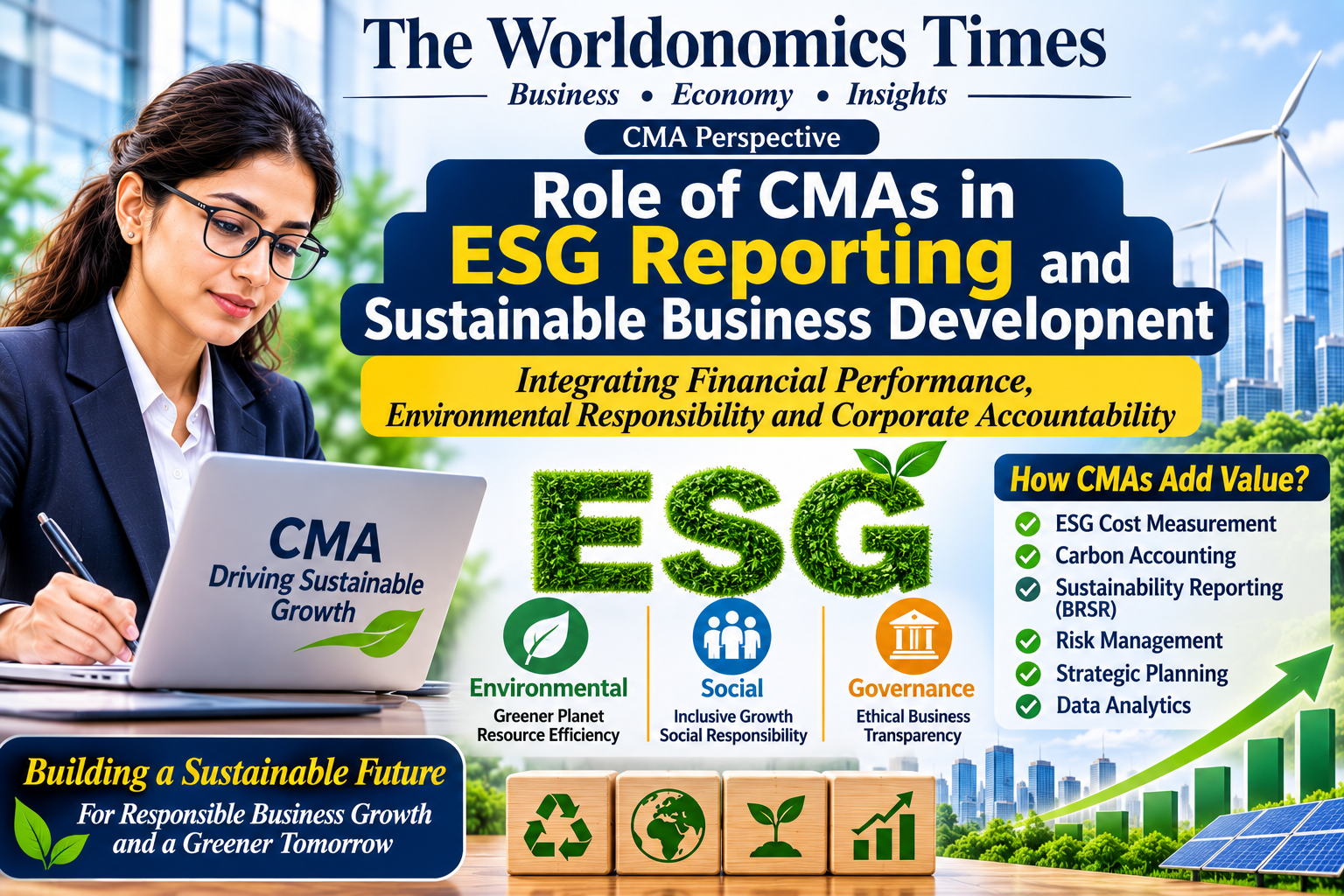
Integrating Financial Performance, Environmental Responsibility and Corporate Accountability
By CMA Madhuri Kashyap
The Worldonomics Times | CMA Perspective
Introduction
Sustainable business development has become an important priority for organisations across the world. Businesses are increasingly expected to achieve financial growth while managing their environmental impact, maintaining social responsibility and following ethical governance practices.
This shift has brought Environmental, Social and Governance (ESG) considerations into corporate decision-making. Investors, regulators, customers, lenders and other stakeholders are paying greater attention to how companies manage sustainability-related risks and opportunities.
In this changing business environment, Cost and Management Accountants (CMAs) have an important opportunity to contribute to ESG reporting and sustainable business development. Their expertise in cost management, financial analysis, performance measurement and internal controls can help organisations connect sustainability objectives with financial and operational performance.
1. Understanding ESG and Its Importance
ESG represents three important dimensions of responsible business management:
- Environmental: Energy consumption, carbon emissions, water usage, waste management and resource efficiency.
- Social: Employee welfare, workplace safety, diversity, human rights and community development.
- Governance: Ethical business practices, transparency, accountability, risk management and corporate oversight.
ESG is no longer limited to corporate social responsibility initiatives. It is increasingly linked to business strategy, investment decisions, risk management and long-term competitiveness.
Companies that understand their ESG risks and opportunities are better positioned to respond to changing stakeholder expectations and regulatory developments.
2. Role of CMAs in ESG Cost Measurement
One of the most important contributions of CMA professionals is the measurement and analysis of costs associated with sustainability initiatives.
Businesses invest in renewable energy, energy-efficient machinery, waste reduction, water conservation and cleaner production technologies. These investments require proper financial evaluation.
CMAs can help organisations:
- Measure energy and resource consumption costs.
- Analyse waste generation and disposal expenses.
- Evaluate the financial benefits of energy efficiency.
- Assess the cost of sustainable production processes.
- Compare traditional and environmentally responsible alternatives.
- Monitor sustainability-related capital expenditure.
Such analysis helps management understand whether sustainability initiatives are financially viable and how they contribute to long-term business performance.
3. Carbon Accounting and Environmental Cost Management
Climate change has increased the importance of measuring greenhouse gas emissions. Organisations are increasingly examining their direct and indirect environmental impact.
CMAs can develop expertise in carbon accounting, environmental cost measurement and resource efficiency analysis.
They can assist businesses in collecting relevant operational data, identifying emission-related cost drivers and monitoring progress against sustainability targets.
For example, a manufacturing company may evaluate energy consumption across production units, identify high-consumption processes and assess investments in energy-efficient equipment.
Environmental cost management can also help businesses identify hidden costs associated with pollution, waste, inefficient resource utilisation and regulatory non-compliance.
4. ESG Reporting and Sustainability Disclosures in India
India’s sustainability reporting framework has evolved significantly. The Securities and Exchange Board of India (SEBI) introduced the Business Responsibility and Sustainability Report (BRSR) framework for specified listed entities.
BRSR requires eligible companies to disclose information relating to environmental, social and governance performance through prescribed reporting requirements.
CMAs can contribute to ESG data collection, cost analysis, internal controls, performance measurement and reporting processes.
Their financial and analytical expertise can help improve the consistency and reliability of sustainability-related information.
Professionals should remain updated on applicable SEBI requirements and other relevant reporting frameworks, as regulatory provisions and applicability may change.
5. Integrating ESG with Financial Planning and Budgeting
Sustainability objectives require financial resources and long-term planning. Organisations must evaluate the financial implications of adopting renewable energy, improving production processes, reducing emissions and strengthening employee welfare.
CMAs can integrate ESG considerations into annual budgets, capital expenditure plans and long-term financial forecasts.
For example, when a company considers installing solar power systems, a CMA can evaluate installation costs, expected energy savings, maintenance expenses and the estimated payback period.
This approach ensures that sustainability initiatives are assessed not only from an environmental perspective but also from a financial and operational standpoint.
6. Supporting Sustainable Manufacturing and MSME Development
India’s MSME sector plays a major role in manufacturing, employment and economic development. However, smaller enterprises often face financial and technical challenges in adopting sustainable business practices.
CMA professionals can support MSMEs by identifying opportunities for energy savings, reducing material wastage, improving inventory management and evaluating resource-efficient technologies.
They can also help small businesses understand sustainability-related cost implications and prepare practical improvement plans.
Efficient resource utilisation can reduce operating costs while improving competitiveness and business resilience.
7. ESG Risk Management and Corporate Governance
ESG-related risks can affect financial performance, reputation and business continuity.
Environmental risks may arise from climate-related disruptions, resource shortages or pollution. Social risks may involve workplace safety, employee welfare and supply chain practices. Governance risks may include unethical conduct, weak internal controls and inadequate disclosures.
CMAs can contribute by incorporating relevant ESG risks into management reporting, internal control reviews and enterprise risk management processes.
Their role may include identifying financial exposure, evaluating control weaknesses and helping management monitor sustainability-related performance indicators.
8. Technology and Data Analytics in ESG Reporting
Digital technology is transforming sustainability measurement and reporting.
Organisations increasingly use ERP systems, data analytics platforms and automated dashboards to collect and monitor environmental and operational information.
CMAs with digital skills can use tools such as advanced Excel, Power BI and business intelligence platforms to analyse energy consumption, waste generation, operational efficiency and sustainability expenditure.
Artificial intelligence and automation may further improve data collection and trend analysis. However, organisations must ensure that reported information is accurate, properly documented and supported by appropriate verification procedures.
9. Skills Required for CMAs in the ESG Profession
To develop expertise in ESG and sustainability reporting, CMA professionals should strengthen their knowledge in:
- Environmental and sustainability cost accounting.
- ESG reporting frameworks and applicable regulations.
- Carbon accounting and resource efficiency.
- Financial modelling and investment appraisal.
- Risk management and corporate governance.
- Data analytics and digital reporting tools.
- Sustainability performance measurement.
- Professional ethics and assurance principles.
Continuous professional development and practical exposure will help CMAs respond to emerging opportunities in this field.
Conclusion
ESG reporting and sustainable business development are creating new opportunities for Cost and Management Accountants. Their expertise in cost measurement, financial planning, performance evaluation and risk management can help organisations integrate sustainability into their business strategies.
As Indian companies increasingly focus on responsible growth, resource efficiency and transparent disclosures, CMA professionals can play an important role in connecting financial performance with environmental and social responsibility.
The future of business will depend not only on how much value organisations create but also on how responsibly they create it.
CMAs can become important partners in sustainable development by transforming ESG information into measurable performance, responsible decisions and long-term business value.