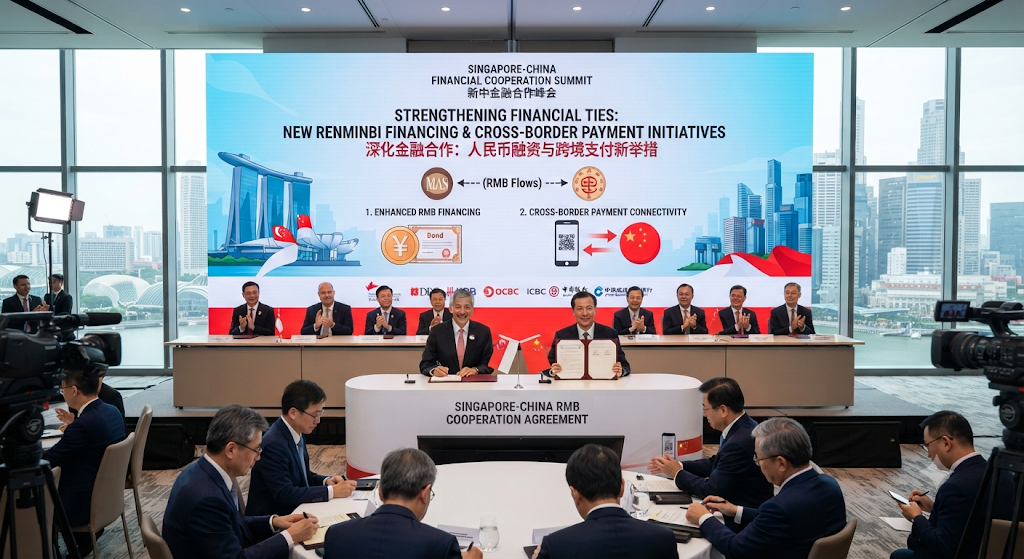
New financial cooperation measures aim to improve business financing, facilitate international trade, expand investment opportunities and strengthen economic connectivity between Singapore and China.
SINGAPORE | 24 November 2026
Singapore and China are taking significant steps to deepen their financial and economic partnership through new initiatives focused on renminbi (RMB) financing, cross-border payment connectivity and capital market cooperation. The developments are expected to create new opportunities for businesses, financial institutions and investors operating across the two economies.
The initiatives were announced on 23 November 2026 during the 22nd Joint Council for Bilateral Cooperation (JCBC) meeting in Singapore, co-chaired by Singapore Deputy Prime Minister Gan Kim Yong and Chinese Vice-Premier Ding Xuexiang.
At the centre of the financial cooperation programme is an enhancement of the Monetary Authority of Singapore’s (MAS) Renminbi Facility, developed in collaboration with the People’s Bank of China (PBOC). The expanded framework is designed to address growing demand for renminbi financing across the region and provide businesses with improved access to funding for international trade and commercial activities.
The announcement reflects the increasing importance of Singapore as a regional financial hub and its role in connecting Chinese businesses with international markets, particularly across Southeast Asia.
Expanded Renminbi Financing to Support Businesses
A major component of the agreement is the restructuring of the existing MAS RMB Facility into two separate facilities: an RMB Corporate Facility and an RMB Liquidity Facility.
The RMB Corporate Facility will support a wider range of corporate financing activities, including international trade with third countries, working capital requirements, capital expenditure and eligible intra-group funding.
This development could benefit companies involved in cross-border supply chains, manufacturing, logistics, infrastructure and international commerce. Businesses often require access to financing in different currencies to manage payments, purchase raw materials and support overseas operations.
By expanding renminbi financing options, Singapore and China aim to make it easier for eligible financial institutions to provide funding for these commercial activities.
The facility will also offer a broader range of financing tenures, including one-month, three-month and six-month options.
Meanwhile, the RMB Liquidity Facility will continue providing financial institutions in Singapore with access to backstop renminbi funding. This is intended to support liquidity and financial stability in Singapore’s offshore renminbi market.
MAS will also broaden the collateral accepted under both facilities. In addition to Singapore-dollar cash, eligible institutions will be able to use Singapore Government Securities and MAS Bills. The two central banks are also exploring the possibility of accepting China Government Bonds as eligible collateral.
Cross-Border Payments Could Become More Efficient
Another important development involves payment connectivity between Singapore and China.
MAS and the People’s Bank of China are exploring a linkage between their respective fast payment systems to facilitate small-value cross-border transfers.
If implemented, the connection could make international payments more convenient for individuals and businesses while complementing existing local-currency payment and settlement channels.
For businesses, efficient payment systems are essential for managing supplier payments, receiving international revenues and conducting daily commercial transactions.
Small and medium-sized enterprises (SMEs), in particular, could benefit from more accessible payment channels that help reduce transaction friction and improve the efficiency of cross-border business activities.
The initiative also reflects the broader movement towards digital financial infrastructure, where faster payment processing and improved financial connectivity are becoming increasingly important for international trade.
Capital Market Cooperation Opens New Opportunities
Beyond financing and payments, Singapore and China are also strengthening cooperation in their capital markets.
The MAS and China Securities Regulatory Commission (CSRC) will support companies seeking access to each other’s financial markets for listings and fundraising, based on their individual business requirements.
The two regulators will also support the development of new financial indices and additional exchange-traded fund (ETF) products through cooperation involving Singapore Exchange (SGX), the Shanghai Stock Exchange and the Shenzhen Stock Exchange.
These initiatives could provide companies with additional opportunities to raise capital while giving investors access to a wider range of investment products.
Cooperation between financial institutions is also expanding. DBS Bank, Singapore’s second renminbi clearing bank, has commenced clearing services to facilitate renminbi transactions for economic and investment activities in the region.
Bank of China’s Singapore branch has also been included as an MAS Primary Dealer, strengthening its participation in Singapore’s government securities market.
Additionally, DBS and Bank of China have onboarded clients for trading and custody of selected onshore renminbi bonds in Singapore.
Strengthening Singapore’s Position as a Regional Financial Hub
The latest initiatives reinforce Singapore’s ambition to remain a leading international financial centre and an important gateway for businesses entering Southeast Asian markets.
China remains an important economic partner for Singapore, with extensive trade, investment and business connections across multiple industries.
Improved access to renminbi financing could help Singapore-based companies manage their business relationships with Chinese suppliers, manufacturers and customers more efficiently.
At the same time, Chinese businesses may find Singapore an attractive platform for accessing international capital, establishing regional operations and expanding into ASEAN markets.
The cooperation also supports the development of stronger financial connections between regional economies, potentially encouraging greater investment and commercial activity.
What Lies Ahead?
The success of these initiatives will depend on effective implementation, regulatory coordination and participation from financial institutions and businesses.
The proposed payment-system linkage is still being explored, while the enhanced RMB facilities will require continued operational cooperation between MAS and the PBOC.
Both countries will also need to maintain strong regulatory safeguards, transparency and financial stability as cross-border financial activities expand.
Nevertheless, the latest developments demonstrate a shared commitment to strengthening economic connectivity through financial innovation and institutional cooperation.
The Worldonomis Times View
The expanded financial cooperation between Singapore and China represents an important development in the evolution of international trade and regional financial connectivity.
For businesses, access to appropriate financing is just as important as access to customers and international markets. The enhanced renminbi facilities could help companies manage working capital, finance cross-border trade and support expansion into new markets.
Singapore’s position as a trusted financial centre gives it an important advantage in facilitating these transactions. By strengthening its financial relationship with China, the country can further establish itself as a bridge between major Asian economies and international business communities.
However, the long-term success of these initiatives will depend on accessibility, transparency and practical benefits for businesses, particularly SMEs. Financial cooperation should not remain limited to large institutions and multinational corporations; smaller enterprises should also be able to benefit from improved financing and payment infrastructure.
The exploration of faster cross-border payments is another encouraging development. As international business becomes increasingly digital, efficient and affordable financial transactions will be essential for improving competitiveness.
The Worldonomis Times believes that stronger Singapore-China financial cooperation could become a significant catalyst for regional economic growth. By combining Singapore’s international financial expertise with China’s extensive commercial and industrial ecosystem, both countries have an opportunity to create a more connected, efficient and accessible financial environment for businesses across Asia.