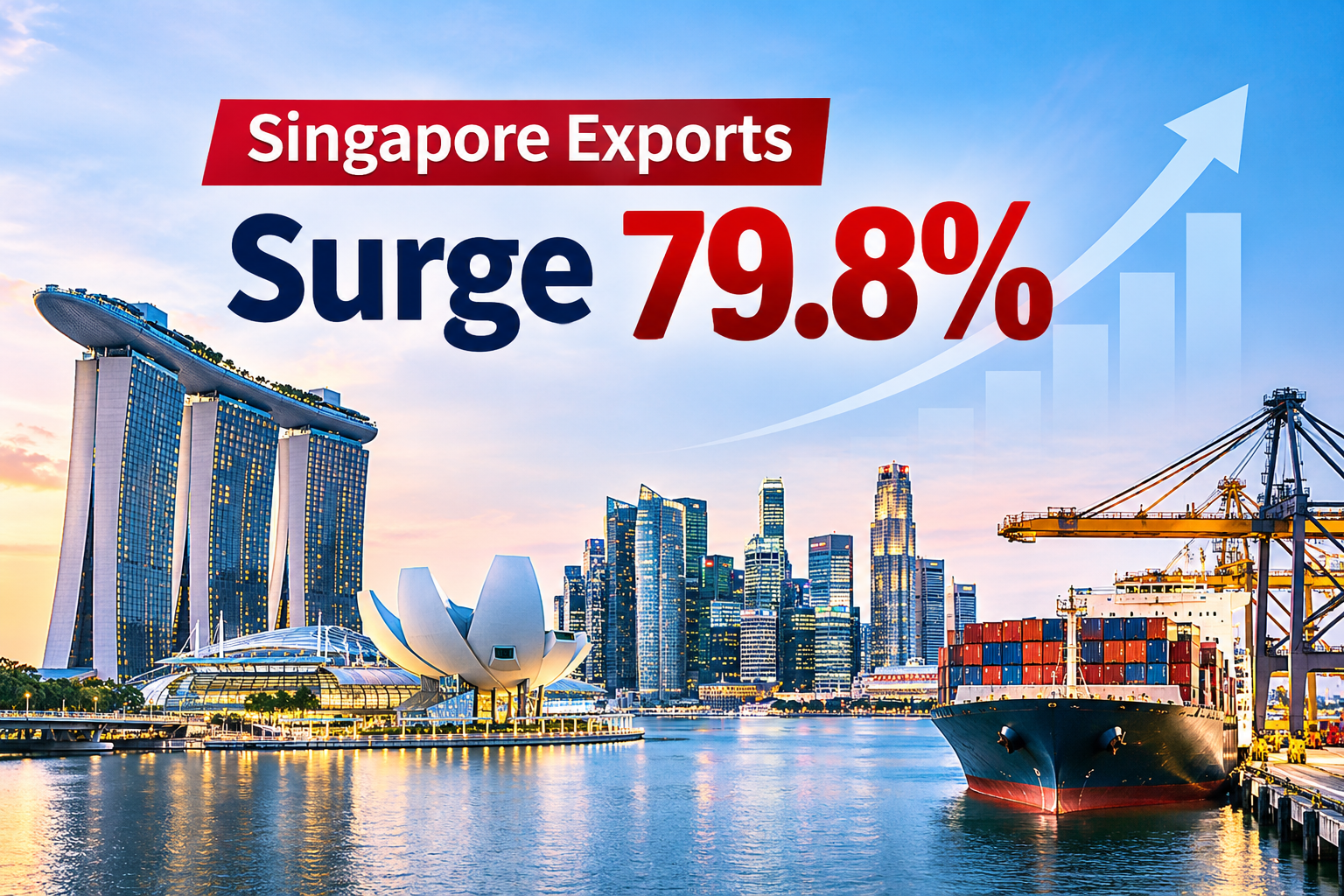
esents an acceleration from the already strong growth recorded in September.
The performance was supported by both electronic and non-electronic products.
Key October 2026 indicators:
| Indicator | Growth |
|---|---|
| Overall NODX | 79.8% |
| Non-electronic NODX | 81.9% |
| Electronic NODX | 73.9% |
| Non-oil re-exports | 48.1% |
| Total merchandise trade | 50.7% |
For the first ten months of 2026, Singapore’s non-oil domestic exports increased by 33.6% year-on-year, demonstrating the strength of its export performance over a longer period.
Non-Electronic Exports Lead the Expansion
Non-electronic exports were the principal contributor to October’s impressive performance.
The segment recorded growth of 81.9%, compared with 54.1% in September.
Three important categories supported the increase:
1. Structures of Ships and Boats
Ship and boat structures recorded a significant contribution to export growth, adding approximately S$4.8 billion in year-on-year export value.
Enterprise Singapore did not provide a percentage growth figure for this category because the exceptionally high increase was influenced by a low base in the corresponding period last year.
This highlights the importance of large, irregular export transactions in influencing monthly trade statistics.
Singapore has an established maritime and offshore engineering ecosystem, making shipbuilding-related structures and marine engineering important areas of international trade.
2. Pharmaceuticals
Pharmaceutical exports increased by an impressive 253.1% year-on-year.
The pharmaceutical sector is an important part of Singapore’s advanced manufacturing industry, supported by multinational pharmaceutical companies, biotechnology businesses, research facilities and specialised manufacturing infrastructure.
The strong October performance reflects the importance of pharmaceutical shipments in driving the country’s non-electronic export growth.
3. Specialised Machinery
Exports of specialised machinery increased by 57.3%.
This category includes industrial equipment and machinery used in manufacturing and other specialised industrial applications.
The growth reflects demand for advanced equipment and industrial technology in international markets.
Electronics Exports Benefit from Artificial Intelligence Demand
Singapore’s electronics exports also recorded strong growth in October, increasing by 73.9% year-on-year.
Although this was slower than the 107.6% expansion recorded in September, the segment continued to benefit from robust demand associated with artificial intelligence and the global expansion of digital infrastructure.
Three categories were particularly important:
| Electronic product | October 2026 growth |
|---|---|
| Disk media products | 189.6% |
| Personal computers | 81.0% |
| Integrated circuits | 53.1% |
Disk media products recorded the highest percentage growth among the highlighted electronic categories.
Integrated circuits, commonly known as semiconductor chips, increased by 53.1%, reflecting continued demand for electronic components used in computing and other advanced technologies.
Personal computer exports also expanded by 81%.
The growth in electronics exports is particularly relevant as companies worldwide continue investing in AI infrastructure, high-performance computing, cloud services and data centres.
Singapore’s established semiconductor ecosystem and international connectivity provide an important foundation for participating in these global technology supply chains.
Exports to the United States and China Record Triple-Digit Growth
Singapore’s export performance was also supported by strong demand from several major international trading partners.
Exports to the United States and China recorded particularly significant increases during October.
United States: 214.6% Growth
Exports to the United States increased by 214.6% year-on-year.
The expansion was supported by pharmaceuticals, disk media products and personal computers.
The United States remains Singapore’s largest export market for the reported NODX market ranking, making the strong increase particularly important for the country’s external trade performance.
China: 144.9% Growth
Exports to China increased by 144.9%.
Important contributors included non-monetary gold, specialised machinery and integrated circuits.
The growth highlights the importance of the Chinese market for Singapore’s manufacturing and technology-related exports.
Taiwan: 79.3% Growth
Exports to Taiwan increased by 79.3%, following growth of 96.9% in September.
Electronic NODX to Taiwan increased by approximately 149%, supported by strong demand for technology-related products.
Performance Across Other Markets
Singapore’s export performance was not uniform across all major destinations.
| Export destination | October 2026 growth |
|---|---|
| United States | +214.6% |
| China | +144.9% |
| Taiwan | +79.3% |
| European Union | +90.8% |
| Hong Kong | +65.4% |
| Malaysia | +19.5% |
| South Korea | +12.1% |
| Thailand | -7.9% |
| Indonesia | -19.0% |
| India | -35.8% |
The decline in exports to India is particularly noteworthy. Singapore’s NODX to India fell by 35.8%, following a 5.7% decline in September, largely because non-electronic shipments contracted.
This indicates that despite strong aggregate export growth, individual markets continue to experience different trade trends.
Re-Exports Also Register Strong Growth
Apart from domestic exports, Singapore’s non-oil re-exports (NORX) increased by 48.1% year-on-year in October, compared with 47.8% growth in September.
Re-exports represent imported goods that are subsequently exported without substantial transformation.
Electronic re-exports increased by 69.1%, supported by integrated circuits, computer components and other electronic products.
Notable growth categories included:
- Integrated circuits: +73.1%.
- Parts for personal computers: +358.9%.
- Other computer peripherals: +250.6%.
Non-electronic re-exports increased by 15%, supported by specialised machinery, works of art and pharmaceuticals.
Among major markets, re-exports to Thailand increased by 112.1%, China by 71.5% and Malaysia by 65.7%.
These figures highlight Singapore’s continuing importance as a regional distribution, logistics and international trading centre.
Total Merchandise Trade Reaches S$199.2 Billion
Singapore’s total merchandise trade reached S$199.2 billion in October 2026, representing an increase of 50.7% compared with the corresponding period last year.
The performance reflected strong growth in both exports and imports.
| Trade indicator | October 2026 |
|---|---|
| Total merchandise trade | S$199.2 billion |
| Total exports | S$109.2 billion |
| Total imports | S$90.0 billion |
| Total trade growth | 50.7% |
| Export growth | 55.8% |
| Import growth | 44.9% |
Total exports increased by 55.8%, while imports expanded by 44.9%.
The difference between total exports and imports resulted in a merchandise trade surplus of approximately S$19.2 billion for October.
The strong trade expansion demonstrates the scale of Singapore’s international trading activity and the interconnected nature of its manufacturing, distribution and logistics industries.
What Does This Mean for Singapore’s Economy?
Singapore’s export performance has important implications for its broader economic outlook.
1. Manufacturing Sector
Higher exports of pharmaceuticals, specialised machinery and electronic products could support manufacturing activity, industrial utilisation and demand for skilled workers.
2. Semiconductor and AI Ecosystem
Continued growth in integrated circuits and electronic products highlights the importance of global AI investment for Singapore’s technology and semiconductor supply chains.
3. Pharmaceutical Industry
The significant increase in pharmaceutical exports reinforces Singapore’s position as a regional manufacturing and distribution centre for advanced pharmaceutical products.
4. Maritime and Shipbuilding Industry
The large contribution from ship and boat structures demonstrates the importance of marine engineering and specialised industrial exports.
However, the exceptional contribution from these shipments should be interpreted carefully because of the low-base effect.
5. International Logistics and Trade Finance
Higher export and re-export activity could create additional business opportunities for shipping companies, freight forwarders, port operators, banks, insurers and trade-finance institutions.
Important Consideration: Can the Growth Be Sustained?
Although the 79.8% increase represents a remarkable export performance, businesses and investors should consider the composition of the growth.
The contribution from ship and boat structures was unusually large and influenced by a low comparison base in October 2025.
Similarly, monthly pharmaceutical shipments can fluctuate considerably depending on production schedules and delivery timing.
Electronics growth, on the other hand, offers an important indication of continuing demand linked to AI and semiconductor technologies.
Future export performance will depend on global demand, international trade conditions, semiconductor investment, pharmaceutical shipments and developments in major trading markets.
Consequently, the October figures should be viewed alongside subsequent monthly data rather than treated as a guaranteed annual growth rate.
Outlook: Singapore Strengthens Its Position in Global Trade
Singapore’s October 2026 export performance demonstrates the benefits of a diversified and internationally connected economy.
The combination of strong pharmaceutical shipments, maritime engineering exports and AI-related electronics demand has supported the country’s impressive trade expansion.
With non-oil domestic exports increasing by 33.6% during the first ten months of 2026, Singapore has maintained substantial export momentum.
The challenge ahead will be to convert these exceptional monthly results into sustainable growth across manufacturing, technology, pharmaceuticals and international trade.
For international businesses and investors, Singapore continues to offer an important gateway to Asian markets and global supply chains.
The Worldonomics Times Analysis: Singapore’s latest export data illustrates how traditional industries such as maritime engineering and pharmaceuticals can complement emerging technology sectors such as semiconductors and AI. This combination remains central to the country’s long-term competitiveness as a global business and trading hub.
The Worldonomics Times – Business, Economics, Finance and Global Developments.