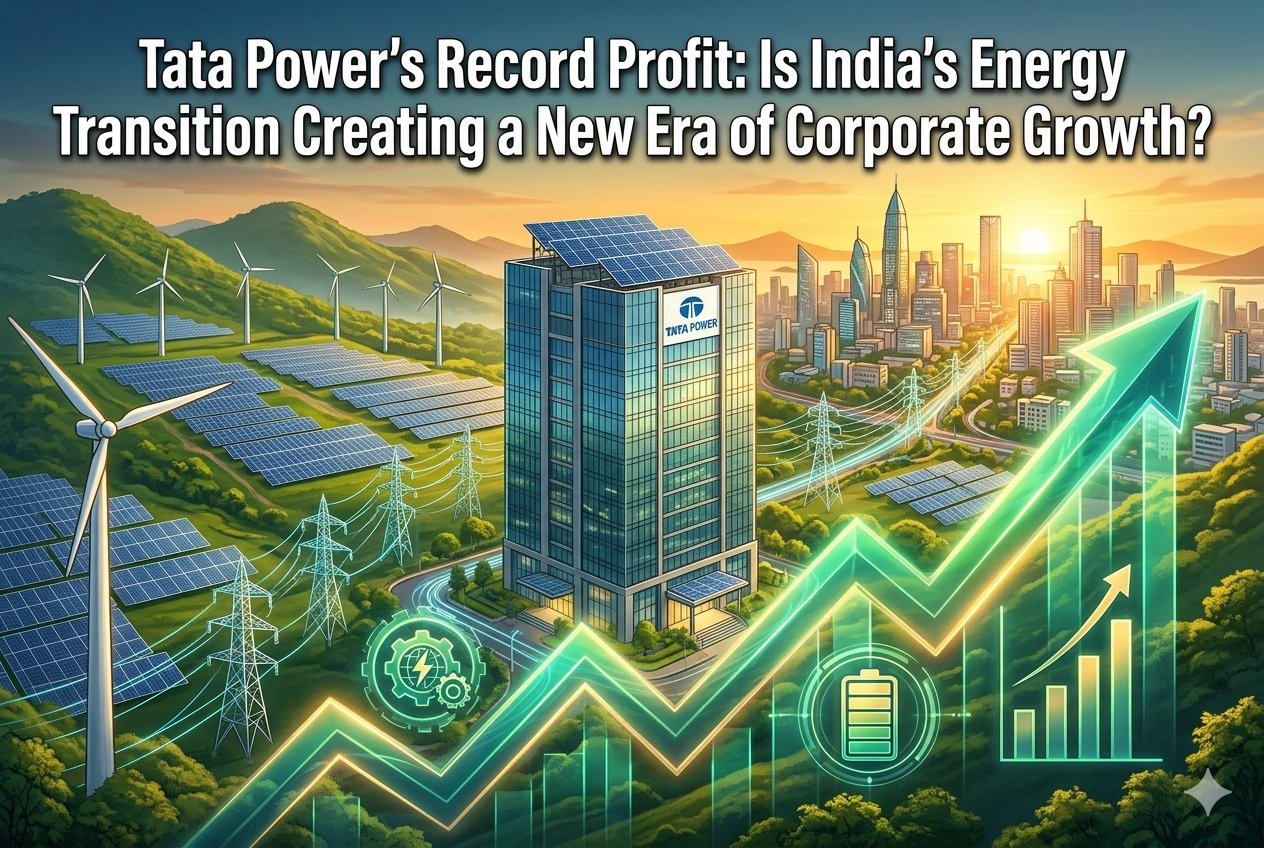
India’s energy sector is undergoing a major transformation. Rising electricity demand, renewable energy adoption, electric mobility and investments in power infrastructure are reshaping the country’s business landscape.
Amid this transformation, Tata Power has delivered an important corporate milestone.
The company reported its highest-ever quarterly consolidated profit after tax (PAT) of ₹1,652 crore in Q2 FY27, registering a 33% year-on-year increase. Its latest performance offers an interesting perspective on how traditional energy businesses are evolving while investing in a cleaner and more sustainable future.
But the bigger question is: What does this growth tell us about India’s energy transition and the future of corporate investment?
1. The Numbers Behind Tata Power’s Record Performance
Tata Power announced its Q2 FY27 financial results on November 11, 2026.
The company’s consolidated financial performance reflects growth in revenue and profitability.
Q2 FY27: Financial performance
| Particulars | Q2 FY27 | Year-on-year growth |
|---|---|---|
| Revenue | ₹19,886 crore | 26% |
| EBITDA | ₹4,245 crore | 5% |
| Reported PAT | ₹1,652 crore | 33% |
The company also reported first-half FY27 PAT of ₹3,053 crore, an increase of 22% compared with the corresponding period last year.
One important detail deserves attention: profit before exceptional items increased by 22% in Q2 FY27. This indicates that the improvement was not solely dependent on exceptional gains.
The numbers demonstrate a strong quarter, but they also raise an important financial question: Why did profit grow faster than EBITDA?
The answer lies in the contribution of different business segments, operating performance, financing costs and exceptional items. Understanding these factors is essential when analysing corporate results rather than looking at net profit in isolation.
2. Renewable Energy: A Major Driver of Future Growth
Renewable energy is becoming an increasingly important part of Tata Power’s business strategy.
The company is expanding its presence across solar, wind, rooftop solar and energy storage.
Some notable developments include:
- Installed clean and green generation capacity reaching 8.6 GW.
- Utility-scale renewable capacity reaching 7.2 GW.
- Rooftop solar installations reaching 5.12 GWp cumulatively.
- Production of 0.9 GW of solar cells and 1 GW of solar modules during Q2 FY27.
These developments reflect a broader shift in India’s energy business.
Companies are no longer competing only on electricity generation. They are also investing in manufacturing, energy storage, distribution networks and consumer-focused renewable solutions.
This creates opportunities across the entire clean-energy value chain.
3. A ₹10,000 Crore Investment: Building Infrastructure for Tomorrow
One of the most significant highlights of Tata Power’s latest results is its capital expenditure.
The company invested approximately ₹10,000 crore during the first half of FY27, its highest half-yearly capital deployment.
The investment supports several growth areas, including:
- Renewable energy projects.
- Transmission and distribution infrastructure.
- Pumped storage projects.
- Battery energy storage systems.
- Solar manufacturing.
- Digitalisation of electricity distribution.
Such investments are important because renewable energy growth requires more than installing solar panels or wind turbines.
Electricity must also be stored, transmitted and distributed efficiently.
This makes infrastructure investment a critical part of India’s energy transition.
4. What Does This Mean for India’s Economy?
The expansion of the energy sector can create economic opportunities across multiple industries.
Employment and skill development: Renewable projects require engineers, technicians, project managers and skilled workers.
MSME opportunities: Solar equipment, electrical components, cables, maintenance services and logistics create opportunities for small and medium enterprises.
Manufacturing growth: Domestic solar manufacturing can strengthen India’s industrial capabilities and support energy security.
Infrastructure development: Transmission networks, storage systems and distribution modernisation can improve the reliability of electricity supply.
The impact of a major energy investment therefore extends beyond the company itself. It can support a wider ecosystem of businesses, workers and suppliers.
5. The Financial Perspective: Profitability Is Only One Part of the Story
From a financial management perspective, Tata Power’s performance offers several important lessons.
A company can report strong revenue growth and record profits, but sustainable growth depends on how efficiently it manages its capital.
For a capital-intensive business such as power generation and distribution, some important financial indicators deserve attention:
Capital allocation: Are investments generating adequate returns over time?
Cash flow management: Can the company finance expansion while maintaining sufficient operating liquidity?
Debt management: Is the company maintaining a sustainable financing structure?
Capacity utilisation: Are new projects generating the expected level of output and revenue?
Return on capital employed: Is the business creating value from the capital invested?
These questions become particularly important when a company is investing thousands of crores in long-term infrastructure projects.
6. Challenges: The Energy Transition Is Not Without Risks
Despite the positive outlook, the sector faces several challenges.
- High capital requirements: Renewable energy and power infrastructure demand substantial long-term investment.
- Project execution: Delays in approvals, construction and commissioning can affect expected returns.
- Grid integration: Renewable power generation requires stronger transmission and storage infrastructure.
- Market competition: Changing technology and competitive pricing can affect margins.
- Financial risks: Interest costs, debt obligations and project cash flows need careful management.
Tata Power’s latest results are encouraging, but its long-term performance will depend on how successfully it balances expansion, financial discipline and operational efficiency.
Conclusion: The Future Belongs to Businesses That Can Combine Growth with Sustainability
Tata Power’s record quarterly profit is more than a corporate earnings milestone. It reflects the changing dynamics of India’s energy industry.
The growing importance of renewable energy, infrastructure investment, manufacturing and energy storage is creating new opportunities for businesses and the wider economy.
However, the real measure of success will not simply be the amount invested or the profits reported in one quarter.
It will be the ability to convert investment into reliable infrastructure, sustainable profitability, technological progress and long-term economic value.
India’s energy transition is not just about changing how electricity is generated. It is about transforming how businesses invest, operate and create value.
The future of energy will be shaped not only by who generates power, but by who manages it efficiently and sustainably.