India’s manufacturing ambitions are receiving another significant boost.
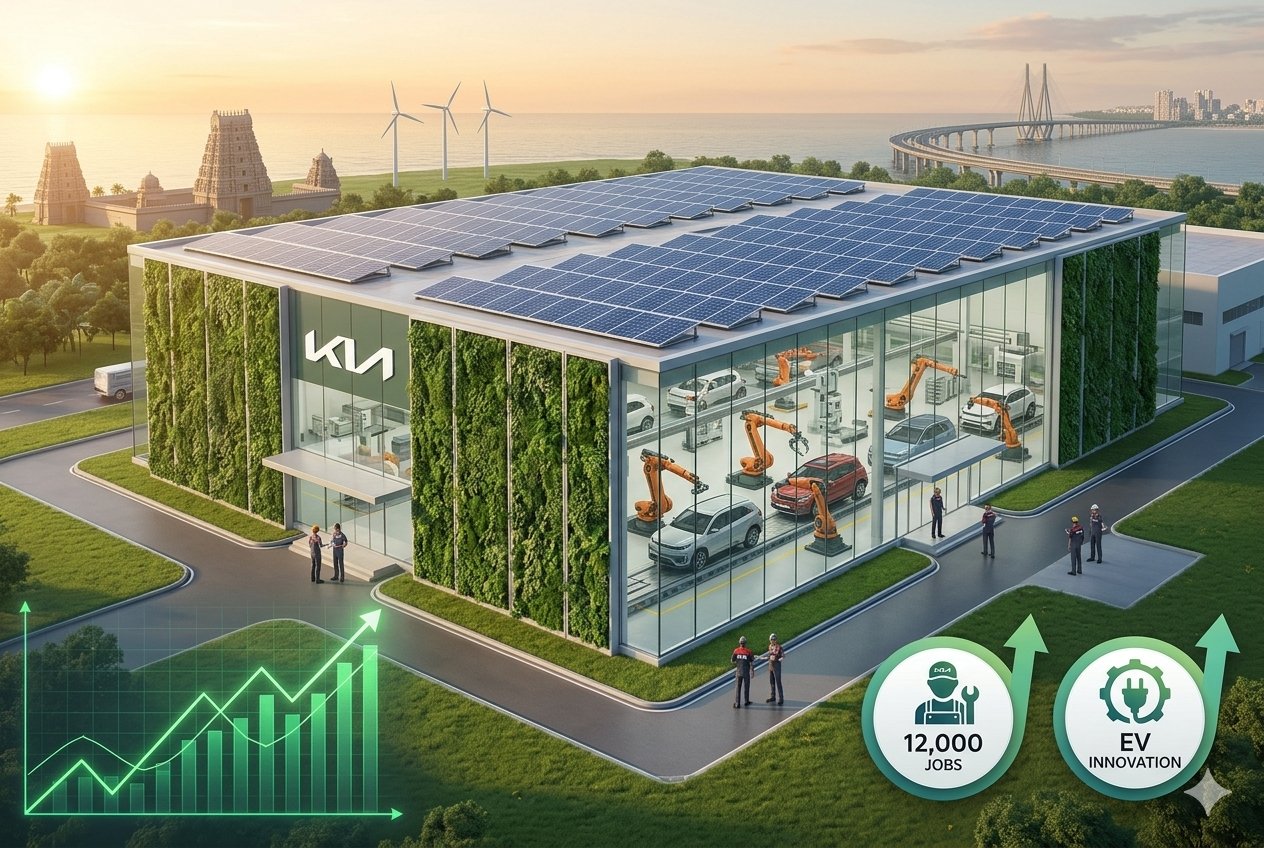
South Korean automobile manufacturer Kia has announced plans to invest approximately US$2 billion (around ₹17,700 crore) in an additional manufacturing facility in Andhra Pradesh. The proposed investment is expected to generate nearly 12,000 jobs, marking an important development for India’s automobile industry.
But this announcement is about much more than another automobile factory. It raises an important question: Can large corporate investments become a catalyst for wider economic development?
Let’s examine what this development could mean for India.
1. A Major Corporate Commitment to India
Kia’s proposed investment reflects the growing importance of India as a manufacturing destination.
The company already operates a manufacturing facility in Andhra Pradesh. Its proposed additional investment signals confidence in India’s automobile market, manufacturing capabilities and long-term growth potential.
According to media reports, the proposed expansion could increase Kia India’s annual production capacity to approximately 6.3 lakh vehicles. However, the company has not yet disclosed the complete implementation schedule or detailed operational plans.
This development could strengthen India’s position in the global automobile manufacturing ecosystem.
2. Employment Generation: Beyond the Factory Floor
One of the most significant expected outcomes is employment generation.
The proposed project is expected to create around 12,000 jobs. However, the economic impact of a manufacturing facility can extend far beyond its direct workforce.
A large automobile manufacturing operation creates demand for:
- Engineers and technical professionals.
- Production and quality-control specialists.
- Logistics and supply-chain managers.
- Skilled technicians and maintenance workers.
- Finance, accounting and administrative professionals.
- Ancillary manufacturers and service providers.
The supplier ecosystem can also generate opportunities for small businesses, transport operators and local service providers.
Therefore, the real employment impact may extend across multiple sectors.
3. Opportunities for MSMEs and Ancillary Industries
An automobile does not emerge from a single factory. It is the result of a complex network of suppliers, manufacturers and service providers.
Components such as tyres, batteries, electronics, metal parts, wiring systems and interiors are supported by specialised businesses.
A large manufacturing investment can increase demand across this network.
For India’s MSMEs, this creates opportunities to become part of organised supply chains, improve production capabilities and build long-term relationships with large corporations.
However, these opportunities also come with expectations around quality, timely delivery, technology adoption and financial discipline.
4. What Does This Mean for India’s Economy?
Large manufacturing investments can create a multiplier effect.
When a company invests in a new facility, the impact is not limited to its own operations. It can encourage infrastructure development, attract supporting industries, increase local employment and stimulate demand for goods and services.
For Andhra Pradesh, the proposed project could strengthen the state’s industrial ecosystem.
For India, it supports broader objectives such as:
- Strengthening domestic manufacturing.
- Attracting foreign direct investment.
- Expanding export capabilities.
- Developing skilled human resources.
- Reducing dependence on selected imported components.
- Improving India’s position in global supply chains.
The benefits, however, will depend on how effectively the proposed investment is implemented.
5. The Financial Perspective: Investment Must Deliver Returns
From a financial management perspective, a ₹17,700 crore investment is not merely an announcement. It represents a major capital-allocation decision.
Such investments involve evaluating:
- Expected return on investment (ROI).
- Project cost and financing structure.
- Future demand and production capacity utilisation.
- Operating costs and profitability.
- Supply-chain efficiency.
- Cash-flow management.
- Risks associated with technology and market competition.
A manufacturing facility may have significant production capacity, but its commercial success ultimately depends on market demand, efficient operations and sustainable profitability.
For businesses, the lesson is clear: expansion should be supported by sound financial planning and effective execution.
6. The Challenge: From Investment Announcement to Actual Growth
While large investment announcements create optimism, their real economic value becomes visible only when projects move from planning to execution.
Land acquisition, regulatory approvals, infrastructure readiness, supplier development, workforce training and project financing can all influence implementation.
Similarly, the expected 12,000 jobs should be understood as a projected employment outcome, not an indication that all these positions already exist.
The focus must therefore remain on converting investment commitments into operational capacity, actual employment and measurable economic benefits.
Conclusion: India’s Manufacturing Story Is Entering an Important Phase
Kia’s proposed $2 billion investment is an encouraging development for India’s manufacturing ambitions.
It highlights how corporate expansion can create opportunities across employment, MSMEs, infrastructure, technology and regional economic development.
But the larger lesson goes beyond one company or one industry.
A country’s manufacturing strength is not measured only by the amount of investment it attracts, but by the value it creates through jobs, productivity, innovation and sustainable business growth.
India has the opportunity to transform corporate investment into long-term economic progress. The real success will lie in turning announcements into action.
Because the true value of an investment is not just what a company builds, but the economic opportunities it creates around it.