By The Worldonomics Times
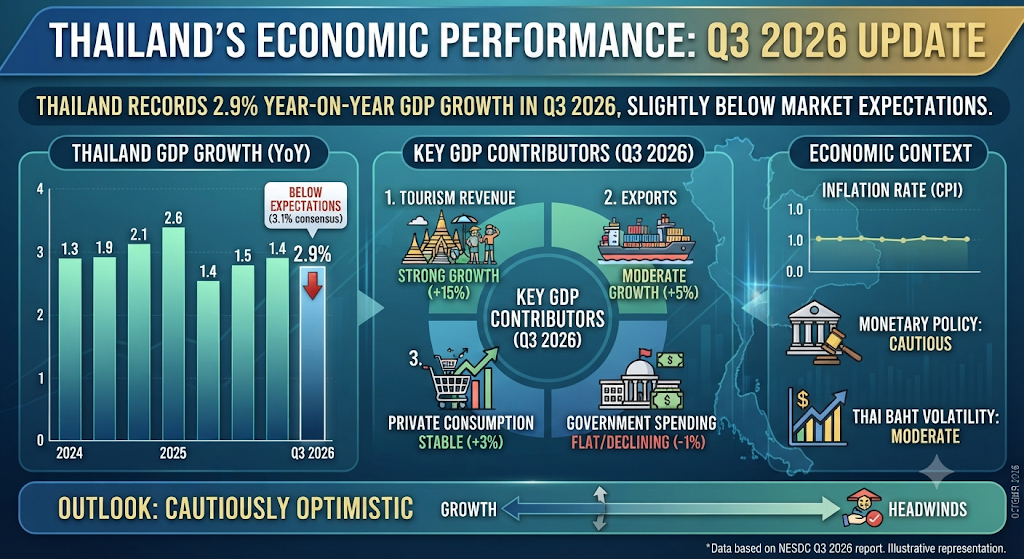
Thailand’s economy recorded year-on-year GDP growth of 2.9% in the third quarter of 2026, slightly below market expectations, as strong exports and private investment helped offset weaker performance in parts of the domestic economy. Although growth accelerated from 2.4% in the second quarter, the latest figures indicate that the country’s recovery remains uneven.
According to the Office of the National Economic and Social Development Council (NESDC), the economy expanded by 0.3% quarter-on-quarter after seasonal adjustment. Economists had expected approximately 3.0% annual growth and 0.7% quarterly growth. During the first nine months of 2026, Thailand’s GDP increased by 2.8% compared with the same period a year earlier.
The results highlight the importance of international demand, particularly for electronics and products associated with artificial intelligence, while also drawing attention to the challenges facing household consumption, tourism and government spending.
Exports and Technology Investment Drive Economic Growth
Exports were among the strongest contributors to Thailand’s economic performance during the third quarter.
The NESDC reported that the value of exports reached approximately US$106.4 billion, representing growth of 23.6% compared with the same period in 2025. Demand for electronics, computer components, telecommunications equipment and machinery supported this expansion, reflecting increased global investment in artificial intelligence and data-centre infrastructure.
Exports of telecommunications equipment increased by 115.9%, while computer parts and accessories rose by 68%. Integrated circuits and related products also recorded substantial growth.
This performance demonstrates how Thailand is benefiting from the expansion of international technology supply chains. The country has an established manufacturing base and is seeking to strengthen its position in electronics, electrical equipment and advanced industrial production.
However, strong exports also increase Thailand’s exposure to changes in international trade policies and the global technology investment cycle. A slowdown in demand for AI-related infrastructure could affect future export orders and manufacturing activity.
Private Investment Reaches a Major Milestone
Investment activity provided another important source of economic support.
Total investment increased by 11.8% year-on-year in the third quarter, its strongest expansion in more than a decade. Private investment rose by 16.2%, supported by higher spending on machinery, equipment and industrial technology.
Investment in machinery and equipment increased by 20.5%, reflecting business demand for production capacity and technology-related assets. Public investment also returned to growth, expanding by 1.7% after contracting in the previous quarter.
Nevertheless, construction investment declined by 0.5%, indicating that the recovery was not equally strong across all investment categories. Weakness in residential, industrial and commercial building activity suggests that some domestic sectors continue to face financial and demand-related constraints.
Household Spending and Government Consumption Remain Challenges
Domestic consumption improved moderately, but it did not provide the same momentum as exports and investment.
Private consumption increased by 2.5%, compared with 2.1% in the second quarter. Vehicle purchases were a notable contributor, with spending on durable goods rising as consumers increased purchases of cars and other long-lasting products.
However, spending on services grew more slowly, particularly in hotels, restaurants and healthcare. Government consumption declined by 1.6%, marking its first contraction in four quarters.
These figures suggest that Thailand’s economic expansion remains dependent on selected growth drivers rather than a broad-based increase in domestic demand.
Household debt, purchasing-power pressures and uneven access to credit continue to influence consumer behaviour. Sustained growth will require stronger employment opportunities, rising household incomes and improved confidence among consumers and businesses.
Tourism and Manufacturing Face Different Conditions
Tourism remains an important part of Thailand’s economy, supporting employment, transportation, hospitality and retail businesses. However, international visitor numbers continued to face pressure during the third quarter.
The NESDC reported approximately 7.06 million international tourist arrivals, a decline of 5% compared with the same period in 2025. Tourism receipts nevertheless increased by 11.7% to around 359 billion baht, indicating that higher spending per visitor helped support industry revenues.
Manufacturing performed more strongly. Output increased by 3.7%, its fastest annual expansion in 16 quarters, supported by electronics and other export-oriented industries.
The contrast between these sectors illustrates the different forces shaping Thailand’s economy. Manufacturing is benefiting from international technology demand, while tourism must continue addressing changes in visitor numbers, travel patterns and global economic conditions.
Thailand’s Economic Outlook for 2026 and 2027
Following the latest GDP release, the NESDC projected that Thailand’s economy would grow by 2.5% in 2026, compared with 2.4% in 2025. For 2027, it expects growth between 2.0% and 3.0%, with a midpoint of 2.5%.
The outlook depends on continued private investment, stronger public infrastructure spending, improving household consumption and a gradual recovery in tourism. Exports are also expected to remain important, although their growth is projected to moderate as the exceptional expansion recorded in 2026 becomes harder to sustain.
Several risks could affect this outlook. Geopolitical tensions, energy-price volatility, international trade restrictions and disruptions to supply chains could increase production costs and weaken external demand. The authorities have also highlighted the importance of agricultural productivity and water management in preparing for potential climate-related pressures.
Implications for International Trade and India
Thailand’s economic performance has implications for international businesses because the country is an important manufacturing and trading centre in Southeast Asia.
Strong electronics exports and investment in industrial equipment could create opportunities for suppliers, technology companies and international investors. At the same time, slower tourism growth and weaker domestic demand may limit opportunities in consumer-facing industries.
For India, Thailand is an important partner within ASEAN and a participant in regional manufacturing and trade networks. Changes in Thai industrial production can influence demand for Indian engineering goods, chemicals, pharmaceuticals, machinery and other intermediate products.
The latest figures also highlight opportunities for closer cooperation in electronics, automotive components, digital infrastructure, renewable energy and logistics. Indian businesses seeking to expand in Southeast Asia could benefit from monitoring Thailand’s investment priorities and its role in regional supply chains.
However, weaker Thai exports to India during the third quarter underline the importance of strengthening bilateral trade and identifying new areas of commercial cooperation.
The Worldonomics Times View
Thailand’s 2.9% GDP growth in the third quarter of 2026 reflects an economy that is expanding but still faces significant structural and external challenges. Strong electronics exports, technology-related investment and improved manufacturing activity have supported the recovery, while household spending, tourism and government consumption remain less encouraging.
The fact that growth exceeded the previous quarter’s pace but fell short of market expectations demonstrates the importance of looking beyond headline GDP figures. A sustainable recovery requires stronger domestic demand alongside export competitiveness.
Thailand’s policymakers will need to support investment, improve household purchasing power, strengthen tourism and help domestic businesses benefit from international supply-chain opportunities. Greater attention to infrastructure, workforce skills and productivity will also be essential.
For India and other trading partners, Thailand’s performance offers both opportunities and a reminder of the close connections between regional economies.
Ultimately, Thailand’s economic outlook will depend on whether its strong export and investment momentum can translate into broader improvements in employment, household incomes and domestic business activity. Achieving that balance will be crucial for building a more resilient and sustainable economy.