By The Worldonomics Times
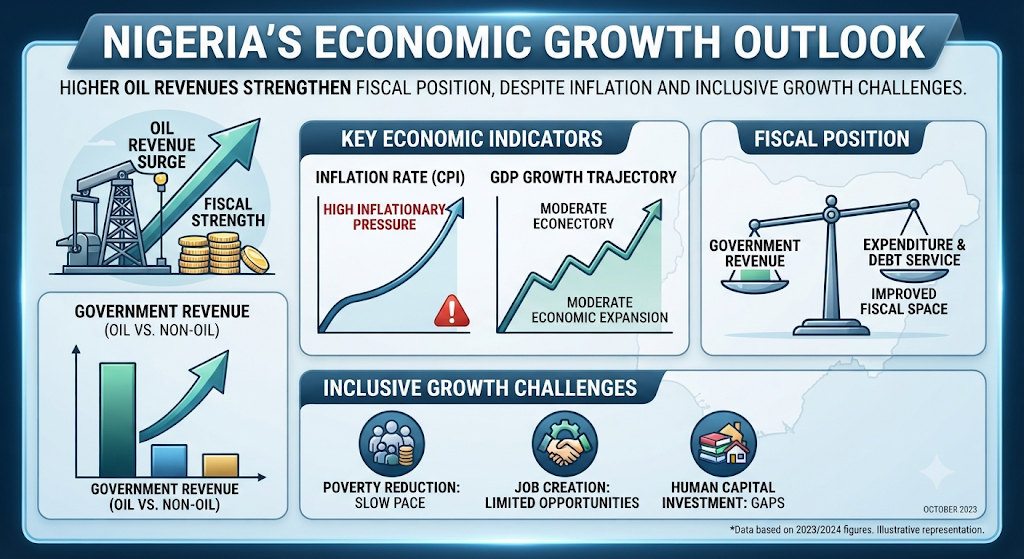
Nigeria’s economic recovery is showing signs of progress, supported by stronger oil revenues, improved external balances and continued growth in non-oil sectors. However, higher crude oil prices have not automatically translated into broad improvements in living standards. Persistent inflation, high public debt-servicing costs, poverty and uneven access to economic opportunities remain major challenges. The central issue for policymakers is how to convert additional oil income and macroeconomic stability into productive investment, employment and more inclusive growth.
According to the World Bank’s October 2026 Nigeria Development Update, real GDP grew by 4.2% in the first half of 2026, compared with 3.9% during the same period in 2025. Growth was supported primarily by services and a stronger contribution from agriculture. Higher international oil prices also improved government revenues and Nigeria’s external position, although the benefits were partly limited by existing oil-related financing commitments.
Higher Oil Revenues Support Government Finances
Oil remains a major source of foreign exchange and public revenue for Nigeria. As one of Africa’s leading oil producers, the country depends on crude exports to support government finances, maintain external reserves and fund development programmes.
The increase in international oil prices during 2026 has strengthened export earnings and improved the government’s revenue position. Higher oil receipts have also supported transfers to federal, state and local governments through the Federation Account.
The World Bank reported that Nigeria’s current account surplus increased to $12 billion, equivalent to 7.1% of GDP, in the first half of 2026. This compared with $8.6 billion, or 6.7% of GDP, in the corresponding period of 2025. The country’s gross external reserves also rose above $54 billion in September 2026.
Nevertheless, the improvement in oil income does not remove the structural weaknesses in public finances. A significant share of government revenue is required for debt servicing and other expenditure commitments. The International Monetary Fund’s 2026 assessment projected federal government interest payments at approximately 53.7% of federal revenue, highlighting the limited fiscal space available for development spending.
Oil Revenue Gains Face Production and Collection Challenges
Although higher global oil prices provide an opportunity to strengthen public finances, Nigeria’s ability to benefit depends on production volumes, export performance and effective revenue collection.
Oil production has faced challenges over several years, including pipeline theft, operational disruptions, infrastructure constraints and underinvestment. Increasing production capacity and improving the reliability of exports are therefore important for turning favourable international prices into sustainable government income.
There are also signs that higher oil prices do not always translate into revenue targets being achieved. A report published by Nigerian newspaper The PUNCH in October 2026, based on Federation Account figures, indicated that statutory revenue for the first ten months of the year fell approximately ₦20.74 trillion short of the budget target for that period.
This suggests that revenue performance depends on more than the international price of crude. Production levels, oil-related deductions, collection efficiency, exchange rates and financing arrangements also influence how much income ultimately reaches government accounts.
Improving transparency, reducing leakages and strengthening the management of oil-related revenues will be essential to securing more predictable public finances.
Inflation Continues to Affect Households
Despite improvements in economic growth and external stability, inflation remains one of Nigeria’s most significant economic challenges.
The World Bank reported that headline inflation declined substantially from 27.6% in January 2025 to 15.2% in December 2025. However, higher fuel prices associated with the Middle East conflict and seasonal food-price pressures temporarily interrupted the disinflation process during 2026.
Rising food, transportation, electricity and housing costs continue to affect household budgets. For lower-income families, these expenses account for a substantial share of monthly spending, leaving less money available for education, healthcare and other essential needs.
Higher fuel prices also increase operating costs for businesses, particularly in transportation, agriculture, manufacturing and logistics. Companies may respond by increasing product prices, which can create further pressure on consumers.
The Central Bank of Nigeria therefore faces the challenge of maintaining price stability while supporting economic activity. Monetary policy, exchange-rate stability and improvements in domestic food production will all influence the inflation outlook.
Non-Oil Sectors Provide Additional Growth Support
Nigeria’s economic growth is not dependent on oil alone. Services, agriculture, trade, telecommunications, financial services and real estate are increasingly important contributors to economic activity.
The World Bank’s October update highlighted the role of services and agriculture in supporting growth during the first half of 2026. The Central Bank of Nigeria’s second-quarter economic report also recorded real GDP growth of 4.43% year-on-year, with expansion in information and communication technology, agriculture, real estate, trade and financial services.
Expanding these sectors can help Nigeria reduce its dependence on volatile oil revenues. Agriculture has the potential to improve food security, create rural employment and strengthen domestic supply chains. Manufacturing and technology services can support higher-value production, while financial services can improve access to capital for businesses.
However, these industries require reliable electricity, better transportation networks, affordable financing and a more predictable business environment. Addressing these constraints will be important for sustaining growth beyond the oil sector.
Inclusive Growth and Poverty Reduction Remain Priorities
Economic growth does not automatically guarantee that all sections of society benefit equally.
The World Bank has highlighted the gap between Nigeria’s improving macroeconomic indicators and the living conditions of many households. Its country assessment estimated that 69.6% of Nigerians lived below the lower-middle-income poverty line of $4.20 per day in 2025, while 50.8%, or approximately 123 million people, were living in extreme poverty under the measure used in the report.
These figures underline the importance of ensuring that economic recovery generates employment, raises real incomes and improves access to essential services.
Investment in education, healthcare, electricity, roads and social protection can help distribute the benefits of growth more widely. Targeted support for vulnerable households is also important when food and transport costs remain high.
State governments have a particularly important role because they are responsible for delivering many public services. The World Bank’s October 2026 report examined how increased public revenues have influenced state spending priorities and stressed the need for more effective and accountable public expenditure.
Implications for International Markets and India
Nigeria’s economic performance matters beyond its domestic market. As a major African economy and oil exporter, changes in its production, exports and fiscal position can influence regional trade, investment and energy markets.
Stronger oil revenues can improve foreign exchange availability and support demand for imported machinery, infrastructure equipment and consumer products. However, persistent inflation and fiscal pressures could limit the pace of domestic investment and consumption.
For India, Nigeria is an important partner in energy and commercial relations. Changes in Nigerian crude exports can influence India’s energy sourcing options, while improvements in Nigeria’s economic conditions could create opportunities for Indian companies in pharmaceuticals, engineering, telecommunications, agriculture, infrastructure and consumer goods.
Indian businesses seeking to expand in West Africa will need to monitor currency conditions, payment risks, infrastructure constraints and regulatory developments. Stronger trade and investment cooperation could benefit both countries, particularly in sectors that support industrial development and essential services.
The Worldonomics Times View
Nigeria’s economic performance in 2026 demonstrates the importance of favourable oil-market conditions alongside domestic economic reforms. Higher oil prices have supported government revenues, strengthened external balances and provided additional resources for public spending.
However, the benefits remain constrained by revenue-management weaknesses, debt-servicing obligations, inflation and persistent poverty. Stronger oil earnings alone cannot deliver sustainable economic development unless they are converted into productive investment and better public services.
Nigeria’s long-term prospects will depend on improving oil production, strengthening non-oil industries, maintaining price stability and ensuring that public resources are used effectively. Greater investment in infrastructure, education, healthcare and job creation will be essential to making economic growth more inclusive.
For international businesses and trading partners, Nigeria remains an important market with considerable potential, but its progress will depend on continued improvements in economic stability and the business environment.
Ultimately, the country’s challenge is not simply to generate higher revenues from oil, but to use those revenues to build a more diversified, productive and inclusive economy that improves living standards across the population.