How changing lifestyles, urbanisation and declining social connections are creating a new economic reality.
Introduction: A Social Issue with Economic Consequences
In today’s highly connected world, people can communicate instantly across continents, attend virtual meetings and maintain hundreds of online connections. Yet, meaningful human interaction is becoming an increasingly important concern.
Loneliness is generally viewed as a personal or social issue. However, it also has an economic dimension that deserves attention.
From workplace productivity to healthcare expenditure, consumer behaviour and the growth of new businesses, social isolation can influence several areas of the economy.
The question is no longer simply whether people are becoming more isolated, but what this changing social behaviour means for businesses, governments and economic development.
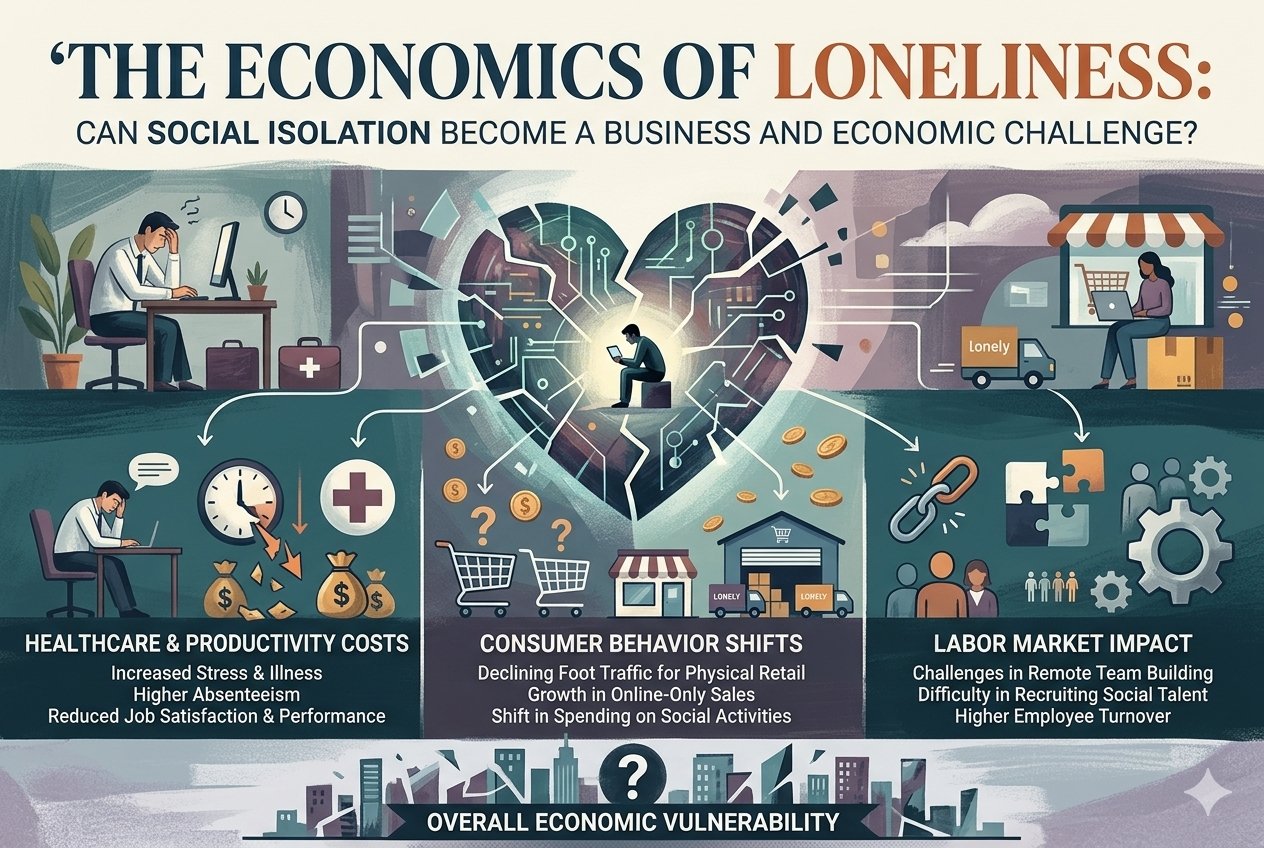
1. The Hidden Economic Cost of Loneliness
Loneliness can have consequences beyond emotional well-being.
It may influence:
- Employee concentration and workplace engagement.
- Absenteeism and employee retention.
- Healthcare utilisation and associated expenditure.
- Productivity and participation in economic activities.
When social isolation affects an individual’s well-being, its consequences can extend to employers, families and public healthcare systems.
This makes loneliness a subject of economic and organisational interest.
2. The Changing Nature of Consumer Spending
Consumer behaviour is closely connected to lifestyle and social preferences.
As people increasingly live independently or seek meaningful social experiences, spending patterns may change.
Consider the growth of:
- Solo travel and individual tourism.
- Co-working and shared community spaces.
- Hobby clubs and recreational communities.
- Social networking and experience-based platforms.
- Cafés and activity-based social spaces.
These developments demonstrate how changing social preferences can create new consumer markets.
Businesses that understand the demand for meaningful experiences may discover opportunities beyond traditional products and services.
3. The Workplace Connection
Modern organisations are increasingly recognising that employee performance is influenced by more than salary and professional qualifications.
Remote working, digital communication and geographically distributed teams have changed workplace relationships.
Although flexible working offers several advantages, limited personal interaction may make some employees feel disconnected.
Companies can respond through:
- Employee engagement initiatives.
- Collaborative workplace activities.
- Mentorship programmes.
- Inclusive team cultures.
- Opportunities for meaningful professional interaction.
A connected workforce can contribute to stronger collaboration, engagement and organisational culture.
4. The Business Opportunity: An Emerging Experience Economy
Loneliness may also influence the development of new business models.
Entrepreneurs are exploring services built around shared experiences, community participation and social interaction.
For example, businesses offering group activities, hobby-based memberships, community events and experience-led travel are responding to consumers’ desire for connection.
This creates an interesting business proposition: people are not always purchasing a product; sometimes they are paying for an experience, belonging or shared activity.
However, businesses must ensure that these services create genuine value rather than commercially exploiting social vulnerability.
5. India’s Changing Social and Economic Landscape
India’s rapid urbanisation, migration for employment, changing family structures and growing metropolitan lifestyles are transforming traditional patterns of social interaction.
Young professionals moving to unfamiliar cities may experience difficulties building social networks.
At the same time, digital communities, recreational groups and shared-interest platforms are creating alternative ways to connect.
This changing environment presents an opportunity for businesses, urban planners and policymakers to rethink how cities and communities can support social well-being.
6. What Can Businesses and Policymakers Do?
Addressing loneliness requires more than digital solutions.
Businesses can encourage healthier workplace relationships, while policymakers can promote accessible public spaces, community centres, recreational infrastructure and inclusive urban development.
The objective should be to create environments where people can participate meaningfully in society.
Conclusion: The Value of Human Connection
Economic progress is usually measured through GDP growth, investment, employment and productivity. But the quality of human relationships also influences how people live, work and participate in the economy.
Loneliness reminds us that economic development is not only about producing more or consuming more. It is also about creating societies in which people feel connected and supported.
For businesses, understanding human behaviour can reveal opportunities that traditional market analysis may overlook.
In an economy increasingly driven by technology and digital interaction, meaningful human connection may become one of the most valuable experiences of all.