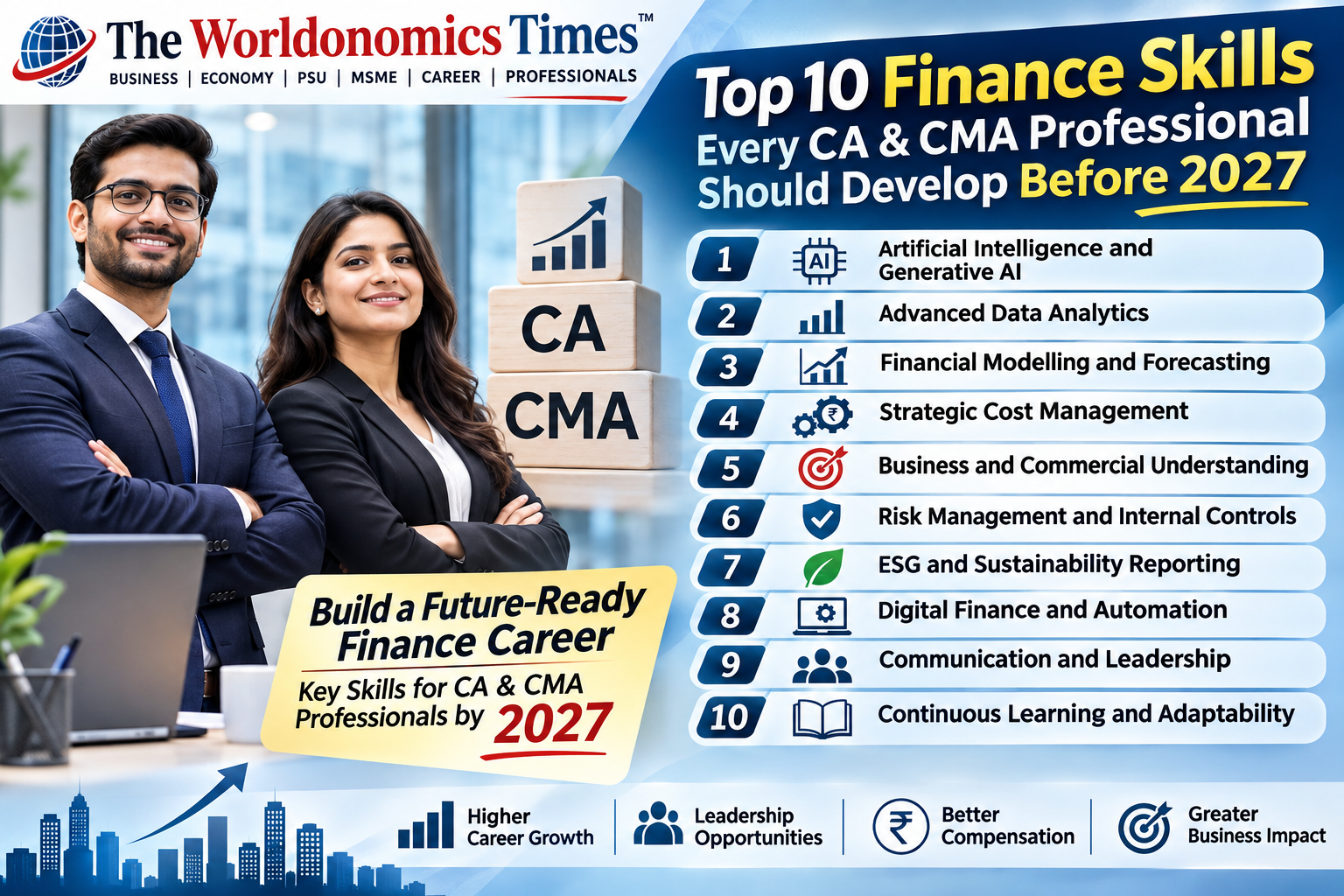
The finance profession is changing rapidly. For CA and CMA professionals, technical knowledge remains essential—but technology, analytics, strategic thinking and business leadership are becoming equally important.
The role of finance professionals is undergoing a significant transformation. Artificial intelligence, automation, data analytics, digital finance and changing business models are reshaping how organisations manage money, measure performance and make strategic decisions.
For Chartered Accountants and Cost & Management Accountants, professional qualifications continue to provide a strong foundation. However, success in the evolving corporate environment will increasingly depend on the ability to combine accounting and finance expertise with technology, analytics and business understanding.
As 2027 approaches, finance professionals who continuously upgrade their skills are likely to have a significant advantage in industry, consulting, financial services and public-sector organisations.
Here are 10 finance skills every CA and CMA professional should consider developing before 2027.
1. Artificial Intelligence and Generative AI
AI is rapidly becoming an important tool for finance teams. Professionals should understand how AI can support financial analysis, reporting, forecasting, research, documentation and routine processes.
The objective is not necessarily to become an AI programmer. Instead, finance professionals should learn how to use AI responsibly to improve productivity and decision-making.
Understanding AI tools, prompt writing, data privacy and verification of AI-generated information can become valuable professional capabilities.
2. Advanced Data Analytics
Modern finance departments generate enormous amounts of data. The ability to convert this data into meaningful business insights is therefore increasingly important.
CA and CMA professionals should develop practical knowledge of tools such as Excel, Power BI and other business intelligence platforms.
Skills in data cleaning, dashboards, trend analysis, variance analysis and financial modelling can help professionals move beyond traditional reporting roles.
3. Financial Modelling and Forecasting
Businesses need finance professionals who can look beyond historical numbers and understand what could happen next.
Financial modelling helps organisations evaluate investments, budgets, expansion plans, funding requirements and different business scenarios.
Professionals should develop the ability to build models covering revenue, costs, cash flows, profitability, working capital and sensitivity analysis.
4. Strategic Cost Management
Cost management is becoming increasingly important in a competitive business environment.
For CMA professionals in particular, advanced knowledge of cost management can create significant career opportunities. Professionals should understand cost drivers, activity-based costing, cost optimisation, pricing strategies, profitability analysis and cost reduction.
The modern finance professional should be able to answer not only “What did it cost?” but also “Why did it cost this much, and how can we improve it?”
5. Business and Commercial Understanding
Finance professionals increasingly need to understand the business behind the numbers.
A strong finance professional should understand customers, competitors, supply chains, products, pricing, sales channels and operational risks.
Whether working as a CFO, finance manager, business partner or consultant, professionals who understand commercial realities can contribute more effectively to strategic decisions.
6. Risk Management and Internal Controls
Risk management is no longer limited to compliance departments. Financial, operational, cyber, regulatory and business risks can directly affect an organisation’s performance.
CA and CMA professionals should strengthen their understanding of enterprise risk management, internal controls, fraud risks, governance and business continuity.
Strong risk awareness can help finance professionals become trusted advisers to senior management.
7. ESG and Sustainability Reporting
Environmental, social and governance considerations are increasingly influencing business decisions, investment and reporting.
Finance professionals should understand the basics of sustainability reporting, ESG metrics, carbon-related information and the financial implications of sustainability initiatives.
As companies integrate sustainability into their strategies, professionals who can connect ESG information with financial performance may find new opportunities.
8. Digital Finance and Automation
Automation is changing traditional finance processes such as reconciliation, invoice processing, reporting and routine data entry.
Professionals should understand how technologies such as ERP systems, robotic process automation and digital workflows can improve finance operations.
The future finance professional will increasingly be expected to design, monitor and improve automated processes rather than simply perform repetitive tasks manually.
9. Communication and Leadership
Technical expertise alone does not guarantee career progression.
Finance professionals must be able to explain complex financial information in simple business language. Presentation skills, negotiation, stakeholder management, team leadership and executive communication are becoming increasingly valuable.
A CFO or senior finance leader must be able to communicate effectively with boards, CEOs, investors, employees, regulators and operational teams.
10. Continuous Learning and Adaptability
Perhaps the most important skill for 2027 and beyond is the ability to keep learning.
Technology, regulations, financial products, business models and workplace expectations continue to evolve. Professionals who rely only on knowledge acquired during qualification may eventually find their skills becoming outdated.
Continuous learning through certifications, workshops, professional networks, industry exposure and practical projects can help CA and CMA professionals remain competitive.
Preparing for the Finance Profession of 2027
The finance profession is moving from recording and reporting numbers to interpreting numbers and influencing decisions.
CA and CMA professionals already possess strong foundations in accounting, finance, taxation, costing and management. The next step is to combine that expertise with technology, analytics, strategic thinking and leadership.
The professionals who succeed in the coming years will not necessarily be those who know the most accounting rules. They will be those who can understand the numbers, use technology intelligently, identify risks, communicate insights and help organisations make better decisions.
As 2027 approaches, investing in these 10 skills can help finance professionals build stronger careers and prepare themselves for the rapidly evolving world of finance.