By The Worldonomics Times | Global Economy
Artificial Intelligence (AI) is rapidly emerging as one of the most influential forces shaping the global economy. From advanced semiconductor manufacturing and cloud computing to automated business operations and intelligent financial systems, AI investment is creating new economic opportunities and transforming traditional industries. The growing demand for AI technologies is attracting significant capital from governments, multinational corporations, institutional investors, and technology startups.
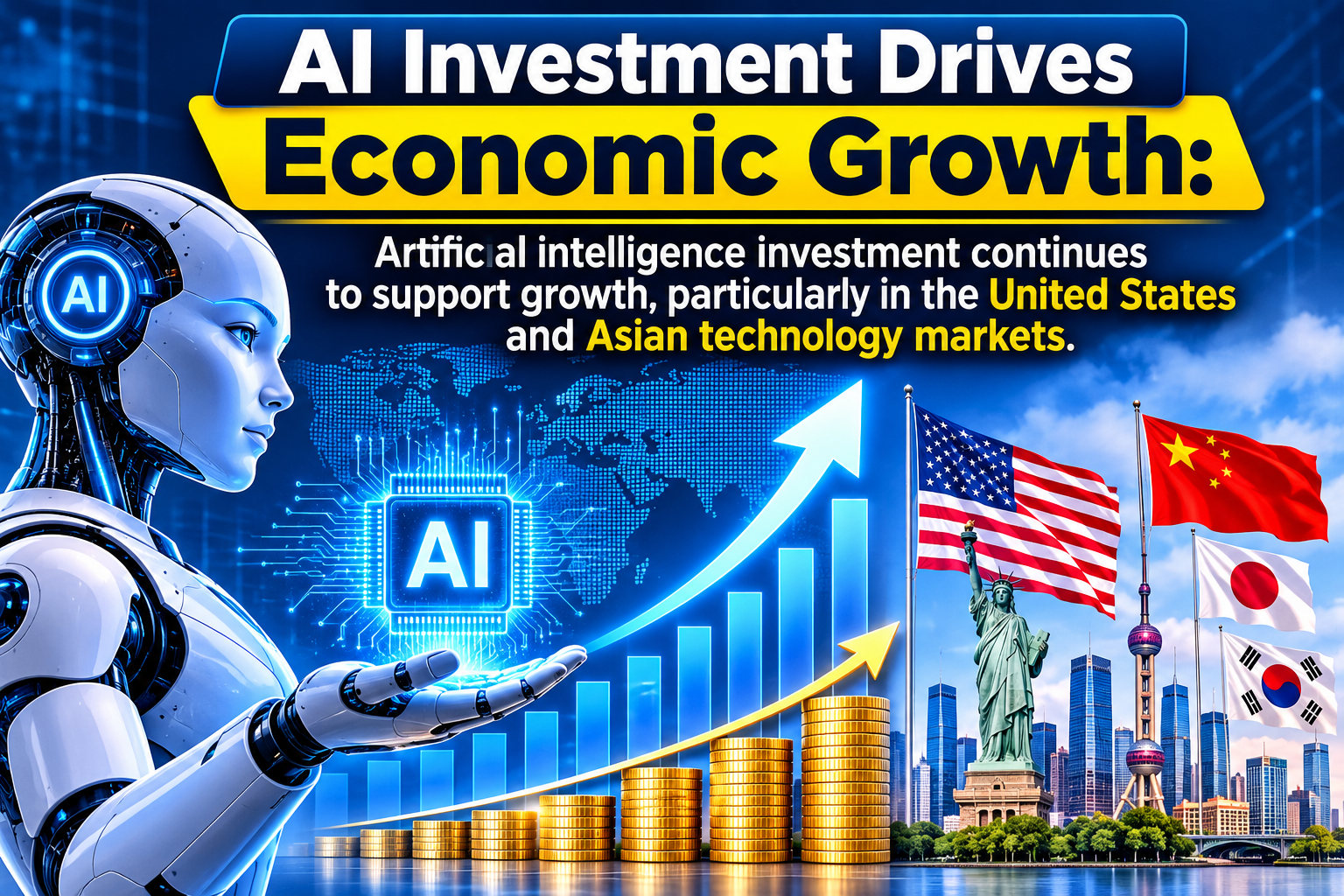
The United States and Asian technology markets are at the centre of this transformation. Massive investments in data centres, computing infrastructure, semiconductor production, and AI-powered applications are supporting business expansion, encouraging innovation, and contributing to economic growth. As countries compete to strengthen their technological capabilities, artificial intelligence is increasingly becoming a strategic priority for long-term economic development.
The United States Leads the Global AI Investment Boom
The United States continues to occupy a leading position in the global artificial intelligence industry, supported by major technology companies, strong venture capital networks, advanced research institutions, and a highly developed digital ecosystem.
Companies such as Microsoft, Google, Amazon, Meta, and Nvidia are investing heavily in AI infrastructure, advanced computing systems, and next-generation technologies. These investments are generating demand for semiconductor chips, specialised software, cloud services, data centres, and high-performance computing equipment.
According to the International Monetary Fund’s 2026 Annual Report, AI-related technology investment contributed an estimated 0.5 percentage point to US GDP growth in 2025. This demonstrates how technology spending is becoming an increasingly important component of economic expansion.
The growing AI ecosystem is also creating employment opportunities across engineering, software development, cybersecurity, data science, infrastructure management, and research.
Asia Strengthens Its Position in the AI Economy
Asian economies are becoming essential participants in the global AI investment landscape. Countries including China, Japan, South Korea, Taiwan, Singapore, and India are strengthening their technological capabilities through investments in semiconductor manufacturing, electronics, digital infrastructure, and AI research.
East Asia plays a particularly important role in the global semiconductor supply chain. Advanced chips and electronic components manufactured in the region are essential for powering AI applications, data centres, and high-performance computing systems.
China is investing significantly in domestic AI development, semiconductor capabilities, and digital technologies. Meanwhile, South Korea and Taiwan maintain important positions in advanced semiconductor manufacturing and supporting technology industries.
Singapore is strengthening its position through digital infrastructure, research capabilities, and technology-friendly policies. India is also expanding its AI ecosystem through technology startups, digital public infrastructure, skilled professionals, and growing demand for enterprise automation.
This regional development is creating new opportunities for international trade, industrial investment, and technology partnerships.
AI Infrastructure: A Major Driver of Capital Investment
The expansion of artificial intelligence requires substantial physical and digital infrastructure. Unlike many traditional software industries, advanced AI development depends on powerful computing facilities, specialised semiconductor chips, large-scale data centres, reliable electricity supplies, and sophisticated cooling systems.
Technology companies are therefore directing significant capital towards infrastructure expansion. These investments are benefiting several interconnected industries, including construction, electrical equipment, energy, telecommunications, semiconductor manufacturing, and cloud computing.
According to Goldman Sachs Research, global AI-related investment could reach approximately $1 trillion in 2026. Such spending reflects the growing importance of AI infrastructure in the international investment landscape.
However, infrastructure expansion also presents challenges. Increasing electricity consumption, high construction costs, semiconductor supply constraints, and access to reliable energy could influence the pace and profitability of future AI development.
Transforming Businesses and Improving Productivity
Beyond infrastructure investment, artificial intelligence is changing how businesses operate across different sectors.
In manufacturing, AI-powered automation can improve production efficiency, reduce operational waste, and strengthen quality control. In banking and financial services, intelligent systems are supporting fraud detection, risk assessment, customer service, and data analysis.
Healthcare organisations are exploring AI applications for medical imaging, administrative efficiency, and research. Retail companies are using intelligent systems to understand consumer behaviour, improve inventory management, and personalise customer experiences.
For small and medium-sized enterprises, AI-powered tools are creating opportunities to automate routine activities, improve marketing strategies, and compete more effectively.
Over time, these productivity improvements could support higher business output, stronger profitability, and more efficient resource utilisation.
Challenges and Risks Behind the AI Investment Boom
Despite its considerable economic potential, the rapid expansion of AI investment carries important risks.
One major concern is whether current investment levels can generate sufficient long-term financial returns. Building data centres and purchasing advanced computing equipment require substantial capital, while the commercial benefits of some AI applications may take years to materialise.
High market valuations, increasing competition, cybersecurity threats, data privacy concerns, and regulatory uncertainty also require attention.
There are concerns about employment displacement as automation changes traditional job roles. Consequently, governments and businesses must prioritise workforce training, digital education, and reskilling programmes to ensure that workers can participate in the evolving economy.
The Worldonomics View
At The Worldonomics Times, we believe that artificial intelligence represents more than a technological revolution; it is becoming a fundamental driver of economic competitiveness and global investment.
The growing AI investment momentum in the United States and Asia demonstrates how technological innovation can create opportunities across multiple industries. However, sustainable economic benefits will depend on converting infrastructure spending into measurable productivity improvements, profitable business models, and wider economic participation.
In our view, countries should not focus exclusively on competing for AI investments. They must also develop skilled workforces, strengthen research ecosystems, improve digital infrastructure, and establish responsible regulatory frameworks.
India, in particular, has an opportunity to strengthen its position by combining its technology talent, expanding digital economy, startup ecosystem, and growing domestic market. Greater investment in semiconductor capabilities, AI research, data infrastructure, and industry-specific applications could help the country become a more significant participant in the global AI economy.
The Worldonomics perspective is clear: the future of economic growth will increasingly depend on how effectively nations transform artificial intelligence investment into productivity, innovation, employment, and sustainable prosperity.
Conclusion
Artificial intelligence is reshaping the global economic landscape by attracting substantial investment, transforming business operations, and creating new opportunities across industries. The United States continues to lead in private AI investment, while Asian economies are strengthening their positions through semiconductor manufacturing, technological innovation, and digital infrastructure development.
Although challenges involving infrastructure costs, energy requirements, employment, and financial sustainability remain, the long-term potential of AI is considerable.
Ultimately, the countries and businesses that successfully combine technological investment with responsible innovation, workforce development, and strategic planning will be better positioned to benefit from the next phase of global economic transformation.