Higher Consumer Prices Are Increasing Pressure on the Federal Reserve to Tighten Monetary Policy
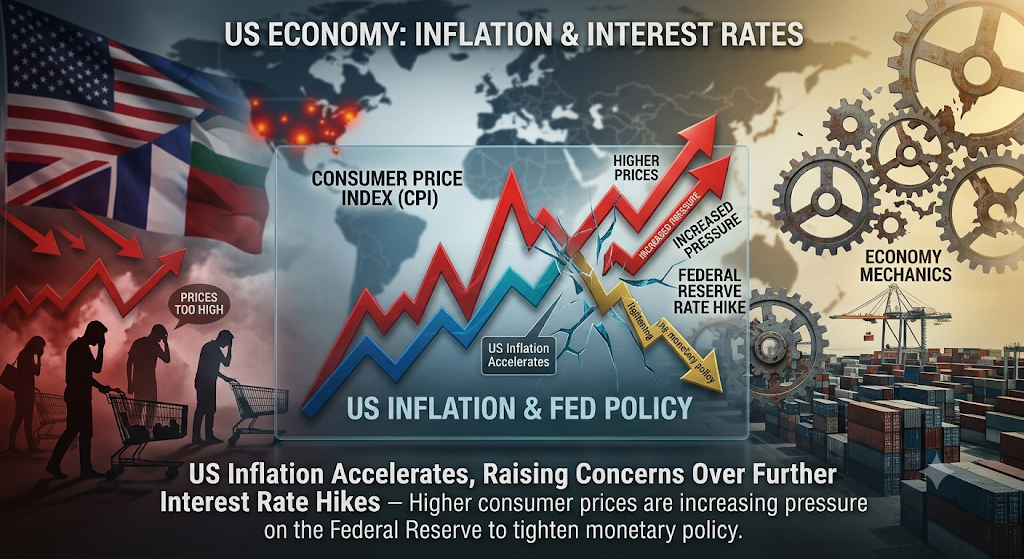
United States economy is facing renewed pressure as consumer prices keep climbing, which brings new challenges for policymakers and financial markets. The latest inflation numbers have made many worry that the Federal Reserve might have to keep a monetary policy or add more rate hikes to tame inflation.
Prices for goods and services such as food, energy, housing, transportation and healthcare are rising, putting strain on American households and businesses. Even though United States economy has shown strength through consumer spending and business investment steady inflation makes the economic outlook uncertain. Raises questions about the path of monetary policy, in the months ahead.United States economy is facing renewed pressure as consumer prices keep climbing, which brings new challenges for policymakers and financial markets. The latest inflation numbers have made many worry that the Federal Reserve might have to keep a monetary policy or add more rate hikes to tame inflation.
Prices for goods and services such as food, energy, housing, transportation and healthcare are rising, putting strain on American households and businesses. Even though United States economy has shown strength through consumer spending and business investment steady inflation makes the economic outlook uncertain. Raises questions about the path of monetary policy, in the months ahead.
Inflationary Pressures Show Signs of Persistence
The US Bureau of Labor Statistics said that the Consumer Price Index went up by 0.4% in October 2026. This was after a 0.6% rise in September. The Consumer Price Index is a way to measure how much prices for items are changing. Food prices went up by 0.5% in October. Energy prices also went up by 0.7%. The cost of housing continued to go up. Housing costs made up than 30% of the increase in prices for all items.
Core inflation, which means prices for everything except food and energy went up by 0.3% in October. This shows that rising prices are not just coming from things like oil and groceries.
The numbers show that inflation is still a problem even after the central bank tried to make it better by changing interest rates. Higher gas prices, problems with how productsre made and sent to stores, taxes, on imports and people still buying a lot of things are all making prices go up.
Federal Reserve Faces a Difficult Policy Decision
The Federal Reserve now has the job of balancing price stability with sustainable economic growth. Raising interest rates can help bring down inflation. When rates go up borrowing becomes more expensive. People spend less. Businesses invest less. This can help calm pressures.. Going too far with rate hikes can hurt the economy. It can slow down growth increase unemployment and make life harder for companies.
At its meeting on October 28 2026 the Federal Open Market Committee kept the funds rate steady at 3.75% to 4.00%. The committee said it needed time to review new economic data before deciding what to do next. This cautious move showed that they were not ready to act
Still there are growing disagreements among Federal Reserve officials. Many are worried that inflation is not going away. Some believe more rate increases could be needed. Dallas Federal Reserve President Lorie Logan has said the Fed should consider least two more quarter-percentage-point hikes. Her comments show that the debate inside the institution is heating up.
Because of these tensions the Federal Reserve’s December policy meeting will draw a lot of attention. Investors, businesses and economists will all be watching closely. They want to know if the Fed will continue its path or take stronger action to control inflation. The next few weeks could be a turning point, for the economy.
Impact on Consumers and American Households
I see how American households feel the sting of rising inflation as households purchasing power shrinks and financial pressure grows. Grocery bills climb, housing costs rise utility bills grow, insurance premiums increase and transportation charges add to the strain on household budgets.
I notice that lower- and middle-income families are especially vulnerable because a larger share of lower- and middle-income families income is spent on essentials. When wages increase persistent price rises can cut the real value of earnings and limit how much lower- and middle-income families can save.
I worry that higher interest rates could add challenges for consumers making mortgages, automobile loans, personal loans and credit‑card borrowing more expensive. As a result American households may cut spending hurting sectors such, as retail, hospitality, entertainment and consumer services.
Financial Markets and Business Investment Under Pressure
Inflation concerns are also affecting markets. When people expect interest rates to rise further it can cause bond yields to go up. This can lead to ups and downs in stock markets and changes in the value of the US dollar.
Companies that borrow a lot of money may have to pay more to finance their operations. This could mean delaying plans to grow, invest in infrastructure or hire more people. Medium-sized businesses might struggle more because they usually have less money to fall back on when borrowing and operating costs go up.
At the time investors are expected to stay careful. They are watching closely to see if high interest rates will last for a time. Different types of companies will feel the impact differently. Technology firms, real estate companies, financial institutions and businesses that sell to consumers may each be affected in ways. The way these companies are financed and how they make money will play a role, in how hard they are hit.
Global Economic Implications
The Federal Reserve’s monetary policy decisions extend beyond the United States. As the US dollar remains a major international reserve and trade currency, changes in American interest rates can influence global capital flows, exchange rates, and borrowing costs.
Higher US interest rates may encourage international investors to move capital towards dollar-denominated assets. This can place pressure on emerging-market currencies and increase the cost of servicing foreign-currency debt.
Developing economies, particularly those dependent on imported energy, commodities, and external financing, may face additional economic challenges. Central banks in these countries could also come under pressure to maintain relatively high interest rates to protect currency stability and manage imported inflation.
The Road Ahead: Balancing Inflation Control and Economic Growth
The coming months will be crucial in determining whether inflation in the United States begins to moderate or requires further monetary intervention. The Federal Reserve will closely monitor employment figures, consumer spending, wage growth, energy prices, and inflation expectations before making additional policy decisions.
A prolonged period of elevated interest rates could slow economic growth, weaken consumer confidence, and discourage business investment. Conversely, allowing inflation to remain persistently high could undermine purchasing power and create longer-term economic instability.
Policymakers must therefore adopt a measured approach that addresses inflation without unnecessarily damaging economic momentum. Improving supply-chain efficiency, encouraging productivity, supporting energy diversification, and maintaining predictable economic policies will also be important in addressing the underlying sources of price increases.
The Worldonomics Times Views
The resurgence of inflation in the United States serves as a reminder that controlling price stability remains one of the most complicated challenges in modern economic management. Although the Federal Reserve has several monetary policy instruments available, interest rate adjustments alone cannot resolve every source of inflation, particularly when supply disruptions, geopolitical developments, and structural cost pressures are involved.
The challenge ahead will be to strike the right balance between controlling inflation and preserving economic growth. Excessively aggressive tightening could weaken employment and investment, while insufficient action could allow inflationary expectations to become deeply embedded in the economy.
The Federal Reserve’s upcoming decisions will have implications not only for American households and businesses but also for international financial markets and emerging economies. Ultimately, the stability of the US economy will depend on the ability of policymakers to respond effectively to inflation while maintaining confidence in long-term economic prospects.