By The Worldonomics Times
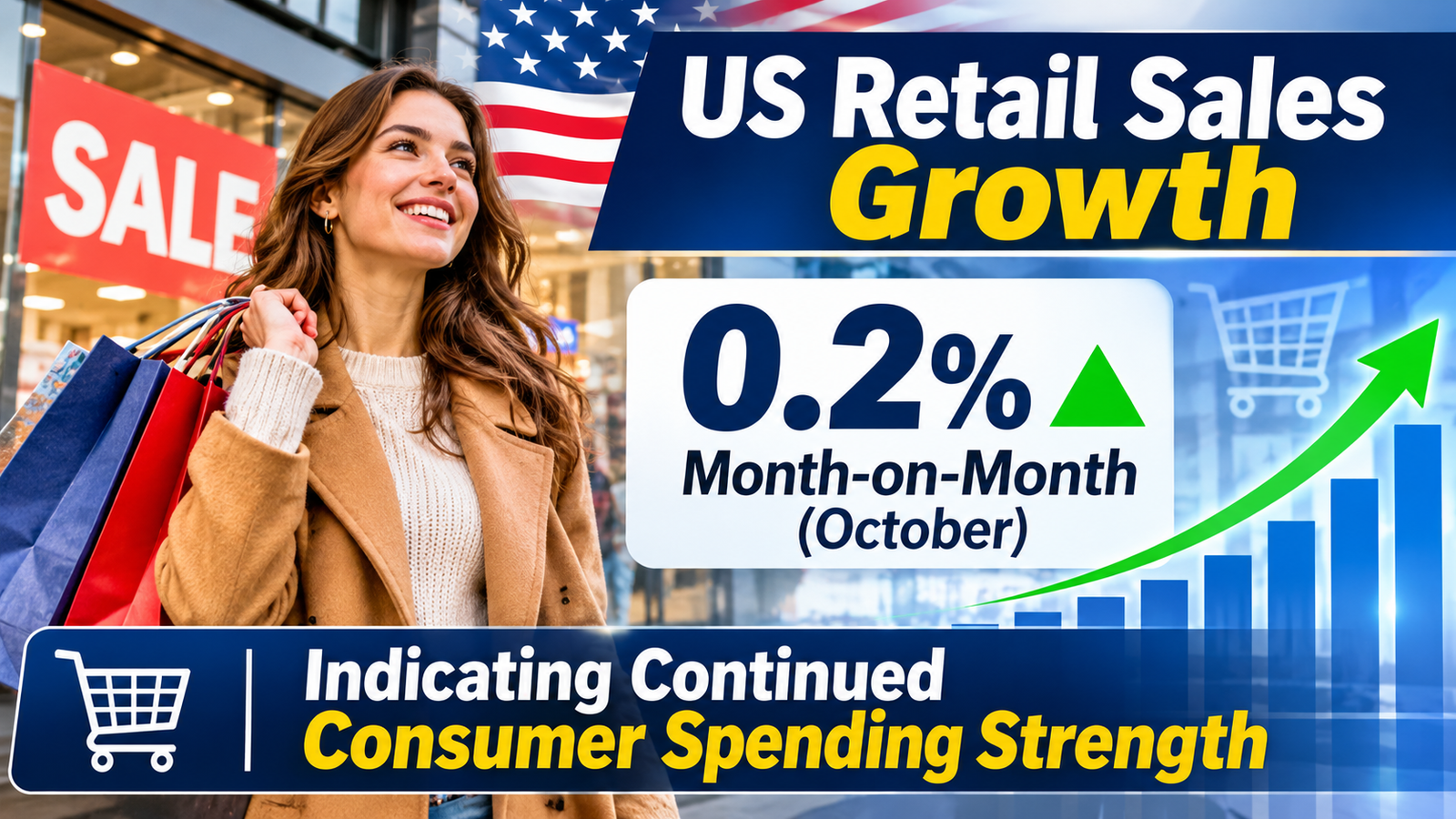
Consumer spending in the United States continued to expand in October 2026, indicating that households are still supporting economic activity despite elevated prices and uncertainty about the economic outlook. According to the latest report from the US Census Bureau, retail and food services sales increased by 0.2% month-on-month, reaching approximately $748.2 billion.
Although the increase was slower than September’s 0.8% growth, the latest figures suggest that consumer demand has not weakened significantly. The performance is particularly important because household consumption represents a major component of the US economy. However, differences between retail categories and continuing pressure on household budgets indicate that consumer confidence and spending patterns remain uneven.
Retail Sales Record Moderate Growth
The US Census Bureau released its advance retail sales estimates on November 17, 2026. The report showed that total retail and food services sales increased by 0.2% in October compared with the previous month. Sales were also 6.8% higher than in October 2025.
September’s increase remained at 0.8%, while the August-to-October period recorded sales growth of 6.4% compared with the corresponding period a year earlier.
However, the Census Bureau cautioned that the 90% confidence interval for October’s monthly increase includes zero. This means there is insufficient statistical evidence to conclude that the actual monthly change was different from zero. The figures are also not adjusted for price changes, meaning that higher prices can contribute to an increase in reported sales even when the volume of goods purchased changes less significantly.
These details suggest that the latest report should be viewed as evidence of broadly sustained spending rather than proof of a strong acceleration in consumer demand.
Spending Patterns Differ Across Retail Categories
The October report revealed considerable differences across retail sectors. Spending at motor vehicle and parts dealerships declined by 1.6%, while furniture store sales fell by 2.3%. Electronics and appliance sales remained unchanged, reflecting more cautious purchases of certain expensive household products.
In contrast, non-store retailers, including online businesses, recorded a 1.2% increase. Sales at gasoline stations rose by 1.5%, while food services and drinking places reported a modest increase of 0.2%.
An especially important indicator was the performance of the retail control group, which excludes automobiles, gasoline, building materials and food services. This measure increased by 0.6% in October, following an upwardly revised 0.5% increase in September.
The control group is closely monitored because it provides an indication of consumer spending that feeds into the calculation of gross domestic product. Its performance suggests that underlying retail activity remained relatively firm even as purchases of certain big-ticket products weakened.
Inflation Continues to Influence Household Budgets
Despite continued spending, American consumers are facing financial pressure from higher living costs. Rising prices for groceries, fuel, housing-related expenses and other essential products have reduced the purchasing power of many households.
Retail sales figures are not adjusted for inflation, so their growth does not necessarily indicate an equivalent increase in the quantity of goods purchased. When prices rise, consumers may spend more money simply to maintain their existing consumption levels.
Recent economic reporting has also highlighted differences in spending capacity between higher-income and lower-income households. Wealthier consumers may have greater financial reserves and investments to support their purchases, while households with limited savings can be more affected by rising prices and borrowing costs.
Credit card borrowing is another concern. Greater dependence on credit can help households maintain spending temporarily, but it may create financial difficulties if interest expenses increase or employment conditions weaken.
Retail Performance and the US Economic Outlook
Consumer spending plays a central role in determining the direction of the US economy. Strong household demand supports retail businesses, manufacturing, transportation, hospitality and other service industries.
The October retail sales report provides some reassurance that consumer activity remains active at the beginning of the fourth quarter. The 0.6% increase in the retail control group is particularly relevant because it indicates continued spending across several important categories.
However, the slower headline growth compared with September suggests that momentum may be moderating. Higher prices, cautious purchases of expensive products and changing household financial conditions could influence spending during the coming months.
The holiday shopping season will be an important test of consumer demand. Retailers are likely to focus on discounts, promotions and online sales to attract customers. Strong seasonal spending could support business revenues, although consumers may remain selective about discretionary purchases.
Implications for the Federal Reserve
The Federal Reserve closely monitors consumer spending because demand influences economic growth, employment and inflation.
If household spending remains strong while supply conditions are constrained, businesses may find it easier to pass higher costs on to consumers. This can make inflation more persistent and complicate monetary policy decisions.
The October retail sales figures therefore provide another important indicator for policymakers. The stronger control-group performance suggests that underlying demand remains active, while the modest headline increase and uncertainty around the estimate point to a more cautious interpretation.
The Federal Reserve must balance the need to control inflation with the risk of weakening economic activity through higher borrowing costs. Future decisions will depend on a broader range of indicators, including employment, wages, inflation and household income.
Implications for India
The performance of the US consumer market is important for India because the United States is one of its major trading partners and an important destination for Indian exports.
Continued American consumer spending can support demand for Indian products and services, particularly pharmaceuticals, textiles, engineering goods, jewellery and information technology services. A stable US economy can also support international investment and business confidence.
However, slower spending or changes in American household priorities could affect Indian exporters, particularly those dependent on discretionary consumer demand. Changes in US monetary policy may also influence international capital flows, currency movements and financing conditions for emerging markets.
For India, maintaining export competitiveness, diversifying overseas markets and strengthening domestic consumption can help reduce dependence on economic developments in any single country.
The Worldonomics Times View
The 0.2% increase in US retail sales during October reflects an economy in which consumer spending continues to provide support, but the pace of growth has moderated. The stronger performance of the retail control group is encouraging, although the statistical uncertainty surrounding the headline figure and the impact of inflation should not be overlooked.
The coming holiday shopping season will offer a clearer indication of whether households remain willing and financially able to sustain spending. Retailers will need to respond to changing consumer priorities through competitive pricing, efficient operations and flexible sales strategies.
For policymakers, the priority should be to monitor inflation and employment alongside consumer demand rather than relying on a single monthly indicator. For businesses, understanding differences in spending patterns across income groups and product categories will be essential.
For India, stable US consumer demand can provide opportunities for exporters and service providers, while changes in American economic conditions remain an important external risk.
Ultimately, consumer spending will continue to play a decisive role in the US economic outlook. The challenge will be to sustain demand while ensuring that household purchasing power and financial stability are not weakened by persistent inflation.