India’s Crude Oil Dependency: A Structural Economic Challenge
Abstract
India’s growing dependence on crude oil imports has emerged as a major structural economic challenge, influencing inflation, fiscal stability, external balances, and long-term economic growth. As one of the world’s largest energy consumers, India imports a significant portion of its crude oil requirements, making the economy vulnerable to global oil price volatility and geopolitical disruptions.
Rising crude oil prices not only increase the country’s import bill but also exert pressure on the current account deficit, currency stability, transportation costs, and overall inflation. These effects can, in turn, influence industrial productivity, corporate profitability, household consumption, and financial markets.
This article examines the broader macroeconomic implications of India’s crude oil dependence and its impact on GDP growth, fiscal management, currency stability, and financial markets. It also analyses how sustained increases in energy prices can reduce economic competitiveness and weaken growth momentum in an emerging economy like India.
The article further highlights the need for diversification of energy sources and explores alternative and sustainable energy solutions such as solar energy, wind power, green hydrogen, biofuels, natural gas, electric mobility, and nuclear energy. Strengthening renewable energy infrastructure, improving energy efficiency, and reducing import dependence are essential for enhancing India’s energy security and supporting sustainable long-term economic development in an increasingly uncertain global energy environment.
Introduction
Crude oil remains one of the world’s most strategically important commodities, influencing inflation, transportation costs, currency stability, fiscal balances, and global economic growth. For emerging economies like India, fluctuations in oil prices have far-reaching implications for households, businesses, government finances, and financial markets.
India’s economic growth story over the last two decades has been remarkable. However, one major structural vulnerability continues to influence inflation, fiscal stability, foreign exchange reserves, and the overall macroeconomic environment—crude oil imports.
As the world’s third-largest crude oil importer, India remains heavily dependent on overseas energy supplies to meet its domestic consumption requirements. According to Petroleum Planning & Analysis Cell (PPAC) data, India’s oil import dependency has now reached nearly 88% of total crude consumption.
This dependence makes India particularly sensitive to movements in global crude prices. Any sustained increase in oil prices can quickly transmit into the broader economy through higher transportation and production costs, increased inflationary pressures, a larger import bill, and pressure on the rupee.
The issue, therefore, is not simply the price of crude oil itself. It is the wider economic impact of India’s dependence on imported energy.
India’s Long-Term Oil Burden: Lessons from the Past
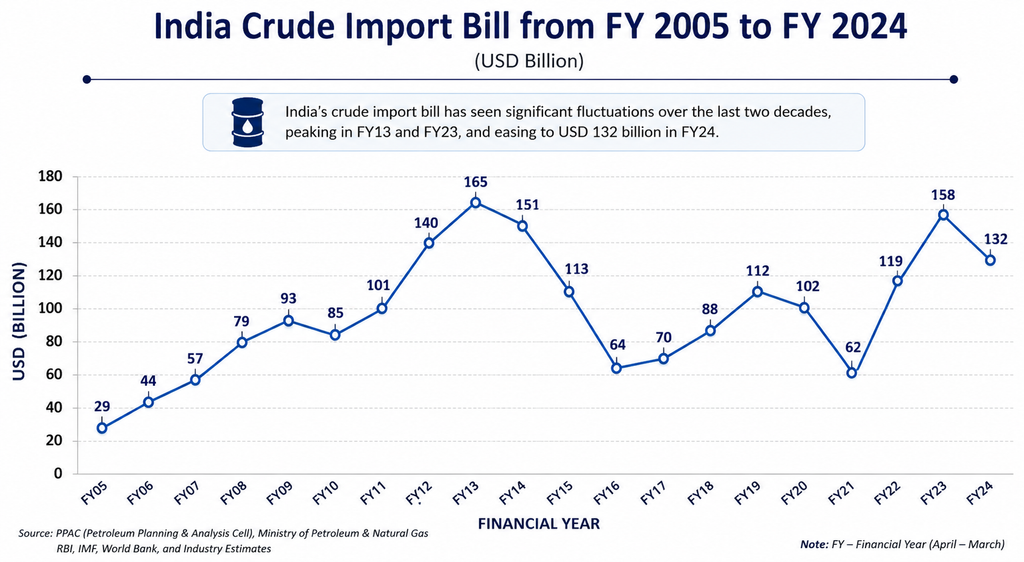
Between FY2005 and FY2024, India’s crude oil import bill witnessed sharp fluctuations depending on global Brent crude prices.
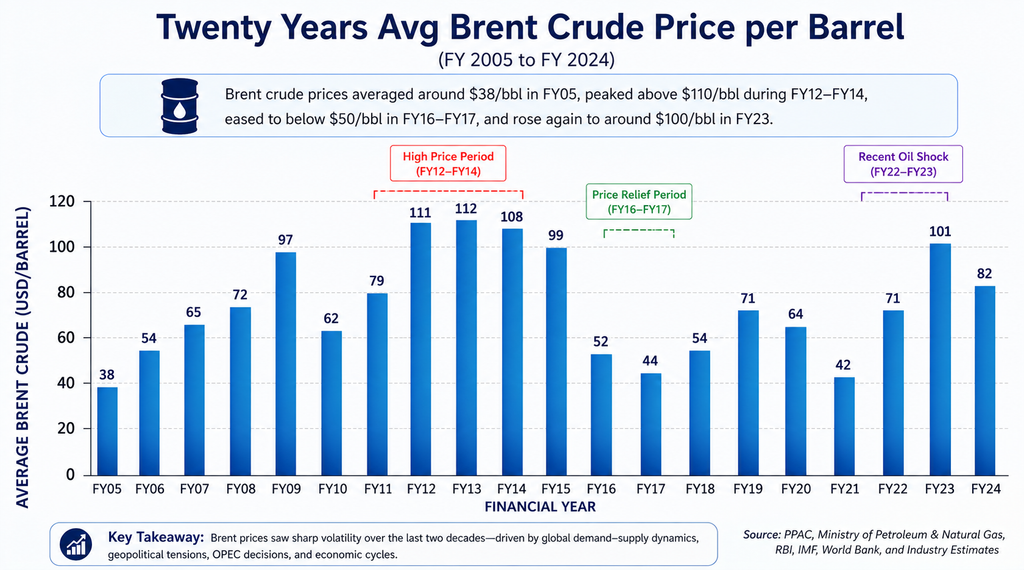
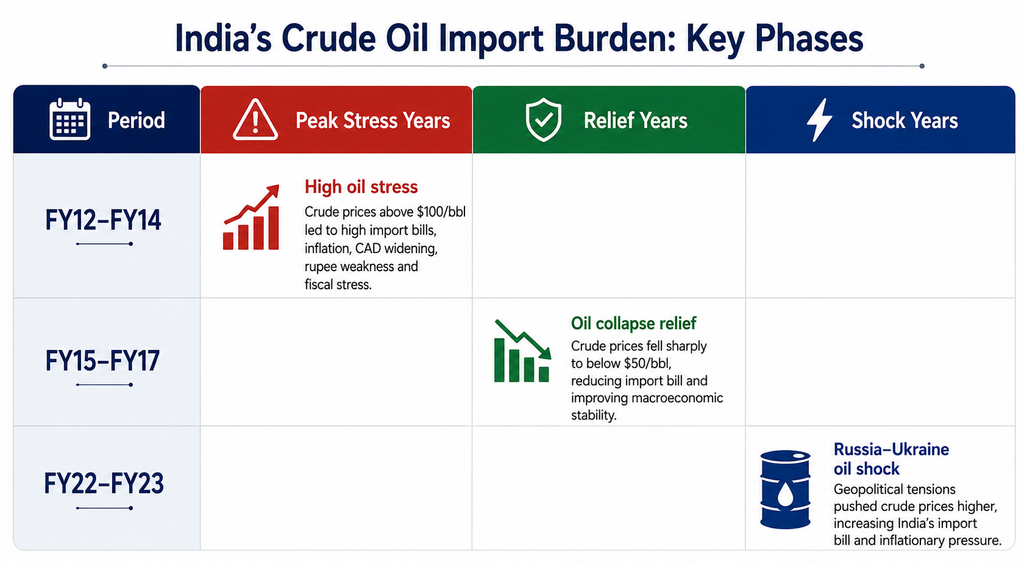
Periods of elevated crude oil prices have historically created significant macroeconomic challenges for India. One of the most difficult phases occurred between FY2012 and FY2014, when international crude prices remained elevated for an extended period.
FY2012–FY2014: A Period of Severe Oil Pressure
At that time:
- Brent crude prices remained above $100 per barrel for multiple years.
- India’s crude oil import bill rose to nearly $140–165 billion annually.
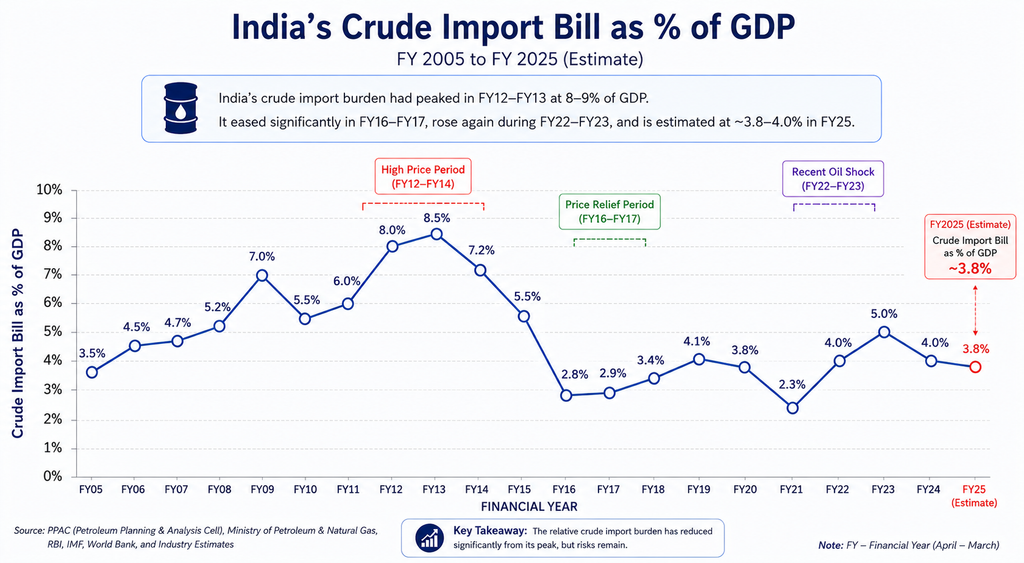
- The crude import burden touched approximately 8–9% of GDP.
The Economic Consequences Were Significant
The impact was reflected in:
- Higher inflation
- A widening current account deficit
- Rising fuel subsidy requirements
- Rupee depreciation
- Increased fiscal stress on the government
The period eventually contributed to India being categorised among the so-called “Fragile Five” emerging economies, reflecting concerns over external vulnerability and dependence on foreign capital inflows.
Source: PPAC, Ministry of Petroleum & Natural Gas, RBI, IMF, World Bank, and industry estimates.
Why Oil Dependency Matters?
India’s crude oil dependence is no longer merely an energy concern. It directly influences inflation, fiscal stability, currency strength, foreign exchange reserves, capital flows, and long-term economic resilience.
However, India’s vulnerability has not remained unchanged. The experience of the last decade shows that lower global oil prices, stronger foreign exchange reserves, economic diversification, and structural policy measures can significantly improve the country’s ability to absorb external oil shocks.
FY2015–FY2017: The Relief Phase
A major turning point came after the collapse in global crude prices during 2014–15.
Brent crude declined sharply from above $100 per barrel to nearly $50 and below. Consequently:
- India’s crude oil import bill reduced substantially.
- Inflation cooled.
- The fiscal deficit improved.
- Foreign exchange reserves strengthened.
- Macroeconomic stability improved significantly.
India’s crude oil import bill fell from above $165 billion to nearly $64 billion in FY2016, creating a substantial positive impact on the economy.
This phase provided policymakers with fiscal breathing space and helped strengthen India’s overall economic resilience.
The episode also demonstrated how closely India’s macroeconomic conditions can be linked to global energy prices.
The Post-Pandemic Oil Shock: FY2021–FY2023
The COVID-19 pandemic temporarily reduced global oil demand, causing crude prices to collapse during FY2021.
However, the subsequent global economic recovery and the Russia–Ukraine conflict triggered another sharp rise in oil prices during FY2022 and FY2023.
India’s crude oil import bill again surged sharply:
- FY2022: approximately $119 billion
- FY2023: approximately $158 billion
Despite these elevated prices, India’s macroeconomic situation remained relatively more stable compared with the FY2012–FY2014 period.
Several factors contributed to this greater resilience:
- India’s GDP base had expanded significantly.
- Foreign exchange reserves were much stronger.
- Energy efficiency had improved.
- The services economy had become larger.
- Discounted Russian crude imports partially reduced import pressures.
The episode demonstrated that although India remains vulnerable to global oil shocks, its capacity to withstand such shocks has improved over time.
India’s Oil Vulnerability Has Reduced — But Risks Remain
Current Position: FY2025–26 and FY2026–27 Outlook
As of FY2025–26, India’s crude oil import burden remains relatively manageable compared with the severe stress witnessed during FY2012–FY2014.
Despite ongoing geopolitical uncertainties and supply-side disruptions across global energy markets, Brent crude prices have largely remained within the range of approximately $75–85 per barrel.
Based on current estimates:
- India’s crude oil import bill for FY2025–26 may remain in the range of approximately $130–145 billion.
- The crude import burden is expected to remain around 3.8–4.2% of GDP, significantly lower than during the peak stress years of FY2012–FY2014.
For FY2026–27, the outlook will largely depend on:
- Global geopolitical developments
- OPEC production decisions
- China’s economic recovery
- Global recession risks
- The pace of the renewable energy transition
- Rupee–US dollar exchange-rate stability
If crude oil prices remain stable and India continues to expand renewable energy, electric mobility, ethanol blending, and domestic manufacturing, the relative burden of crude oil imports on GDP may gradually decline over the long term.
However, any sustained rise in Brent crude prices above $100 per barrel could once again create:
- Inflationary pressures
- Current account stress
- Risks of rupee depreciation
- Fiscal challenges for the economy
Therefore, reducing structural dependence on imported energy remains one of India’s most important long-term economic priorities.
Why Crude Oil Matters So Much for India
Crude oil affects almost every sector of the Indian economy.
Higher oil prices increase:
- Transportation costs,
- Manufacturing expenses,
- Logistics inflation,
- Fertilizer subsidy burden,
- Current account deficit,
- Pressure on the Indian Rupee.
Economists broadly estimate that every sustained $10 increase in crude oil prices can:
- Increase India’s import bill by approximately $12–15 billion,
- Widen the current account deficit,
- Put pressure on inflation and interest rates,
- Reduce GDP growth moderately.
Sustained increases in crude oil prices can also significantly influence equity markets, corporate profitability, bond yields, investor sentiment, and the overall economy.
This is a concern across the world because higher energy prices, particularly when driven by supply disruptions, can hamper global economic growth.
Therefore, oil prices remain one of the most important external variables influencing India’s macroeconomic stability.
India’s Rising Energy Demand: The Structural Challenge
India’s long-term energy challenge is further amplified by rapidly rising domestic energy demand, driven by urbanisation, industrialisation, infrastructure expansion, and increasing vehicle ownership.
As economic activity expands, the country’s overall energy requirement is also expected to increase.
Even as renewable energy adoption accelerates, India’s growing economy will continue to require substantial energy imports for many years to come.
This creates a fundamental challenge: India needs more energy to sustain economic growth, but continued dependence on imported fossil fuels exposes the economy to global price volatility and geopolitical risks.
The long-term objective, therefore, should not necessarily be to eliminate oil consumption immediately, but to gradually reduce the relative economic burden and vulnerability associated with imported energy.
Policy Measures Taken by India
Over the years, India has undertaken several structural measures to reduce its vulnerability to oil shocks, including:
- Expansion of strategic petroleum reserves
- Ethanol blending initiatives
- Direct benefit transfer reforms
- Rationalisation of fuel subsidies
- Promotion of electric vehicles
- Renewable energy expansion
- Diversification of crude oil import sources
These measures have helped improve India’s ability to withstand external oil shocks compared with the past decade.
The diversification of crude import sources is particularly important because energy security depends not only on the quantity of energy available but also on the reliability and diversity of supply.
The Importance of Responsible Consumption
Energy security is not solely a responsibility of governments and businesses. Consumer behaviour also plays an important role.
In recent years, policymakers and national leadership have repeatedly encouraged responsible economic behaviour among citizens.
Small collective actions can create meaningful long-term macroeconomic benefits, including:
- Greater use of public transport and metro systems
- Reduction in unnecessary fuel consumption
- Support for domestic manufacturing
- Reduction in non-essential imports
- Promotion of “Vocal for Local” initiatives
These measures are not merely symbolic appeals; they also have significant economic implications for:
- Foreign exchange conservation
- Trade deficit management
- Domestic employment generation
- Long-term economic resilience
When millions of individuals and businesses make more efficient use of energy and reduce unnecessary consumption, the cumulative economic impact can become meaningful.
The Road Ahead: Towards Greater Energy Security
India’s long-term solution lies in a combination of energy diversification, technological transition, and greater efficiency.
Key priorities include:
- Energy diversification
- Renewable energy expansion
- Electric mobility
- Domestic manufacturing growth
- Strategic petroleum reserves
- Improved public transportation infrastructure
- Greater energy efficiency
India has significantly accelerated investment in renewable energy, ethanol blending, solar infrastructure, electric mobility, and green hydrogen initiatives to gradually reduce its long-term dependence on imported fossil fuels.
These structural transitions may play a critical role in improving India’s external stability over the coming decades.
While crude oil dependence cannot disappear immediately, reducing the relative burden of imported energy on GDP will remain one of India’s most important economic priorities.
The transition will require sustained investment, technological innovation, infrastructure development, and consistent policy support.
A strong economy is not built solely through policy reforms. It is also shaped by millions of responsible economic decisions taken by citizens and businesses every day.
Small but responsible economic decisions taken today can contribute significantly to building a stronger, more resilient, and economically self-reliant India in the decades ahead.
What Crude Oil Means for Investors
For investors, crude oil should not be viewed merely as a global commodity price indicator. It is a critical macroeconomic variable capable of influencing several important financial-market factors.
Changes in crude oil prices can affect:
- Equity market sentiment
- Corporate profitability
- Interest-rate cycles
- Currency movements
- Inflation trends
- Asset-allocation strategies
Higher oil prices can increase input and transportation costs for many businesses, potentially affecting profit margins. At the same time, persistent inflationary pressure can influence interest rates and bond yields.
A weaker rupee resulting from higher import costs can further amplify the impact on the domestic economy.
Therefore, investors should consider energy prices as part of the broader macroeconomic environment rather than viewing them in isolation.
In an increasingly uncertain global environment, long-term investors may benefit from closely monitoring energy prices, geopolitical developments, inflation cycles, and policy responses while maintaining diversified and disciplined investment portfolios.
The objective is not to predict every movement in crude oil prices, but to understand how energy shocks can influence the broader economic and investment environment.
Conclusion
For a rapidly growing economy like India, energy security is no longer merely an energy issue—it is a strategic economic imperative that directly influences inflation, interest rates, fiscal stability, currency strength, and overall economic resilience.
History clearly demonstrates that periods of elevated crude oil prices have often coincided with higher inflation, widening current account deficits, currency volatility, and increased pressure on financial markets.
Conversely, periods of lower oil prices have generally supported macroeconomic stability, improved fiscal health, stronger foreign exchange reserves, and better investor confidence.
India’s ability to withstand oil shocks has improved over time, supported by a larger and more diversified economy, stronger foreign exchange reserves, greater energy efficiency, diversified sources of crude imports, and structural policy measures.
Nevertheless, the fundamental vulnerability remains because India continues to depend significantly on imported energy.
For investors, crude oil should therefore be regarded as a critical macroeconomic variable capable of influencing equity markets, corporate profitability, interest rates, currency movements, inflation, and asset-allocation decisions.
India’s long-term economic resilience will ultimately depend not only on GDP growth but also on how effectively the nation manages its external energy dependence through structural reforms, renewable energy expansion, domestic manufacturing, energy efficiency, and technological innovation.
For a nation aspiring to become a global economic powerhouse, reducing excessive dependence on imported energy will remain one of the most important pillars of sustainable long-term growth.
India’s energy transition will not happen overnight. But a gradual reduction in energy vulnerability, combined with responsible consumption and sustained investment in alternative energy sources, can help create a stronger, more resilient, and more self-reliant economy for the decades ahead.
Disclaimer
The figures and macroeconomic trends mentioned in this article are approximate estimates compiled from publicly available sources, including PPAC (Petroleum Planning & Analysis Cell), the Ministry of Petroleum & Natural Gas, RBI publications, World Bank databases, IMF data, and industry reports.
This article is intended solely for educational, analytical, and informational purposes and should not be construed as investment, policy, or economic advice. Investors are advised to consult their financial advisor before making any investment decisions.
The above article was previously published in the October 2026 edition of The Worldonomics Times.
About the Author
CMA (Dr.) R. K. Mohapatra, Founder of NextZen Wealth, Certified Retirement Advisor, Financial Consultant, Editorial Board Member of The Worldonomics Times, and Author.
Key Reference Sources
- PPAC India
- Ministry of Petroleum & Natural Gas
- RBI Reports
- World Bank Data
- IMF Data
- FY2024 import-bill references from Economic Times and Business Standard