By Worldonomics Times | Global Economy
Date: October 27, 2026
Introduction
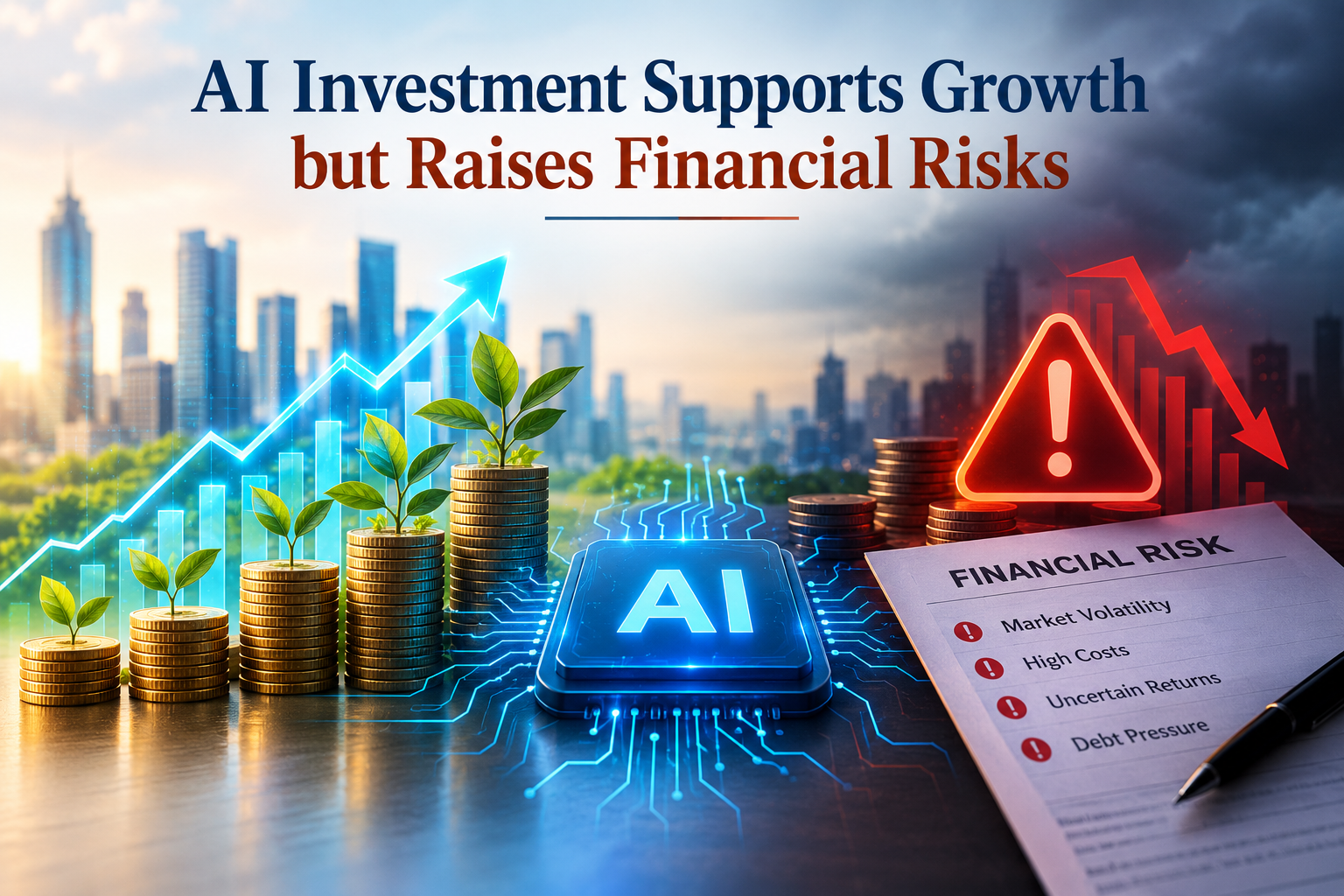
Artificial intelligence (AI) is becoming a major driver of global economic activity, attracting billions of dollars in investment across data centres, advanced semiconductors, cloud computing and digital infrastructure. The rapid expansion of AI technologies is supporting business investment, creating new commercial opportunities and strengthening expectations of productivity growth. However, growing dependence on the AI investment boom is also raising concerns about financial stability.
The International Monetary Fund (IMF), in its October 2026 Global Financial Stability Report, has warned that weaker-than-expected AI investment or disappointing profitability could trigger a correction in AI-related asset prices. Such a downturn could have wider consequences for financial markets, particularly as borrowing and concentrated investment exposures increase across parts of the AI ecosystem. <Cite refs={[“turn482677search0″,”turn482677search2”]}/>
The central challenge for the global economy is to benefit from AI-driven innovation while ensuring that excessive optimism does not create new financial vulnerabilities.
AI Investment Becomes a Major Growth Driver
Investment in artificial intelligence has expanded beyond software development into large-scale physical infrastructure. Technology companies are spending heavily on computing facilities, specialised chips, electricity systems and high-capacity data networks to support the growing demand for AI services.
This investment generates economic activity across multiple industries. Construction companies build data centres, semiconductor manufacturers expand production, energy providers supply electricity, and telecommunications businesses upgrade their networks. Professional services and technology firms also benefit from rising demand for AI-related products and expertise.
For businesses, AI offers opportunities to automate repetitive tasks, improve decision-making, analyse large datasets and enhance customer services. If these technologies deliver sustained productivity improvements, they could help companies reduce costs and increase output over time.
The IMF has noted that strong investment in AI-related firms has helped support economic activity and financial markets amid geopolitical tensions and broader policy uncertainty. Nevertheless, the long-term benefits will depend on whether companies can convert their substantial investments into sustainable revenues and profits. <Cite refs={[“turn482677search2″,”turn482677search5”]}/>
IMF Warns of a Potential Market Correction
Despite the optimism surrounding AI, the IMF has identified a potential correction in AI-related asset prices as a significant financial risk. Investors have committed substantial capital to companies expected to benefit from the technology, often on the assumption that future demand and profitability will remain strong.
However, technological progress does not automatically guarantee commercial success. AI services may become cheaper to develop, competition could intensify, and businesses may take longer than expected to generate sufficient returns on their investments.
If revenue growth falls short of expectations, investors could reassess company valuations and reduce their exposure to AI-related stocks. A sudden decline in share prices could affect investor confidence and encourage broader selling across financial markets.
The risk is not necessarily that AI will fail as a technology. Instead, the concern is that financial markets may have priced in benefits that prove slower to materialise or smaller than anticipated. <Cite refs={[“turn482677search3″,”turn482677search5”]}/>
Rising Debt Adds to Financial Vulnerabilities
Another concern is the growing role of debt in financing AI infrastructure. Building and operating large data centres requires substantial upfront spending, while the commercial returns may take years to emerge.
Borrowing can support productive investment, but excessive debt increases the pressure on companies to generate reliable cash flows. If AI demand weakens or financing costs rise, heavily indebted businesses may find it more difficult to service their obligations.
The IMF has also highlighted the potential risks associated with concentrated exposures and circular financing arrangements within the AI ecosystem. Financial connections between technology companies, investors and infrastructure providers could transmit difficulties from one part of the sector to another.
If a major company faces financial distress, its suppliers, lenders and investment partners could experience losses. Forced asset sales and tighter lending conditions could then amplify market volatility and affect businesses beyond the technology industry. <Cite refs={[“turn482677search2″,”turn482677search5”]}/>
Implications for the Global Economy
A sharp slowdown in AI investment could have consequences extending well beyond stock markets. Data centres, semiconductor manufacturing and related infrastructure have become important sources of capital expenditure in several major economies.
If technology companies reduce their spending, suppliers could experience lower demand, construction projects might be delayed, and employment growth in related industries could weaken. A decline in share prices could also reduce household and institutional wealth, potentially discouraging consumer spending and investment.
Emerging markets could face indirect effects through international capital flows, technology supply chains and changes in investor sentiment. Economies closely connected to global technology production or financial markets may be particularly sensitive to a sudden reversal in investment.
These risks do not mean a market correction is inevitable. Rather, they underline the importance of understanding how concentrated investments and financial linkages can magnify an otherwise manageable adjustment. <Cite refs={[“turn482677search3″,”turn482677search6”]}/>
The Role of Governments and Financial Regulators
Governments and regulators must strike a balance between encouraging innovation and safeguarding financial stability. Clear disclosure of corporate debt, investment commitments and financial exposures can help investors assess risks more accurately.
Financial regulators should also monitor excessive leverage, concentrated lending and the connections between banks and non-bank financial institutions. Stress testing can help identify vulnerabilities before market conditions deteriorate.
At the same time, policymakers should avoid measures that unnecessarily restrict productive investment. AI has the potential to improve efficiency across healthcare, manufacturing, education, finance and public services. Effective regulation should support responsible innovation while discouraging excessive risk-taking.
Businesses also have a responsibility to evaluate AI projects on realistic commercial assumptions, maintain sustainable financing structures and demonstrate measurable returns rather than relying solely on market enthusiasm.
The Worldonomics Times View
Artificial intelligence represents an important opportunity to reshape the global economy, improve productivity and create new industries. However, the scale of investment and the growing financial connections surrounding AI make it essential to distinguish genuine economic value from speculative expectations.
The priority should not be to slow technological progress, but to ensure that investment remains financially sustainable. Companies must focus on practical applications, dependable revenues and long-term productivity gains, while investors should assess risks carefully rather than assuming that every AI-related business will succeed.
For governments and regulators, transparency, responsible lending and effective financial supervision will be critical to limiting the impact of a potential market correction.
The future of AI investment will ultimately depend not only on technological breakthroughs, but also on the ability of businesses and financial markets to turn innovation into sustainable economic value.