By The Worldonomics Times
Category: Global Economy & International Financial Markets | November 2026
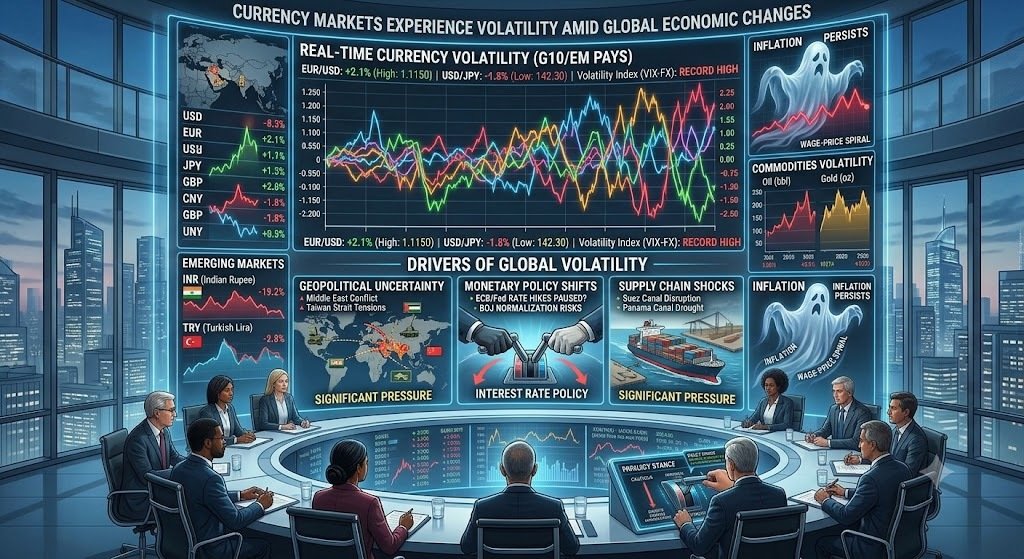
Currency markets across the world are experiencing changing conditions as investors respond to shifting economic growth, inflation trends, interest rate expectations and geopolitical developments. Exchange rates play a critical role in international trade, investment and financial stability, making currency movements an important indicator of broader economic conditions.
Major currencies such as the US dollar, euro, British pound, Japanese yen and Chinese yuan are closely monitored by governments, businesses and financial institutions. Movements in these currencies can influence import and export costs, international investment decisions, commodity prices and the financial position of emerging economies.
As global economic conditions continue to evolve, currency markets remain sensitive to monetary policy decisions, trade developments and changes in investor confidence.
Interest Rate Policies Influence Currency Movements
Interest rate decisions by central banks are among the most important factors affecting currency markets. Higher interest rates can make investments in a particular currency more attractive because investors may receive better returns on deposits and interest-bearing assets.
For example, monetary policy decisions by the US Federal Reserve can influence demand for the US dollar. Changes in US interest rate expectations may also affect currencies in Europe, Asia and emerging markets.
Similarly, decisions by the European Central Bank, Bank of England and Bank of Japan can influence the value of their respective currencies.
However, exchange rates do not depend on interest rates alone. Investors also consider inflation, economic growth, government debt and expectations about future policy decisions.
US Dollar Remains an Important Global Currency
The US dollar continues to hold a central position in international trade and finance. It is widely used in global commodity transactions, international lending and foreign exchange reserves.
Changes in the dollar’s value can have significant consequences for other economies. A stronger dollar may increase the cost of imported commodities and dollar-denominated debt for countries with weaker domestic currencies.
Emerging markets that depend heavily on imported energy, machinery or industrial raw materials may experience additional financial pressure when the dollar strengthens.
On the other hand, a weaker dollar can reduce some import costs for countries purchasing goods priced in US currency, although the overall impact depends on domestic economic conditions and trade structures.
Emerging Market Currencies Face External Pressures
Developing economies often experience greater currency volatility because their financial markets can be more sensitive to international capital movements.
When global investors become cautious, they may shift funds towards assets perceived as safer or more liquid. This can reduce demand for emerging market currencies and place pressure on their exchange rates.
Countries with large current-account deficits, high external debt or significant dependence on imported energy may be particularly exposed to these developments.
Currency depreciation can make exports more competitive in international markets, but it can also increase the cost of imports and contribute to domestic inflation.
Maintaining stable economic policies, adequate foreign exchange reserves and investor confidence is therefore important for emerging economies.
India’s Rupee and International Trade
India’s currency market is influenced by international oil prices, foreign investment flows, trade balances and monetary policy decisions by the Reserve Bank of India.
As a major importer of crude oil and several industrial commodities, India can face additional import costs when the rupee weakens against the US dollar.
Currency movements also affect Indian businesses engaged in international trade. Exporters may benefit from improved price competitiveness in certain circumstances, while import-dependent manufacturers can face higher expenses for machinery, technology and raw materials.
The RBI monitors foreign exchange market conditions and uses appropriate policy measures to support orderly market functioning and financial stability.
India’s expanding domestic economy and growing role in international trade provide opportunities to strengthen its position in global financial markets. However, maintaining macroeconomic stability remains essential.
Geopolitical Developments and Global Trade
Geopolitical tensions, trade restrictions and changes in international economic relationships can create uncertainty in currency markets.
When conflicts or trade disruptions affect major production and transportation regions, investors may reassess the risks associated with different currencies and economies.
Changes in tariffs and trade policies can also influence expectations regarding exports, imports and economic growth.
Countries with strong trade relationships and diversified economic structures may be better positioned to manage external uncertainty. However, sudden geopolitical developments can affect even well-established currencies.
Technology and Financial Market Developments
Digital trading platforms, electronic payment systems and advanced financial technologies are transforming currency markets. Investors and financial institutions can now access foreign exchange markets and analyse market information more efficiently.
Technology has improved transaction speed, market access and risk management capabilities. However, rapid trading activity can also contribute to short-term price fluctuations during periods of uncertainty.
Businesses increasingly use financial instruments such as forward contracts and currency options to manage exposure to exchange rate movements. These tools can help reduce uncertainty in international payments and business planning.
The Worldonomics Times View
At The Worldonomics Times, we believe that currency stability is an important foundation for sustainable international trade, investment and economic confidence.
Exchange rate movements are a natural feature of an interconnected global economy. However, excessive volatility can create difficulties for businesses, investors and households, particularly in economies that depend heavily on international trade and imported commodities.
Governments and central banks should prioritise credible economic policies, transparent communication and responsible financial management. Emerging economies should also strengthen foreign exchange reserves, diversify their export markets and develop deeper domestic financial systems.
Businesses must improve their understanding of currency risks and adopt appropriate financial planning strategies to protect themselves against unexpected exchange rate changes.
The Worldonomics Times believes that resilient currency markets depend on sound economic fundamentals, responsible monetary policies and international financial cooperation.
Conclusion
Currency markets remain an important part of the global economic system, reflecting changes in interest rates, inflation, trade relationships and investor confidence.
As economic conditions continue to change, exchange rate movements will influence international businesses, emerging economies and financial markets.
Although currency volatility can create challenges, strong economic institutions, effective risk management and transparent policy decisions can help reduce uncertainty.
The long-term stability of global currency markets will depend on cooperation among central banks, governments and financial institutions, supported by balanced economic policies and sustainable international growth.