How Government-backed market-access initiatives can help small businesses move from local visibility to institutional and digital markets
New Delhi, November 2026: For India’s Micro, Small and Medium Enterprises (MSMEs), the biggest challenge is often not production but market access. A business may have a good product, competitive pricing and skilled manpower, yet struggle to find large buyers, participate in exhibitions, enter government procurement or build a strong digital customer base.
A combination of three government-backed initiatives — Procurement and Marketing Support (PMS), Government e-Marketplace (GeM), and the Trade Enablement and Marketing (TEAM) Initiative — can provide MSMEs with a more comprehensive route to market expansion.
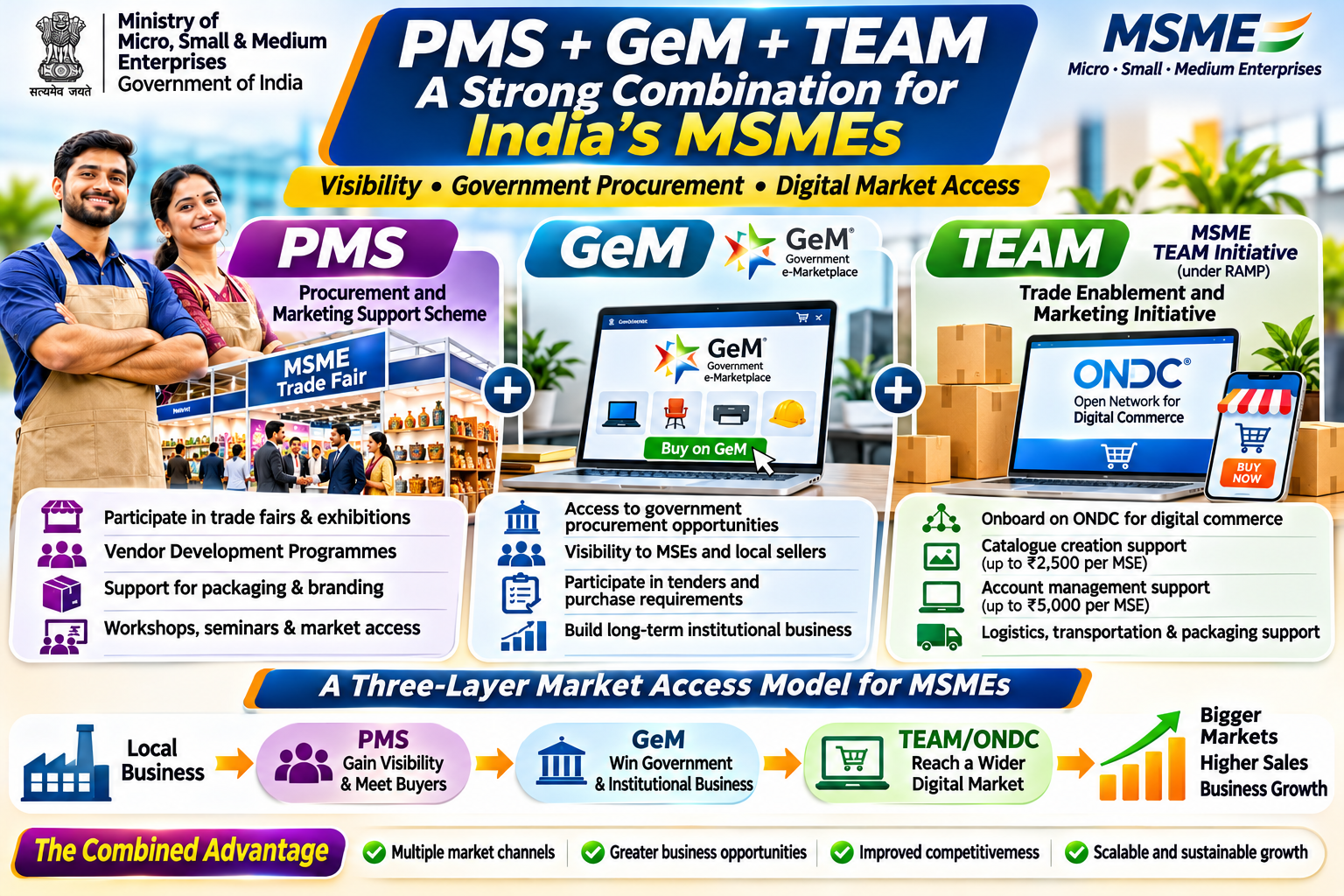
Each initiative addresses a different part of the market-access challenge. PMS helps enterprises improve visibility and participate in trade fairs and marketing activities; GeM provides access to government procurement; and TEAM helps micro and small enterprises build digital market presence through the Open Network for Digital Commerce (ONDC). Together, they can create a powerful ecosystem for MSME growth.
PMS: Building Visibility and Buyer Connections
The Procurement and Marketing Support Scheme is designed to enhance the marketability of products and services offered by MSEs. Its framework includes participation in domestic trade fairs and exhibitions, vendor development programmes, workshops and seminars, as well as support for areas such as modern packaging and market-access awareness. The scheme specifically recognises the importance of educating MSMEs about GeM and other market-access opportunities.
For a small enterprise, participating in a recognised exhibition can provide an opportunity to meet distributors, institutional buyers, government organisations, large companies and other potential customers.
PMS therefore represents the visibility and networking stage of the MSME growth journey.
The scale of implementation is also significant. The MSME Dashboard reported 949 domestic exhibitions and fairs under PMS as of 23 October 2026, demonstrating the continuing importance of physical market-development activities.
GeM: Entering the Government Procurement Market
Once an MSME has a market-ready product, professional packaging, proper documentation and the ability to supply consistently, Government e-Marketplace (GeM) can become an important sales channel.
GeM is India’s digital public procurement platform, connecting government buyers with registered sellers and service providers. Its framework provides visibility to MSEs and local sellers and enables buyers to consider credentials such as MSE status and past experience.
For an MSME, GeM can open the door to a large institutional market comprising government departments, public sector organisations and other eligible public buyers.
However, simply registering on GeM should not be considered the end of the process. An enterprise needs accurate product descriptions, competitive pricing, appropriate specifications, reliable delivery capability, proper tax and business documentation and strong post-sale service.
This is where PMS and GeM can complement each other.
An MSME may first use PMS-supported exhibitions and vendor development programmes to understand buyer requirements and improve its product presentation. It can then use GeM to participate in government procurement opportunities.
TEAM: Taking MSMEs into the Digital Market
The MSME Trade Enablement and Marketing (TEAM) Initiative, launched under RAMP, adds another dimension to this ecosystem.
TEAM was launched on 27 June 2024 with an outlay of ₹277.35 crore for 2024–27. Its objective is to help MSEs access new markets, expand their customer base and increase income through the ONDC network. The initiative targets approximately 5 lakh MSEs, with 50% of the targeted enterprises expected to be women-owned.
TEAM includes support for onboarding MSEs on ONDC, creation of ONDC-compliant catalogues, account-management support, logistics and transportation support, packaging assistance and packaging-design support.
The catalogue support is capped at ₹2,500 per MSE, while account-management support is capped at ₹5,000 per MSE, subject to the applicable guidelines.
For a small manufacturer or service provider, this can reduce some of the barriers associated with entering digital commerce.
Why PMS + GeM + TEAM Creates a Stronger Strategy
The real strength lies in using the three initiatives as complementary tools rather than treating them as independent schemes.
Consider a small manufacturer producing handicrafts, food products, engineering components, uniforms or specialised industrial products.
Step 1 — PMS: The enterprise improves packaging, participates in exhibitions and meets potential buyers.
Step 2 — GeM: After strengthening its product catalogue and supply capability, the enterprise registers and builds its presence on GeM to pursue government and institutional business.
Step 3 — TEAM: The same enterprise develops a digital catalogue and explores ONDC-enabled channels to reach a broader customer base.
The result is a multi-channel market strategy covering physical exhibitions, government procurement and digital commerce.
From Local Enterprise to Multi-Market Business
The combination also encourages MSMEs to think beyond traditional selling methods.
A business that previously depended on local distributors can potentially develop relationships with institutional buyers through exhibitions, government customers through GeM and digital customers through ONDC.
This diversification can reduce dependence on a single sales channel.
It can also encourage businesses to improve their internal systems. Participation in institutional and digital markets generally requires better documentation, product specifications, pricing discipline, inventory management, packaging, delivery processes and customer support.
In this sense, market-access programmes can contribute not only to sales growth but also to business formalisation and professionalisation.
What MSMEs Should Do Now
MSMEs looking to use this ecosystem should begin with a valid Udyam Registration, because PMS eligibility is linked to valid Udyam registration under the scheme framework.
They should then:
- Prepare professional product catalogues.
- Improve packaging and product labelling.
- Adopt barcodes where relevant.
- Identify suitable trade fairs and exhibitions.
- Participate in vendor development programmes.
- Register and maintain an accurate GeM seller profile where eligible.
- Study government procurement specifications and bidding requirements.
- Explore TEAM/ONDC onboarding opportunities.
- Maintain adequate inventory and delivery capability.
- Track enquiries, orders, payments and customer feedback.
- Build a long-term digital marketing strategy.
A Three-Layer Market Access Model
India’s MSME ecosystem is increasingly moving towards integrated market access rather than relying on one channel.
PMS provides visibility.
GeM provides access to government procurement.
TEAM provides digital market access.
Together, they can create a three-layer growth model for MSMEs — Meet Buyers, Win Institutional Business and Reach Digital Customers.
The broader RAMP programme is designed to strengthen market access, finance, technology adoption, digitisation and institutional capacity for MSMEs. The RAMP portal currently reports participation across all 36 States/UTs and hundreds of approved projects, reflecting the scale of the wider MSME support ecosystem.
For India’s small businesses, the opportunity is therefore not merely to produce more, but to sell smarter, reach more buyers and build multiple channels of growth.
Conclusion
PMS, GeM and TEAM represent three complementary routes towards a more competitive MSME ecosystem. PMS can help enterprises become visible and buyer-ready; GeM can connect eligible businesses with government procurement; and TEAM can help MSEs participate in the emerging digital commerce ecosystem.
The next phase of MSME growth will increasingly depend on the ability of entrepreneurs to combine product quality, professional branding, institutional procurement and digital market access.
For an MSME ready to scale, the message is clear: do not depend on one market — build multiple markets.