Why better packaging, labelling and product presentation can help small businesses access bigger markets
New Delhi, November 2026: For India’s Micro, Small and Medium Enterprises (MSMEs), product quality remains the foundation of business success. However, in increasingly competitive domestic and digital markets, quality alone may not be enough. The way a product is packaged, labelled, displayed and presented can significantly influence buyer perception and purchasing decisions.
Packaging is therefore moving beyond its traditional role of protecting products during transportation. For MSMEs, it is becoming a market-access, branding and competitiveness tool.
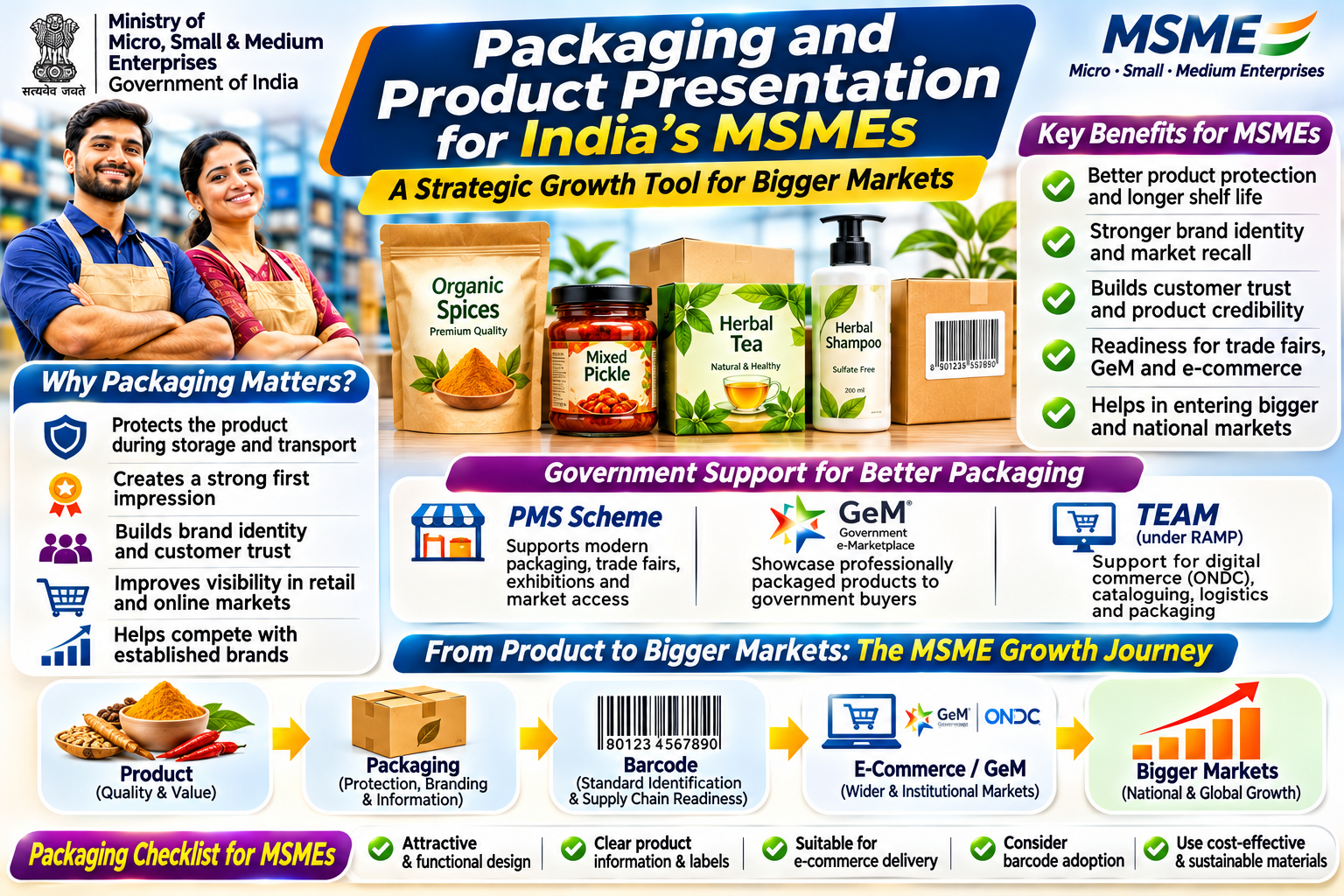
Government-backed programmes are also recognising this importance. The Procurement and Marketing Support (PMS) Scheme includes modern packaging techniques among its capacity-building components for Micro and Small Enterprises (MSEs). The objective is to help enterprises improve their marketability and become better prepared for wider commercial opportunities.
Packaging Is More Than a Box
For a consumer, packaging is often the first physical interaction with a product. Before experiencing the product itself, the buyer sees its box, pouch, bottle, label, colours, typography and product information.
Good packaging can communicate several things immediately:
- What the product is
- Who manufactured it
- How it should be used
- Where it was produced
- Key product specifications
- Quantity and other relevant information
- Brand identity and positioning
- Safety and handling information
For an MSME competing with established brands, professional presentation can help create confidence and make the product appear more organised and market-ready.
Government Support Through PMS
The Procurement and Marketing Support Scheme seeks to improve the market access capabilities of MSEs. Its framework covers areas such as participation in trade fairs and exhibitions, vendor development programmes and capacity-building activities.
Under the capacity-building component, the scheme recognises modern packaging techniques along with adoption of barcodes, e-commerce platforms and workshops/seminars.
This is important because packaging improvements should not be viewed in isolation. An MSME can combine better packaging with a barcode, a professional product catalogue and digital commerce to create a complete market-ready product.
The journey can therefore move from:
Product → Packaging → Barcode → Catalogue → Trade Fair → GeM/Digital Commerce → Larger Buyers
Why Product Presentation Matters in Trade Fairs
Trade fairs and exhibitions provide MSMEs with an opportunity to interact directly with customers, distributors, institutional buyers and other businesses.
At such events, product presentation can make a significant difference.
An attractive and well-organised stall can help an MSME:
- Attract visitors.
- Communicate its product range quickly.
- Demonstrate professionalism.
- Create stronger brand recall.
- Generate enquiries.
- Identify distributors and institutional buyers.
- Develop relationships with larger companies.
A product that is professionally packaged and supported by clear brochures, catalogues, specifications and pricing information is easier for potential buyers to understand.
This is particularly relevant for MSMEs seeking vendor-development opportunities with large companies and public sector organisations.
Packaging and E-Commerce: A Natural Partnership
The growth of digital commerce has made packaging even more important.
When customers purchase through an online platform, they cannot physically examine the product before ordering. Photographs, product descriptions, specifications, reviews and packaging therefore become important components of the buying experience.
A professionally packaged product can also create a stronger impression when it reaches the customer’s doorstep.
For MSMEs entering digital commerce through platforms and networks such as ONDC, packaging should be designed with several considerations in mind:
- Protection during transportation
- Appropriate dimensions and weight
- Clear product identification
- Attractive branding
- Tamper resistance where required
- Easy handling and storage
- Appropriate labelling
- Sustainability considerations
Packaging should therefore be designed not only for the retail shelf but also for the delivery journey.
Barcode Adoption Adds Professionalism
Modern packaging can be strengthened further through barcode adoption.
A barcode provides a standardised method of identifying products and can support inventory management, billing, tracking and organised retail operations.
The PMS framework specifically includes adoption of barcodes as a capacity-building activity.
For an MSME planning to move from local sales to organised retail, institutional buyers or e-commerce, barcode adoption can become an important part of product standardisation.
The combination of:
Professional Packaging + Barcode + Digital Catalogue
can make an MSME’s products considerably more prepared for modern distribution channels.
From Local Brand to National Brand
Many Indian MSMEs already produce high-quality handicrafts, textiles, food products, engineering components, cosmetics, household products and specialised industrial goods.
The challenge is often converting product quality into market recognition.
Packaging can help bridge that gap.
Consider a small food-processing enterprise selling primarily within its district. With improved packaging, proper product information, barcode adoption, professional photography and digital cataloguing, the same enterprise can begin exploring markets outside its immediate geography.
Participation in exhibitions can create buyer connections, while digital commerce can help expand customer reach.
Thus, packaging can become part of a broader brand-building strategy.
Sustainable Packaging: The Next Opportunity
MSMEs should also consider sustainability while redesigning packaging.
Excessive packaging can increase costs and waste. Businesses can explore recyclable, reusable or appropriately sized materials wherever commercially and technically feasible.
Sustainable packaging can also become part of brand positioning, particularly for businesses targeting environmentally conscious consumers and institutional buyers.
However, sustainability should be balanced with product safety, shelf life, transportation requirements and cost efficiency.
A Practical Packaging Checklist for MSMEs
Before launching or redesigning a product package, an MSME should ask:
Is the product adequately protected?
Can customers immediately identify the brand and product?
Are required product details clearly presented?
Is the packaging suitable for transportation and e-commerce?
Can the product be digitally catalogued easily?
Is barcode adoption appropriate?
Does the packaging communicate quality and professionalism?
Can packaging costs be reduced without compromising protection?
Can sustainable materials be used appropriately?
These questions can help entrepreneurs approach packaging as a business investment rather than merely an expense.
Connecting Packaging With PMS, GeM and TEAM
Packaging becomes even more valuable when connected with other market-access initiatives.
PMS can help MSEs develop market visibility, participate in exhibitions and improve packaging and product presentation.
GeM can provide an opportunity to participate in government procurement, subject to applicable registration and procurement requirements.
TEAM under RAMP can help eligible MSEs access digital commerce through ONDC and receive support related to cataloguing, account management, logistics and packaging.
Together, these initiatives can create a broader pathway:
Better Product → Better Packaging → Better Presentation → Better Visibility → More Buyers → Larger Markets
Conclusion
For India’s MSMEs, packaging should no longer be treated as the final step before a product leaves the factory. It should be considered part of the product itself — an important component of branding, market access, customer confidence and business growth.
A high-quality product deserves high-quality presentation.
As Indian MSMEs increasingly enter trade fairs, organised retail, government procurement and digital commerce, investment in professional packaging, labelling, barcodes and product presentation can help them compete more effectively.
The opportunity is particularly significant when packaging improvements are combined with government-supported market-access programmes such as PMS and digital initiatives such as TEAM.
For the MSME entrepreneur, the message is simple:
Make a good product. Package it professionally. Present it confidently. And take it to bigger markets.