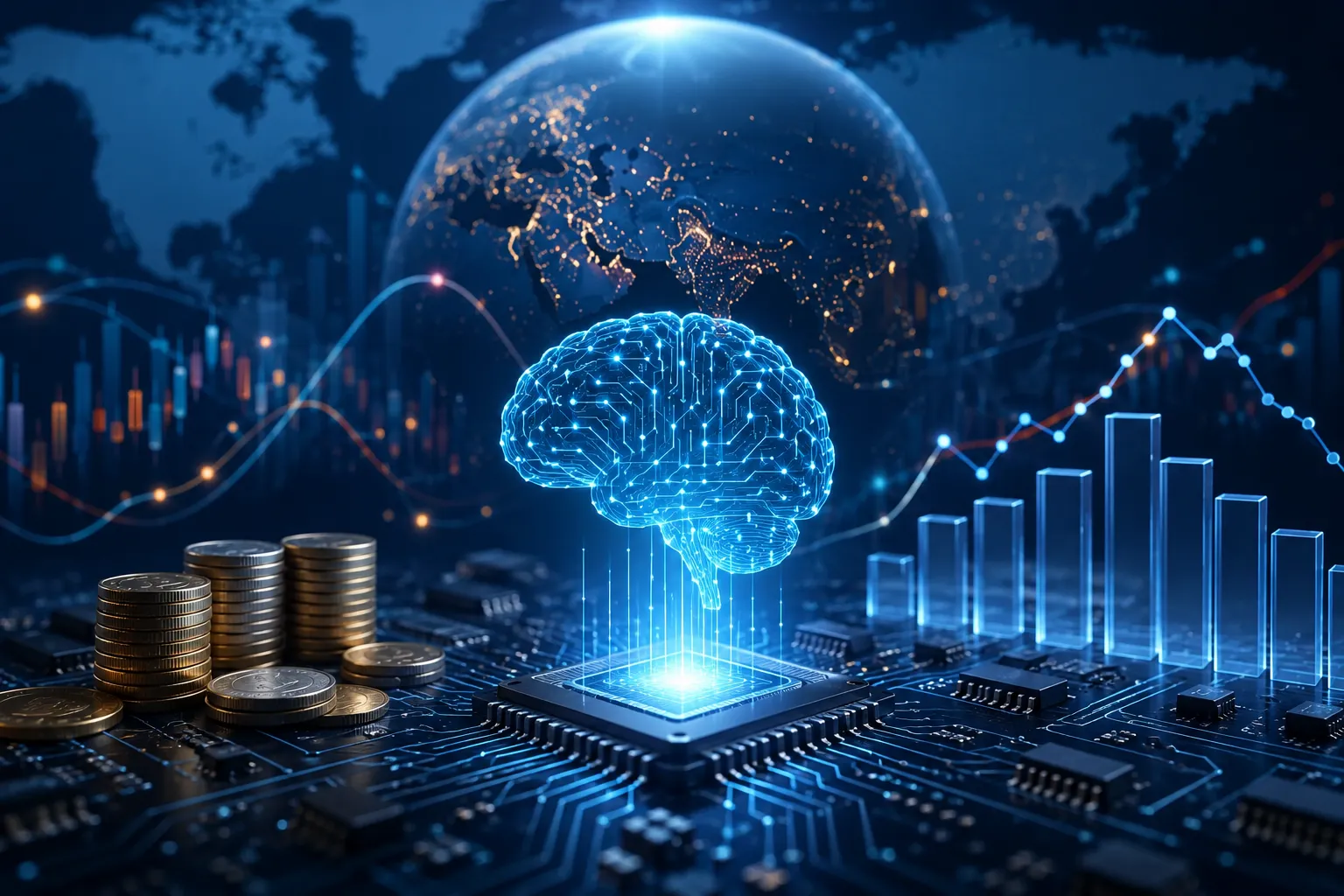
AI-related investments and demand for advanced technologies are supporting international trade and industrial development.
By The Worldonomics Times | Global Economy
Artificial intelligence is increasingly becoming an important force behind global economic growth, transforming industries, influencing international trade and encouraging investment in advanced technologies. Governments and businesses are expanding their spending on AI infrastructure, semiconductors, data centres, cloud computing and digital services. This growing demand is creating new opportunities for manufacturers, technology companies and economies participating in global technology supply chains.
The economic impact of AI is extending beyond the technology sector. Industries such as manufacturing, finance, healthcare, logistics, agriculture and telecommunications are adopting AI-powered systems to improve efficiency, reduce operating costs and strengthen productivity. As investment continues to expand, artificial intelligence is emerging as a significant contributor to global industrial development.
AI Investment Supports Global Economic Activity
Investment in artificial intelligence has increased rapidly as companies compete to develop advanced models, computing systems and digital infrastructure. Technology businesses are investing heavily in specialised chips, servers, data centres and high-performance computing facilities to support growing demand for AI applications.
According to the International Monetary Fund’s September 2026 publication, AI: Deployment and Disruption, AI-related technology investment contributed an estimated 0.5 percentage point to US GDP growth in 2025. The report also noted that global private-sector AI investment could exceed $2 trillion in 2026, based on external estimates.
This investment is generating economic activity across multiple sectors. Construction companies are involved in building data centres, energy providers are expanding electricity capacity, and semiconductor manufacturers are increasing production to meet demand for advanced computing equipment.
The wider impact is becoming visible in international trade, where demand for AI-related products is supporting manufacturing and export growth.
Advanced Technology Demand Strengthens International Trade
The expansion of AI infrastructure has increased demand for semiconductors, electronic components, computer equipment, servers and networking technologies. These products are becoming important elements of international trade as countries strengthen their digital capabilities.
The World Trade Organization reported in October 2026 that global merchandise trade volume grew by 3.5% during the first half of the year. Trade in AI-enabling goods increased by 67% year-on-year, accounting for 47% of global merchandise trade growth in value terms during the same period.
The WTO subsequently raised its forecast for merchandise trade-volume growth in 2026 to 3.9%, compared with its earlier March estimate of 1.9%. Strong AI-related investment was identified as one of the major factors supporting the improved outlook.
Asian economies are particularly important in this development because of their established manufacturing capabilities and participation in semiconductor, electronics and technology supply chains. Countries such as China, Japan, South Korea, Taiwan, India and Singapore are positioned to benefit from different parts of the expanding digital economy.
However, the benefits are not distributed equally. Economies with advanced manufacturing facilities, skilled workforces and reliable infrastructure are better placed to capture a larger share of AI-related trade.
Manufacturing Industries Adopt AI Technologies
Artificial intelligence is changing manufacturing processes by enabling businesses to automate operations, improve production planning and identify equipment problems before they cause costly disruptions.
AI-powered systems can analyse production data, monitor machinery performance and help manufacturers maintain consistent product quality. Predictive maintenance can reduce unexpected equipment failures, while automated inspection systems can improve accuracy and reduce waste.
In automotive manufacturing, AI is supporting robotics, quality control and the development of advanced vehicle technologies. Electronics manufacturers are using intelligent systems to manage complex production processes and improve supply-chain coordination.
These applications can increase industrial productivity and help companies respond more effectively to changing market conditions. They may also encourage investment in modern factories and advanced manufacturing equipment.
Nevertheless, the benefits depend on successful implementation. Businesses must invest in digital infrastructure, employee training, cybersecurity and reliable data systems to achieve meaningful productivity improvements.
Emerging Economies Seek Opportunities in the AI Economy
Artificial intelligence is creating opportunities for developing economies to strengthen their position in global trade and industrial production. Countries with growing technology sectors, skilled workers and expanding digital infrastructure can attract investment in software development, data services, electronics manufacturing and business-process operations.
India, for example, has opportunities to expand its software services industry and develop applications for sectors such as banking, healthcare, education and manufacturing. Southeast Asian economies are also seeking to attract investment in electronics production, semiconductor supply chains and digital infrastructure.
However, significant challenges remain. Limited access to advanced computing facilities, high infrastructure costs, shortages of specialised skills and unequal internet access can restrict the adoption of AI in developing markets.
The World Bank’s June 2026 Global Economic Prospects analysis emphasised that the economic benefits of AI will depend on factors including digital infrastructure, human capital, regulatory frameworks and the speed and breadth of adoption. Countries that fail to develop these foundations risk falling behind as the technology becomes more widely integrated into the global economy.
Productivity Gains and Economic Risks
AI has the potential to improve productivity by allowing businesses to automate repetitive tasks, process large amounts of information and support faster decision-making. These improvements could reduce production costs, strengthen business efficiency and contribute to higher long-term economic output.
However, the overall economic impact remains uncertain. Productivity gains may take time to spread across industries, particularly where businesses lack the skills and infrastructure needed to adopt advanced technologies.
There are also financial risks associated with the rapid expansion of AI investment. If companies spend heavily on infrastructure without generating sufficient commercial returns, investor expectations could weaken. A sharp correction in technology valuations could affect financial markets and reduce investment activity.
Employment is another important concern. Automation may reduce demand for certain routine tasks while increasing demand for workers with technical, analytical and digital skills. Governments and businesses will need to strengthen education and reskilling programmes to help workers adapt.
The Worldonomics View
Artificial intelligence is becoming a major driver of investment, trade and industrial transformation, but its long-term contribution to global economic growth will depend on whether investment translates into sustained productivity improvements.
The current expansion is creating opportunities for technology leaders and manufacturing economies, yet the concentration of advanced computing resources and supply chains in a limited number of countries raises concerns about unequal access. Developing economies must therefore focus on building digital infrastructure, improving education and creating an environment that encourages responsible technology investment.
The objective should not simply be to increase AI spending. It should be to ensure that artificial intelligence improves business productivity, creates new economic opportunities and supports broader development. Countries that combine technological innovation with inclusive economic policies will be better positioned to benefit from this transformation.
Conclusion
Artificial intelligence is reshaping the global economy through increased investment, stronger demand for advanced technologies and the transformation of industrial operations. Its influence is becoming increasingly visible in international trade, manufacturing and digital services.
Although challenges involving employment, infrastructure, investment risks and unequal access remain, AI offers significant opportunities for long-term economic development. The ability of governments and businesses to adopt the technology effectively will determine how widely its benefits are shared across the global economy.