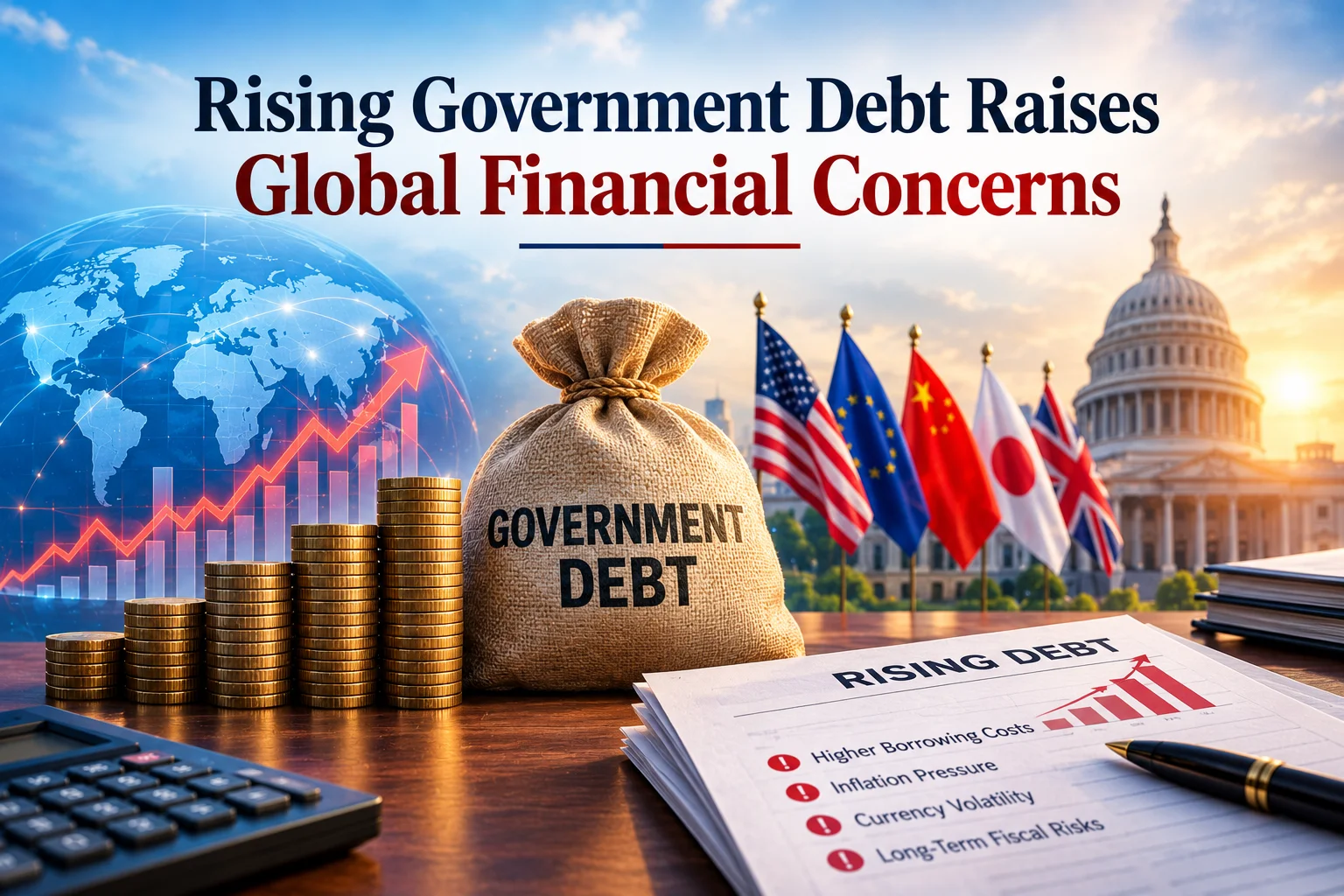
Growing government debt and rising interest payments are putting pressure on public finances worldwide. As governments face economic slowdowns, geopolitical tensions and increasing social spending demands, limited fiscal flexibility is making it harder to respond effectively to unexpected crises.
Government borrowing is an important instrument of economic management. Countries borrow money to finance infrastructure, strengthen public services, support businesses and protect households during difficult economic periods. However, when public debt rises faster than the economy’s ability to manage it, borrowing can become a serious financial burden.
Today, governments across developed and developing economies are confronting increasing debt obligations. Higher interest rates, persistent inflation, defence expenditure, ageing populations and economic uncertainty are putting additional pressure on national budgets.
According to the International Monetary Fund’s April 2026 Fiscal Monitor, global public debt reached just under 94% of global GDP in 2025 and is projected to approach 100% by 2029. This development raises concerns about the ability of governments to manage future economic shocks without creating additional financial instability.
Rising Interest Payments Reduce Fiscal Flexibility
One of the most significant consequences of growing public debt is the increasing cost of interest payments. Governments must allocate a larger share of their annual budgets towards servicing existing loans, leaving fewer resources available for essential development programmes.
When interest rates increase, refinancing existing debt becomes more expensive. Countries that need to issue new bonds or replace maturing loans may face significantly higher borrowing costs than in previous years.
An October 2026 analysis by the IMF highlights that rising sovereign bond yields are increasing fiscal pressure across major economies. The average 10-year government bond yield across G7 countries increased by more than one percentage point between February and September 2026, reaching its highest level in nearly two decades.
Higher debt-servicing costs can reduce public investment in healthcare, education, transportation, energy infrastructure and social protection. This creates a long-term economic challenge because reduced investment can weaken productivity and future growth.
Economic Crises Become More Difficult to Manage
Government borrowing often plays a crucial role during economic crises. During recessions, financial instability or major international disruptions, governments may introduce stimulus packages, emergency assistance and business support programmes.
However, countries with already elevated debt levels may have less room to introduce these measures.
For example, during an economic slowdown, governments may need to increase public spending to support employment and household consumption. If borrowing costs are already high, additional debt can increase financial pressure and weaken investor confidence.
This creates a difficult policy dilemma: reducing expenditure may weaken economic recovery, while increasing borrowing may make public finances less sustainable.
The problem becomes even more complicated when several challenges occur simultaneously, such as rising energy prices, geopolitical conflicts, natural disasters and financial market volatility.
Developing Economies Face Greater Vulnerability
The consequences of public debt are particularly serious for developing economies. Many countries depend on international borrowing to finance infrastructure, industrial development and essential public services.
When international interest rates rise or domestic currencies depreciate, the cost of servicing foreign-currency debt can increase significantly.
The World Bank’s November 2026 International Debt Report revealed that external debt in low- and middle-income countries reached a record $9.4 trillion in 2025. These countries paid approximately $1.4 trillion in principal and interest during the year.
The poorest economies face particularly difficult conditions because they often have limited tax revenues, weaker foreign-exchange reserves and higher borrowing costs.
As debt payments increase, governments may struggle to maintain spending on healthcare, education, food security and infrastructure. This can slow development and increase economic inequality.
Global Uncertainty Adds to Government Financial Pressure
Public debt concerns are also connected to wider international developments. Geopolitical conflicts, trade uncertainty and fluctuations in global commodity prices can increase government expenditure and reduce revenue.
For energy-importing countries, higher oil and gas prices can increase the cost of subsidies and public support programmes. Governments may also face pressure to increase defence spending, strengthen energy security and protect vulnerable households.
At the same time, weaker economic growth can reduce tax collections. When government revenue declines while expenditure increases, budget deficits may widen and borrowing requirements may rise.
The IMF’s October 2026 World Economic Outlook identifies fiscal vulnerabilities among the important downside risks to global economic stability. It also emphasises the need for governments to rebuild fiscal space before another major economic shock occurs.
The Importance of Responsible Fiscal Management
Managing public debt requires a balanced approach. Governments must maintain financial discipline without unnecessarily weakening economic growth or essential public services.
Improving tax collection, reducing inefficient expenditure, controlling unnecessary subsidies and strengthening public-sector efficiency can help improve government finances.
Investment decisions are equally important. Borrowing should ideally support productive projects that generate long-term economic benefits, improve infrastructure and increase national productivity.
Governments should also develop transparent debt-management strategies, maintain realistic budget forecasts and avoid excessive dependence on short-term borrowing.
International financial institutions can support vulnerable countries through concessional financing, technical assistance and effective debt-restructuring mechanisms where necessary.
The Worldonomics Times View
Rising government debt is becoming one of the most important challenges facing the global economy. Borrowing can support economic development and provide essential assistance during crises, but excessive debt can gradually reduce the very financial flexibility that governments need when emergencies occur.
The Worldonomics Times believes that the priority should not simply be to reduce borrowing at any cost. Instead, governments must improve the quality of public spending and ensure that every major borrowing decision contributes to long-term economic stability.
Expenditure on productive infrastructure, education, healthcare, technology and energy security can strengthen future growth. By contrast, inefficient spending and poorly targeted subsidies can increase debt without delivering sustainable economic benefits.
Governments should also establish credible medium-term fiscal plans, strengthen revenue collection and maintain transparent relationships with investors and international financial institutions. Vulnerable developing economies need access to affordable financing and fair debt-restructuring arrangements to prevent debt repayments from undermining essential development priorities.
Importantly, fiscal discipline should not become an excuse for neglecting vulnerable communities. During economic crises, targeted and temporary support can protect households while limiting unnecessary pressure on public budgets.
Ultimately, a government’s financial strength should be measured not only by its ability to borrow, but also by its capacity to manage debt responsibly and respond effectively when economic conditions deteriorate.
A sustainable public debt system is essential for economic resilience. Governments that build stronger fiscal foundations today will be better prepared to protect businesses, support citizens and navigate tomorrow’s global economic challenges.