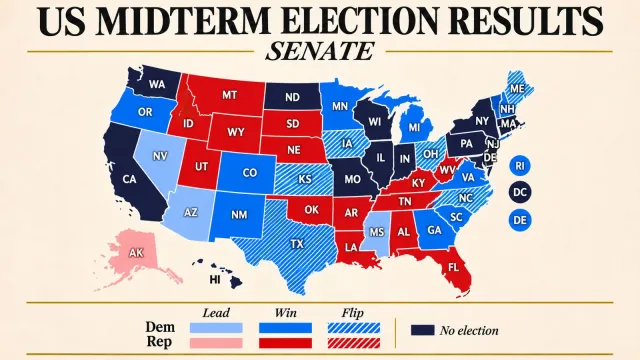
The Democratic Party’s sweeping victory in the November 2026 US midterm elections has reshaped Washington’s political landscape. With Congress now set to face a Republican president, investors and businesses are assessing the implications for trade policy, government spending, technology regulation and economic growth.
The results of the US midterm elections have introduced a significant new chapter in the country’s economic and political outlook. Democrats secured control of both the House of Representatives and the Senate, delivering a major setback to President Donald Trump and his administration.
The November 3 election reflected widespread voter dissatisfaction with the cost of living, energy prices and the direction of the economy. The outcome is expected to create a more challenging legislative environment for the White House, as the new Congress prepares to scrutinise the administration’s economic priorities.
Although President Trump retains executive authority and the power to veto legislation, Democratic control of both congressional chambers gives the opposition greater influence over government spending, taxation debates, regulatory oversight and economic legislation.
For financial markets, the central question is whether the political shift will produce greater policy stability or deepen uncertainty during an already challenging period for the global economy.
A New Political Balance in Washington
The Democratic victory represents a substantial change in the balance of power in Washington. With Republicans losing control of both congressional chambers, the administration will face stronger opposition to several elements of its economic programme.
Congress has important constitutional responsibilities over taxation, federal spending and government borrowing. Democratic lawmakers could use these powers to negotiate changes to budget priorities, challenge proposed spending measures and demand greater oversight of government policies.
The debt ceiling and federal budget negotiations could become particularly important areas of political confrontation. Disagreements over government funding may create uncertainty for businesses, investors and financial institutions.
However, divided government does not automatically mean that all economic policies will change. The president retains veto authority, and major legislative changes will require negotiation between the White House and congressional leadership.
Reuters has noted that Democrats could use spending legislation and debt-ceiling negotiations to seek concessions from the administration, even though their congressional majorities are not sufficient to override presidential vetoes.
Trade Policy and International Business
Trade policy is another area attracting attention after the election.
The Trump administration has relied heavily on tariffs and trade restrictions as instruments of economic and foreign policy. These measures have influenced import costs, manufacturing decisions and international supply chains.
A Democratic-controlled Congress may increase scrutiny of the administration’s trade strategy, particularly where tariffs contribute to higher consumer prices or create uncertainty for American businesses.
However, congressional control does not automatically give Democrats the power to reverse every existing tariff. Presidential authorities and executive decisions remain important in determining trade policy.
For international trading partners, the result creates a complicated environment. Businesses exporting to the United States will need to monitor potential changes in trade negotiations, tariff enforcement and regulatory requirements.
Countries with significant commercial relationships with the US, including China, Canada, Mexico, India and members of the European Union, will be watching closely for signs of policy adjustments.
Financial Markets React to the Political Shift
Financial markets responded quickly to the election outcome, although reactions differed across sectors.
On November 4, US equities initially rallied as investors welcomed clarity over the election result and anticipated legislative gridlock that could limit sudden policy changes. The dollar weakened, while investors reassessed the prospects for regulatory changes and government spending.
The reaction was not uniformly positive. Technology shares, particularly companies involved in artificial intelligence infrastructure and data-centre development, faced pressure as investors considered the possibility of tougher oversight.
By November 5, the technology-heavy Nasdaq Composite had fallen sharply amid concerns about potential restrictions on the rapid expansion of AI infrastructure. Renewable-energy and healthcare shares attracted interest as investors considered possible changes in policy priorities.
These movements demonstrate that elections can create both opportunities and risks for investors. The broader market may welcome reduced uncertainty in one area while individual industries face new regulatory and political challenges.
Government Spending, Inflation and Economic Growth
The election also places renewed attention on the US fiscal outlook.
The federal government faces substantial borrowing requirements, rising interest expenses and pressure to address the cost of living. Negotiations over taxation, healthcare spending, subsidies and infrastructure investment could become more complicated under divided government.
For households, the most immediate concern remains affordability. Higher energy prices, import costs and essential living expenses have contributed to public dissatisfaction.
Democratic lawmakers are likely to place greater emphasis on consumer protection and the cost-of-living issue. The administration, meanwhile, will need to demonstrate that its economic policies can deliver stronger purchasing power and sustainable growth.
There are also implications for the Federal Reserve. Although monetary policy remains independent of Congress, political debates over inflation, economic performance and central-bank oversight could influence the wider policy environment.
If political disagreements delay fiscal decisions or create uncertainty around government borrowing, financial conditions could become more volatile.
The Global Economic Impact
The United States remains a major driver of international trade, investment and financial activity. Changes in its economic policy can influence currencies, commodity prices, global interest-rate expectations and business confidence.
A more divided Washington could slow the passage of major legislation, potentially reducing the likelihood of sudden policy changes. However, prolonged disputes over budgets, borrowing and trade could create new risks for international markets.
Emerging economies may be particularly sensitive to changes in US trade policy and financial conditions. Any renewed uncertainty surrounding tariffs or the dollar could influence capital flows, exchange rates and investment decisions.
For global businesses, the priority will be to maintain flexibility. Companies with substantial exposure to US markets may need to reassess supply chains, investment plans and regulatory risks as the new political environment develops.
The Worldonomics Times View
The 2026 US midterm elections represent more than a political setback for the Republican Party. They mark a significant shift in the economic decision-making environment of the world’s largest economy.
Democratic control of Congress may introduce stronger oversight, more intense debate over spending and increased scrutiny of trade and technology policies. Yet the Republican administration retains considerable executive authority, meaning that the coming period is likely to be defined by negotiation, political confrontation and selective compromise.
For investors, the immediate challenge is distinguishing genuine policy changes from political rhetoric. Market reactions following the election have already shown that different industries can respond in sharply different ways to the same political development.
The greater concern is the possibility that prolonged disagreements over government funding, tariffs and economic priorities could weaken business confidence at a time when households and companies are already facing elevated costs.
The United States needs a predictable economic framework that encourages investment, supports employment and protects the purchasing power of consumers. Political competition should not come at the expense of fiscal stability or long-term economic planning.
The Worldonomics Times believes that the real test of the 2026 midterm elections will be whether Washington can turn its new political balance into constructive economic cooperation. For the United States and the wider global economy, stability, predictability and responsible policymaking will matter far more than short-term political victories.