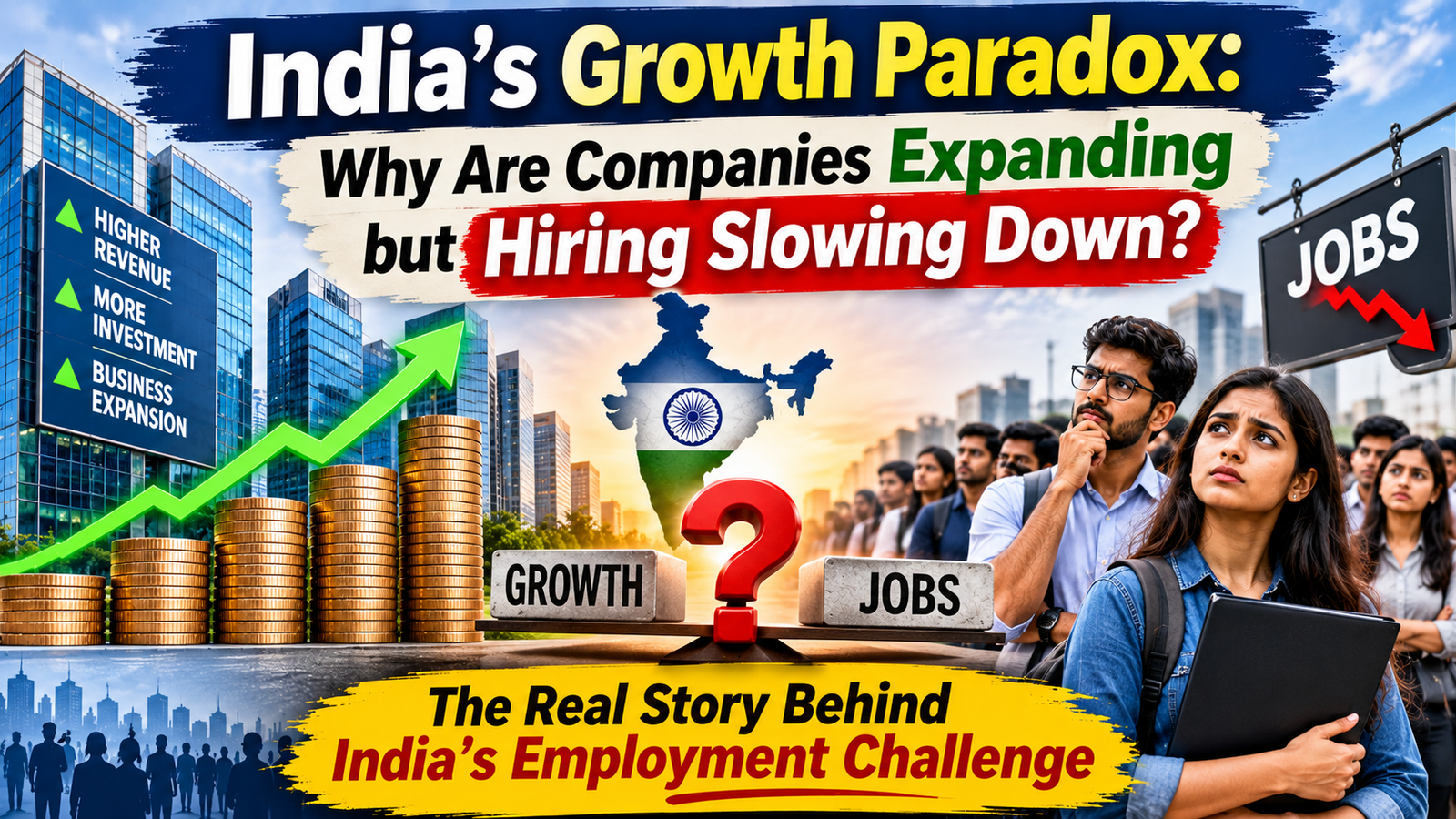
India’s economy continues to demonstrate strong growth potential. But the real test of economic success is whether that growth creates secure jobs, improves wages and raises living standards for ordinary households.
Introduction: A Strong Economy, a Bigger Question
India’s growth story remains one of the most closely watched developments in the global economy. On 11 November 2026, Moody’s raised its growth forecast for India’s financial year 2026–27 to 7%, up from 6.5%, citing resilient domestic demand, investment and economic fundamentals. The Reserve Bank of India’s September survey of professional forecasters had projected growth of 7.1% for the same year.
These projections reinforce India’s position as a major growth economy. However, an important question remains: does faster economic growth automatically translate into better employment opportunities and higher incomes?
For millions of young graduates, job seekers, salaried employees and small-business owners, economic progress is not measured only by GDP figures. It is measured by the availability of decent jobs, regular salary increases, affordable living costs and the ability to save for the future.
The distinction between economic expansion and improvements in everyday financial well-being is central to understanding India’s next stage of development.
1. Understanding the 7% Growth Story
Gross Domestic Product (GDP) measures the value of final goods and services produced within an economy. When real GDP increases, it indicates that economic output is expanding after adjusting for price changes.
India’s growth outlook is supported by several factors:
- Domestic consumption: Household spending supports demand for goods and services.
- Capital investment: Spending on infrastructure, machinery and productive capacity can strengthen future output.
- Services growth: Finance, information technology, business services and other service industries contribute significantly to economic activity.
- Manufacturing and industrial expansion: Higher production can create opportunities across supply chains, logistics and supporting businesses.
Moody’s also pointed to stronger capital-goods output, industrial credit growth and improving capacity utilisation as signs that private investment could strengthen. Reuters
Nevertheless, GDP growth is an aggregate measure. It does not tell us how income is distributed, whether newly created jobs pay sufficiently well or how much financial security workers gain.
An economy can expand rapidly while many households continue to experience stagnant real incomes or uncertain employment.
2. The Employment Question: Are Enough Quality Jobs Being Created?
Employment is the most important link between economic growth and household prosperity. Businesses can increase production and profits without necessarily increasing their workforce at the same rate, particularly when they adopt automation, improve efficiency or concentrate investment in capital-intensive industries.
India’s official labour-market data nevertheless show some encouraging developments. According to the Periodic Labour Force Survey (PLFS) Annual Report 2025, the share of workers in regular wage or salaried employment rose from 22.4% in 2024 to 23.6% in 2025. The share of employment in manufacturing increased from 11.6% to 12.1% over the same period.
These changes suggest a gradual shift in the composition of employment. However, they do not establish that every new job is secure, adequately paid or suited to the qualifications of job seekers.
The broader challenge is to generate productive, formal and reasonably well-paid employment at a scale that matches the size of India’s workforce.
3. The Graduate Employment Paradox
One of the most significant challenges facing India’s economy is the gap between educational qualifications and available employment opportunities.
Every year, universities produce graduates in commerce, management, engineering and other disciplines. Yet many young people struggle to secure their first suitable job, while employers frequently report difficulties finding candidates with the practical skills they need.
This mismatch has economic consequences:
- Graduates may accept jobs below their qualification level.
- Families spend years financing education without receiving the expected financial returns.
- Employers incur additional training costs.
- Delayed entry into stable employment can postpone savings, independent living and major financial decisions.
The PLFS Annual Report 2025 recorded an unemployment rate of 6.5% among people aged 15 and above with secondary education or higher, down from 7.0% in 2024. Youth unemployment among those aged 15–29 stood at 9.9% in 2025.
These figures show improvement, but they also highlight the need to examine employment outcomes beyond the headline unemployment rate. A person working in an insecure, low-paid position may count as employed even if that job does not adequately utilise their education or provide financial stability.
India needs stronger connections between educational institutions, vocational training, apprenticeships and industry requirements. Practical experience, digital skills and workplace readiness must complement academic qualifications.
4. Higher Wages or Merely Higher Numbers?
Economic growth becomes meaningful for households when earnings rise enough to improve purchasing power.
Official PLFS data show that average monthly earnings among regular wage or salaried male workers increased from ₹22,891 in 2024 to ₹24,217 in 2025. For female workers, the corresponding figures increased from ₹17,126 to ₹18,353. These are nominal earnings, meaning they are measured before adjusting for inflation.
Nominal wage growth does not necessarily mean an equivalent improvement in living standards.
Consider a simplified example:
Illustrative example — not actual survey data
Monthly salary before increase
₹30,000
Monthly salary after 5% raise
₹31,500
Annual salary increase
₹18,000
If living costs rise by 6%
Real loss
The employee earns more money but can afford slightly less than before if the relevant cost of living rises faster than their salary.
This is why real wage growth matters more than nominal salary increases alone. Housing, education, healthcare, transport and food costs can absorb a substantial portion of additional income.
For sustainable improvements in household welfare, wage growth must be supported by productivity gains, stronger competition, affordable essential services and more stable employment.
5. Can Manufacturing Become a Major Employment Engine?
Manufacturing has the potential to strengthen the connection between economic growth and job creation.
Expanding industries can generate employment not only inside factories but also in transportation, warehousing, packaging, maintenance, accounting, procurement and other supporting services. Stronger domestic supply chains can also create opportunities for small and medium-sized enterprises.
The Economic Survey 2025–26 reported that employment in organized manufacturing increased by 6% in FY2023–24, adding more than one million jobs compared with the previous financial year.
However, a lasting manufacturing-led employment strategy requires more than attracting investment. Businesses must be able to expand, compete internationally and employ workers productively.
Important priorities include:
- Supporting MSMEs with affordable finance and timely payments.
- Improving logistics, industrial infrastructure and access to reliable energy.
- Expanding apprenticeships and technical training.
- Encouraging labour-intensive industries alongside advanced manufacturing.
- Helping small enterprises move into formal supply chains and grow into larger employers.
Manufacturing can contribute significantly to employment, but the scale and quality of its job creation will depend on the industries that expand and the extent to which domestic firms participate.
6. The Role of MSMEs in Converting Growth into Incomes
Micro, Small and Medium Enterprises (MSMEs) are essential to the relationship between economic growth and employment because they operate across manufacturing, trade, professional services and local supply chains.
When small businesses expand, they can hire accountants, sales executives, technicians, logistics staff and other workers. Their growth can also distribute economic opportunities beyond major metropolitan centres.
However, many MSMEs face constraints such as expensive credit, delayed customer payments, limited working capital and compliance costs. These pressures can discourage hiring even when demand for their products increases.
Improving access to formal finance, strengthening digital infrastructure and ensuring timely payments could help viable businesses invest, expand operations and create more stable jobs.
The objective should not simply be to increase the number of registered enterprises. It should be to help productive businesses survive, grow and become sustainable employers.
7. Why Women’s Employment Matters to Economic Growth
India cannot fully realise its economic potential without expanding women’s access to productive, fairly paid work.
The PLFS Annual Report 2025 estimated the female labour force participation rate at 40.0% for people aged 15 and above under the usual-status measure. The same report found that women remained more concentrated in self-employment than men.
Participation alone, however, does not reveal whether employment is adequately paid or economically independent. Unpaid family work, care responsibilities, workplace safety concerns and limited access to suitable jobs can affect women’s economic opportunities.
Measures that can improve outcomes include:
- Safer transport and workplaces.
- Affordable childcare and better care infrastructure.
- Access to skills training, credit and entrepreneurship support.
- More opportunities for women in manufacturing, finance, technology and professional services.
- Transparent recruitment and equal-pay practices.
Greater participation in productive employment can increase household income, strengthen consumption and savings, and broaden the economy’s talent pool.
8. What Must Change for Growth to Become Inclusive?
Sustaining growth near 7% is important, but translating it into broad-based prosperity requires coordinated action by policymakers, businesses and educational institutions.
Promote employment-intensive investment
Encourage sectors capable of absorbing large numbers of workers, alongside capital-intensive and technology-driven industries.
Connect education with actual job requirements
Expand apprenticeships, industry-linked courses and practical training so that qualifications lead more directly to productive employment.
Improve productivity and real wages
Help workers produce more value through technology, training and better management, while ensuring that productivity gains can support higher earnings.
Strengthen small businesses
Improve access to credit, reduce avoidable compliance burdens and address delayed payments that restrict business expansion.
Expand financial and social security
Improve access to health protection, retirement savings and income security, particularly for workers in informal and platform-based employment.
These priorities align with the Economic Survey 2025–26, which emphasizes the importance of job quality, skill development and sustainable livelihoods alongside economic expansion.
Conclusion: Growth Must Be Felt, Not Just Measured
India’s projected 7% growth represents an important economic opportunity. Strong domestic demand, investment and expanding services can support the country’s long-term development. Yet the ultimate value of this expansion depends on how effectively it improves employment, wages and financial security.
The central challenge is not simply whether India can produce more goods and services. It is whether the benefits of that production can reach a wider share of its population.
A graduate finding a suitable first job, a small business hiring additional workers, a woman earning an independent income and a salaried household building meaningful savings are all examples of economic progress that people can experience directly.
GDP growth remains an essential indicator of national performance, but it cannot serve as the sole measure of prosperity.
India’s next economic milestone should therefore be not only sustained growth, but growth that creates productive jobs, raises real incomes and expands financial security.
The true success of India’s 7% growth story will ultimately be determined by how much better people are able to live because of it.