You may not pay a single rupee to scroll through Instagram, watch YouTube or browse Facebook. But your attention is generating economic value every second.
Imagine opening Instagram for just five minutes. One reel leads to another, an advertisement appears, a suggested product catches your eye, and suddenly half an hour has passed.
You haven’t purchased anything. You haven’t paid a subscription. Yet, somewhere in the digital ecosystem, your activity has created economic value.
Welcome to the Attention Economy – a business model in which human attention becomes a valuable economic resource.
1. When Attention Becomes Currency
Traditional businesses compete for customers’ money. Digital platforms increasingly compete for something equally valuable: customers’ time and attention.
Social media platforms offer free access to content, entertainment and communication. In return, they attract large audiences and generate revenue primarily through advertising.
The longer users engage with content, the more opportunities platforms may have to display advertisements and monetise that engagement.
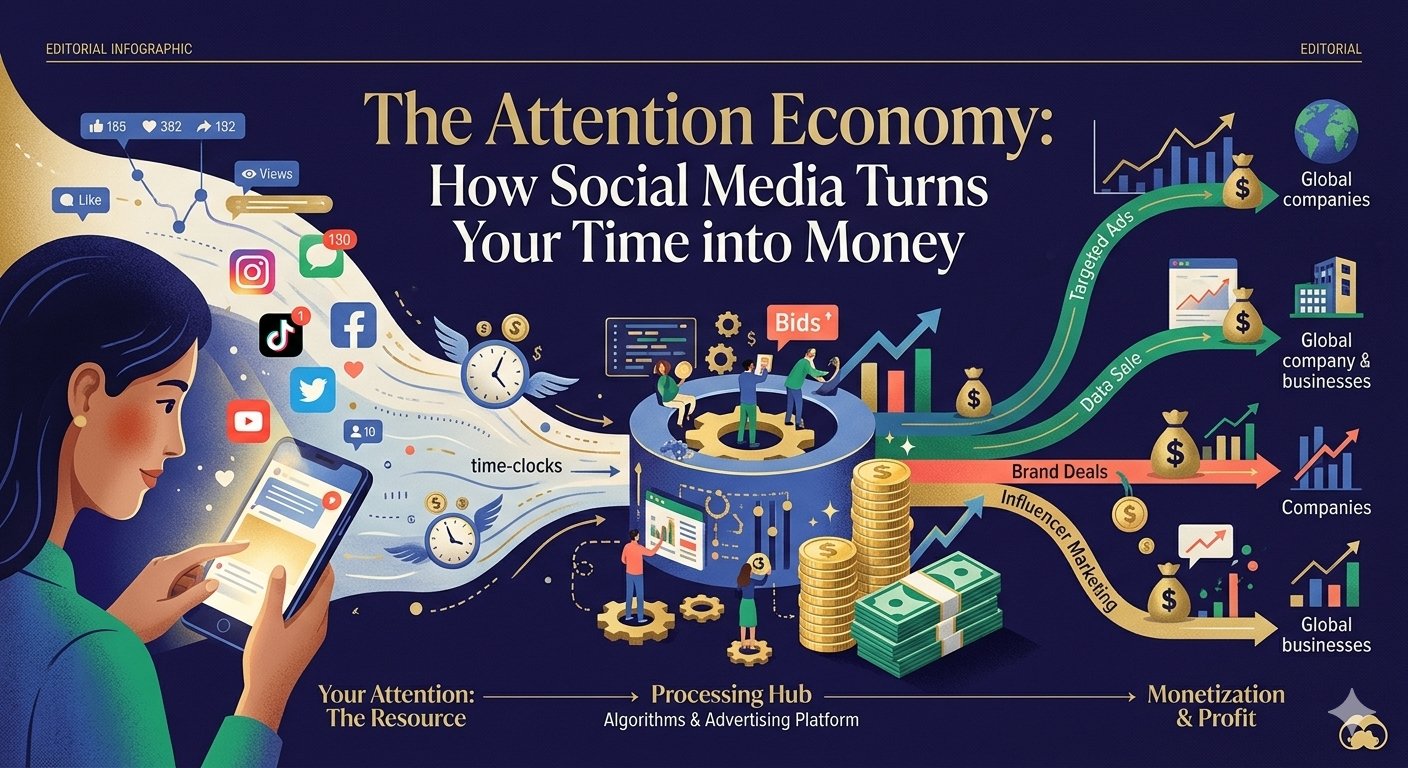
In simple terms, users provide attention, platforms provide digital experiences, and advertisers pay to reach relevant audiences.
This creates a powerful economic relationship between three participants: users, platforms and advertisers.
2. The Business Model Behind ‘Free’
Have you ever wondered how platforms offering free services generate billions in revenue?
The answer lies largely in digital advertising.
Consider the following example:
A clothing brand wants to promote its latest collection to young consumers interested in fashion.
Instead of advertising to everyone, it can use digital advertising tools to reach audiences based on relevant interests, demographics and online behaviour.
The platform provides advertising opportunities, the brand pays for exposure, and users encounter advertisements while browsing content.
This is how attention is converted into commercial value.
The user may not pay directly, but their engagement helps support the platform’s revenue model.
3. Algorithms: The Invisible Business Managers
Behind every recommended reel, suggested video and personalised advertisement lies an increasingly sophisticated recommendation system.
Algorithms analyse signals such as viewing patterns, interactions, interests and engagement to determine what content may be relevant to users.
Their commercial significance is enormous.
Content that attracts attention can increase engagement, create more advertising opportunities and encourage users to return.
However, this also raises an important question:
Are platforms helping us discover what we want, or gradually influencing what we want to see?
The distinction matters because recommendation systems do not merely distribute information. They can influence consumer preferences, purchasing decisions and market visibility.
4. The Creator Economy: Attention Becomes an Entrepreneurial Asset
The attention economy has also created an entirely new category of entrepreneurs.
Content creators, influencers, educators, podcasters and independent journalists can build audiences and monetise their influence.
Their revenue streams may include:
- Brand collaborations and sponsorships.
- Advertising revenue sharing.
- Paid subscriptions and memberships.
- Affiliate marketing.
- Digital products and online courses.
For many creators, an engaged audience has become a valuable business asset.
However, this creates another challenge: creators increasingly compete not only on the quality of their work but also on their ability to capture attention in an overcrowded digital environment.
5. The Hidden Costs: Privacy, Behaviour and Consumer Choices
The attention economy also raises serious concerns.
Personalised advertising relies on data and insights about users’ interests and behaviour. Although this can make advertisements more relevant, it also raises questions about privacy, transparency and informed consent.
Other concerns include:
- Excessive screen time and compulsive usage patterns.
- Misleading advertisements and influencer promotions.
- Algorithmic amplification of sensational content.
- Impulsive purchases driven by targeted marketing.
- Unequal bargaining power between platforms, advertisers and users.
The challenge is to balance commercial innovation with responsible digital practices.
6. The Financial Perspective: Attention as an Economic Asset
From a business and financial management perspective, the attention economy offers an interesting lesson.
Traditional businesses measure performance through sales, revenue, profitability and return on investment.
Digital businesses additionally track indicators such as:
- Daily Active Users (DAU).
- Monthly Active Users (MAU).
- Average Revenue Per User (ARPU).
- Engagement rates.
- Customer Acquisition Cost (CAC).
- Customer Lifetime Value (CLV).
These metrics help companies understand audience growth, engagement and monetisation potential.
However, a large user base does not automatically translate into profitability. Platforms must convert engagement into sustainable revenue while managing infrastructure costs, content moderation, technology investments and regulatory risks.
Attention may attract revenue, but financial discipline determines business sustainability.
7. What Lies Ahead?
As artificial intelligence becomes more integrated into digital platforms, the attention economy is entering another phase.
AI-powered recommendations, personalised advertisements and conversational shopping experiences may make the connection between attention and purchasing decisions even stronger.
Businesses will increasingly compete not merely for visibility but for influence over consumer decisions.
This makes transparency, data protection, ethical advertising and responsible platform design increasingly important.
Conclusion: In the Digital World, Time Has Economic Value
We often believe that when a digital service is free, we are not paying anything.
But the reality is more complex. Our time, engagement and voluntarily shared information can contribute to a business model that generates substantial commercial value.
The attention economy has transformed how businesses advertise, how creators earn and how consumers make decisions.
Perhaps the most important question is no longer how much time we spend online, but how much economic value is created from that time – and who ultimately benefits from it.
Because in today’s digital economy, money is not the only currency. Attention has become one of the most valuable resources businesses compete for.