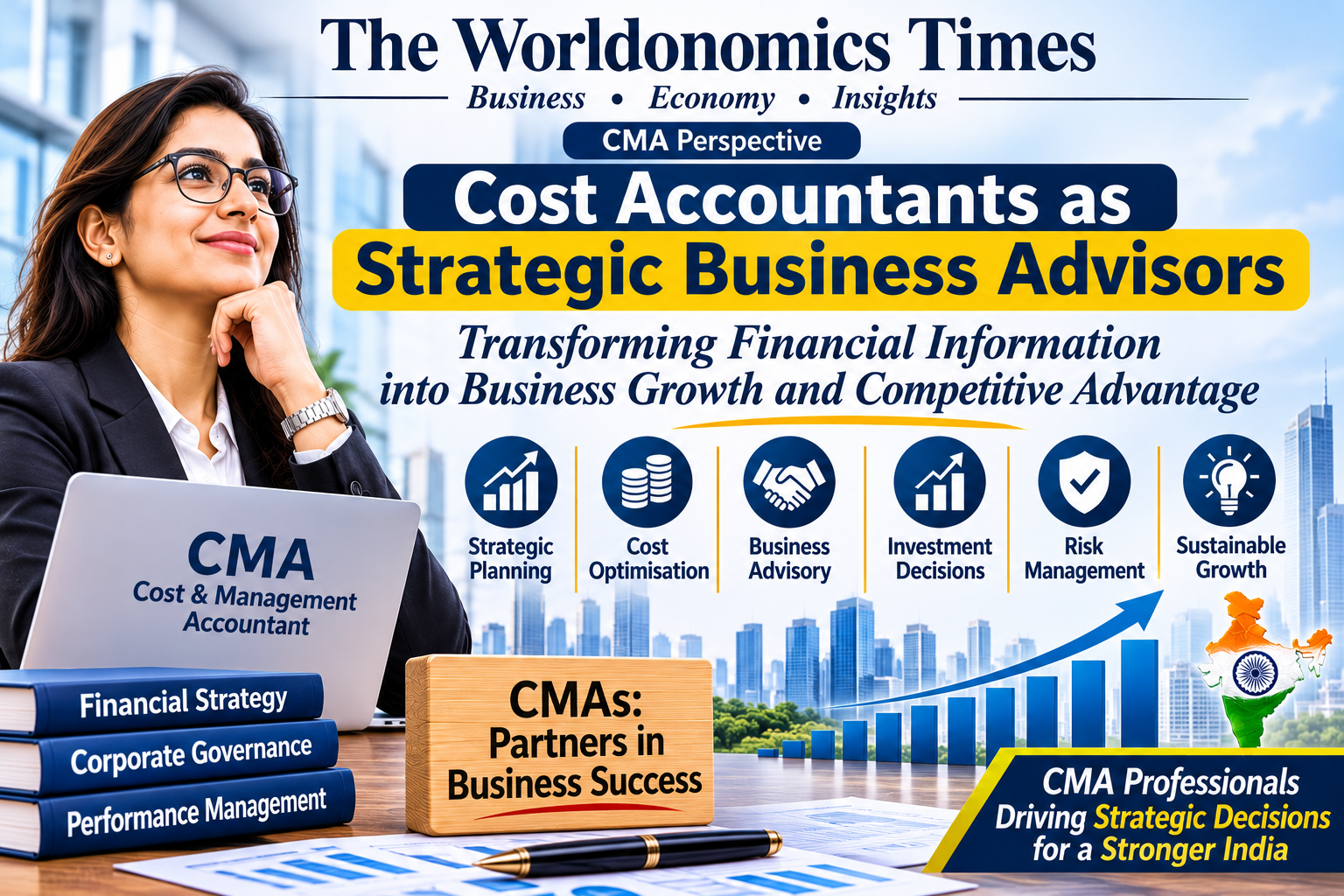
Transforming Financial Information into Business Growth and Competitive Advantage
By CMA Madhuri Kashyap
The Worldonomics Times | CMA Perspective
Introduction
The modern corporate world is becoming increasingly competitive, technology-driven and complex. Businesses today face challenges such as rising production costs, changing customer expectations, global competition, regulatory developments and economic uncertainty. In this environment, organisations need more than traditional accounting and financial reporting. They need professionals who can interpret financial information, evaluate business performance and guide management towards strategic decisions.
Cost and Management Accountants (CMAs) are increasingly fulfilling this role as strategic business advisors. Their expertise in cost management, financial analysis, budgeting, performance evaluation and risk assessment enables them to support management at every stage of business planning and development.
The role of a CMA is no longer limited to recording costs or preparing financial statements. Modern CMAs contribute to business strategy, operational efficiency, investment decisions and long-term value creation.
1. From Traditional Cost Accountant to Strategic Advisor
Traditionally, cost accountants focused on cost determination, cost control, budgeting and cost audit. These functions remain important, but the expectations from CMA professionals have expanded.
Today, management requires professionals who can explain not only what a business has spent but also why costs have changed, how profitability can improve and which strategic alternatives should be considered.
CMAs connect financial information with operational realities. They help management understand the financial impact of decisions involving production, pricing, procurement, expansion and resource allocation.
This transition has positioned CMAs as valuable contributors to corporate leadership and strategic planning.
2. Supporting Strategic Planning and Business Decisions
Strategic planning involves deciding the long-term direction of an organisation and determining how its resources should be used to achieve business objectives.
CMAs support this process by analysing financial trends, evaluating business performance and assessing the financial implications of proposed strategies.
They can assist management in:
- Preparing long-term financial plans.
- Evaluating business expansion opportunities.
- Assessing new product and market proposals.
- Analysing profitability across business segments.
- Identifying financial strengths and weaknesses.
- Developing performance measurement systems.
Their analytical approach helps management make decisions based on financial evidence rather than assumptions alone.
3. Improving Cost Competitiveness and Operational Efficiency
Cost competitiveness is essential for businesses operating in domestic and international markets. Increasing raw material prices, labour costs, energy expenses and logistics charges can reduce profit margins.
CMAs analyse the complete cost structure of an organisation and identify opportunities to improve efficiency.
They examine production processes, material consumption, labour productivity, overhead allocation, capacity utilisation and supply chain costs.
Using techniques such as standard costing, variance analysis, activity-based costing and lean cost management, CMAs can recommend measures to reduce waste and improve resource utilisation.
Their contribution helps businesses remain competitive while maintaining quality and customer satisfaction.
4. Pricing Strategy and Profitability Analysis
Pricing decisions directly influence sales, market share and profitability. Setting prices too high may reduce demand, while pricing too low can affect margins and long-term sustainability.
CMAs support pricing decisions by evaluating production costs, operating expenses, market conditions, contribution margins and break-even points.
They help management understand:
- Product-wise and service-wise profitability.
- Contribution and break-even levels.
- Impact of changes in input costs.
- Pricing alternatives for different markets.
- Profitability of customer segments.
This analysis enables businesses to develop pricing strategies that balance market competitiveness with financial sustainability.
5. Investment Appraisal and Business Expansion
Expansion decisions involve financial commitments and long-term risks. Whether a company plans to establish a new manufacturing unit, purchase machinery, enter a new market or introduce technology, management must assess the financial feasibility of the proposal.
CMAs contribute through capital budgeting and investment appraisal techniques such as Net Present Value (NPV), Internal Rate of Return (IRR), Payback Period and sensitivity analysis.
They evaluate expected cash flows, investment costs, potential returns and financial risks.
By presenting alternative investment scenarios, CMAs help management select projects that are financially viable and aligned with organisational objectives.
6. Risk Management and Financial Governance
Business decisions involve risks relating to finance, operations, compliance, technology and market conditions.
CMAs can support enterprise risk management by identifying financial vulnerabilities, analysing cost variations, reviewing internal controls and evaluating the financial impact of uncertain events.
They may contribute to risk assessment, internal audit, budget monitoring and management reporting, depending on their professional role and applicable requirements.
Their involvement helps organisations improve transparency, strengthen financial discipline and make better-informed decisions.
7. Strategic Advisory for MSMEs and Startups
Micro, Small and Medium Enterprises and startups often operate with limited financial resources and small management teams. They may have innovative products and growth potential but lack structured financial planning.
CMA professionals can act as strategic advisors by helping these enterprises prepare business plans, analyse costs, manage working capital, evaluate funding requirements and monitor profitability.
They can also assist in project feasibility analysis, financial forecasting, pricing strategy and performance measurement.
For growing enterprises, professional financial guidance can make a significant difference in improving business discipline and preparing for expansion.
8. Digital Transformation and Data-Driven Advisory
Digital technology is changing the nature of business advisory services. Enterprise Resource Planning systems, artificial intelligence, business intelligence platforms and data analytics enable organisations to access large volumes of financial and operational information.
Modern CMAs can use these tools to develop dashboards, monitor key performance indicators, analyse business trends and identify unusual cost patterns.
Skills in advanced Excel, Power BI, ERP systems, financial modelling and data analytics can strengthen their ability to provide timely strategic insights.
The future CMA will increasingly combine professional accounting knowledge with technology and business intelligence.
9. Building Leadership and Communication Skills
Technical knowledge alone is not sufficient for effective strategic advisory. CMAs must also communicate complex financial information in a clear and practical manner.
They need to understand business objectives, collaborate with different departments, present recommendations and explain the financial consequences of management decisions.
Leadership, negotiation, problem-solving, presentation and business communication skills are therefore essential for professional growth.
A CMA who can translate financial analysis into actionable business recommendations can become a trusted advisor to senior management.
Conclusion
The changing business environment has transformed the role of Cost and Management Accountants from traditional cost specialists into strategic business partners.
Their expertise in financial analysis, cost optimisation, investment appraisal, risk management and performance evaluation enables organisations to improve decision-making and achieve sustainable growth.
As India continues to expand its manufacturing base, strengthen MSMEs and compete in global markets, the contribution of CMA professionals as strategic advisors will become increasingly valuable.
The modern CMA does not merely report business performance; a strategic CMA helps shape it. By transforming financial information into meaningful business insights, CMAs are becoming partners in corporate success and India’s economic progress.