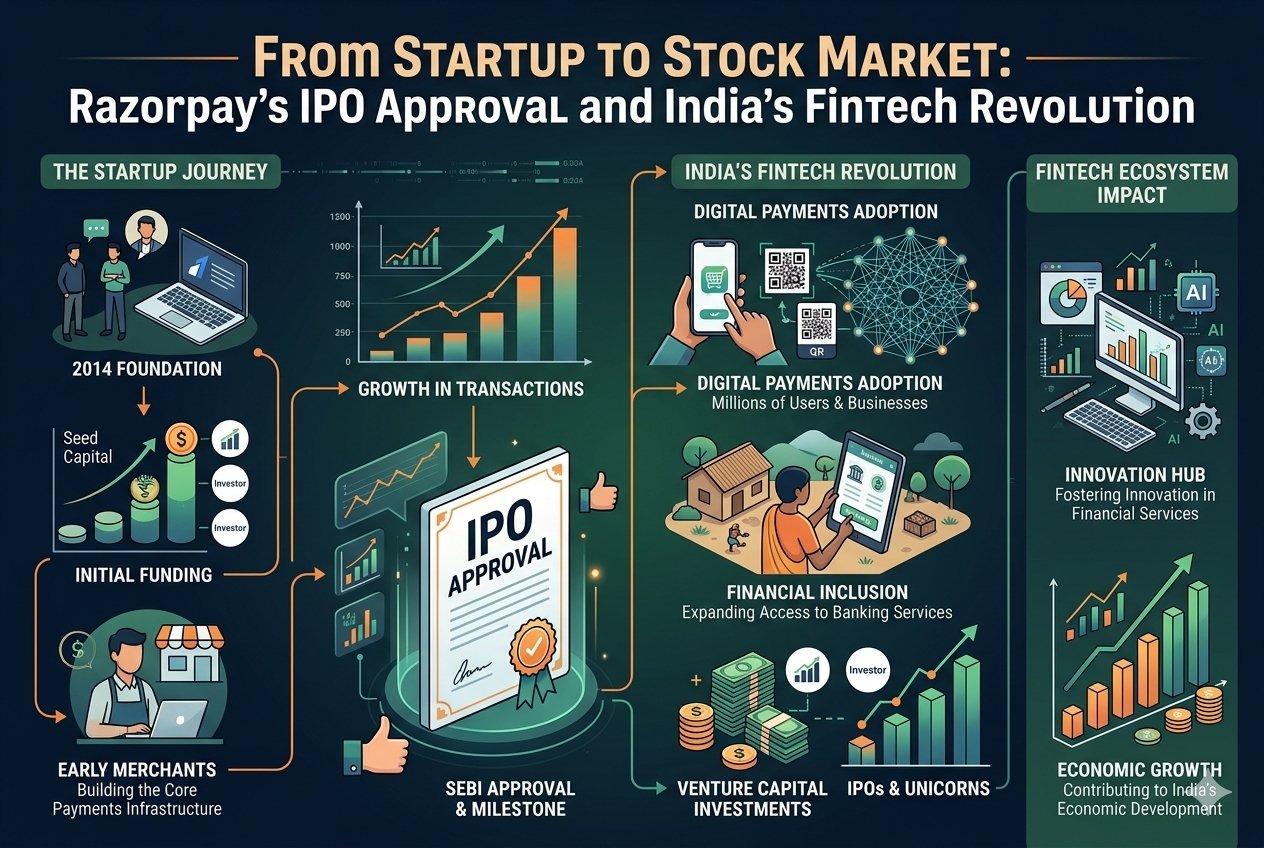
India’s fintech ecosystem is entering another important chapter. Razorpay, one of the country’s leading digital payments companies, has received regulatory approval to move ahead with its proposed Initial Public Offering (IPO). But beyond the excitement of a stock-market debut lies a bigger question: can India’s fast-growing fintech companies translate innovation and scale into sustainable profitability?
The big development
On November 13, 2026, Razorpay received approval from the Securities and Exchange Board of India (SEBI) for its proposed IPO.
Founded in 2014 by Harshil Mathur and Shashank Kumar, Razorpay began as a payment gateway helping businesses accept digital payments. Over the years, it has expanded into a broader financial technology platform, offering payment acceptance, business banking, payouts, payroll and lending-related services.
The company is reportedly targeting a public listing in the first quarter of 2027, subject to market conditions and the completion of regulatory requirements.
Media reports suggest a potential fundraising of approximately ₹5,000–6,500 crore, with an indicative valuation of around $5 billion. These figures are reported expectations, not final IPO terms.
From payment gateway to financial ecosystem
Razorpay’s growth reflects the transformation of India’s digital economy.
Businesses today need more than a mechanism to collect payments. They require integrated solutions to manage transactions, vendor payments, payroll, cash flows and financial operations.
Razorpay has attempted to address this demand by expanding beyond payment processing and building an integrated platform for businesses ranging from startups and small enterprises to large corporations.
Its journey also reflects the wider growth of digital payments in India, supported by UPI, smartphones, internet access and the increasing adoption of online commerce.
What does the IPO structure tell us?
One interesting aspect of the proposed IPO is its reported structure.
According to media reports, Razorpay’s shareholders have approved a fresh issue of shares worth approximately ₹2,700 crore, alongside an Offer for Sale (OFS) by existing investors.
The two components serve different purposes:
Fresh Issue: The company issues new shares and receives the proceeds, which can support business expansion, investment and other corporate requirements.
Offer for Sale: Existing shareholders sell some of their holdings, providing them with an opportunity to realise part of their investment. The proceeds go to the selling shareholders.
This distinction is important because the purpose of an IPO is not always limited to raising capital for the company. It can also provide liquidity to early investors.
The valuation question: Growth versus profitability
Razorpay’s proposed public listing brings an important issue into focus: how should investors value a technology-driven financial services business?
Media reports indicate that the company could be valued at around $5 billion, below the $7.5 billion valuation it reportedly achieved in its 2021 funding round.
This reflects a broader change in investor expectations. During the startup boom, companies were often valued heavily on growth potential, market share and future opportunities. Public-market investors increasingly expect a closer examination of revenue quality, profitability, cash flows and the sustainability of business models.
Razorpay reported operating revenue of approximately ₹3,783 crore in FY25, representing growth of around 65% over the previous year. However, it also reported a net loss, with employee stock option expenses and certain one-time costs contributing to the financial picture.
The message is clear: impressive revenue growth must eventually translate into sustainable earnings and cash generation.
What should investors watch?
Before evaluating Razorpay’s IPO, investors should examine several factors:
- Revenue quality: How much revenue comes from payment processing and how much from newer financial services?
- Profitability: Can the company improve margins while continuing to invest in technology and expansion?
- Competition: How will Razorpay defend its position against PhonePe, Paytm, Cashfree and other fintech players?
- Regulatory environment: How will changing rules around digital payments, data protection and financial services affect operations?
- Valuation: Does the proposed issue price reasonably reflect the company’s financial performance and future prospects?
A popular brand and a large customer base are not substitutes for sound financial fundamentals.
Why this matters for India’s startup ecosystem
Razorpay’s proposed IPO is significant beyond the company itself.
India has produced several fintech businesses that have transformed how consumers and enterprises transact. A successful public-market journey could encourage other mature startups to consider listing, provide liquidity to early investors and strengthen confidence in India’s technology ecosystem.
At the same time, the listing will test whether the market is willing to reward technology companies for long-term potential while demanding financial discipline.
The bigger picture
The journey from a startup to a publicly listed company is not merely a change in ownership structure. It marks a transition in accountability.
A private company can focus on building scale and capturing market opportunities. A listed company must also answer to public shareholders, disclose its financial performance and demonstrate that its business model can generate sustainable value.
Razorpay’s IPO journey could become an important milestone for India’s fintech industry. The next phase of the startup revolution may not be measured only by how quickly companies grow, but by how sustainably they create value.
Because in the public market, innovation may attract attention—but financial performance earns investor confidence.