When macroeconomic analysts and corporate strategists evaluate regional consumer demand across India, their attention is invariably drawn to the massive retail surges accompanying Diwali in metropolitan hubs like Mumbai, Delhi, or Bengaluru. However, a deeper examination of regional finance and supply chain economics reveals that the weeks surrounding Chhath Puja in Bihar represent one of the most powerful, localized liquidity and cash-flow cycles in the nation.
Unlike urban-centric, corporate-driven retail festivals dominated by online e-commerce aggregators, fast-moving consumer goods (FMCG) conglomerates, and discount sales, Chhath Puja operates on an entirely different economic architecture. It is a massive, decentralized economic engine anchored by micro, small, and medium enterprises (MSMEs), local agricultural producers, informal logistics networks, and grassroots financial velocity. For economic analysts and regional business owners, examining Chhath Puja from a financial perspective provides critical insights into how cultural micro-economies sustain liquidity, drive working capital rotation, and temporarily transform rural-urban financial flows in Eastern India.
1. Festival-Driven Business Turnover and Working Capital Rotation
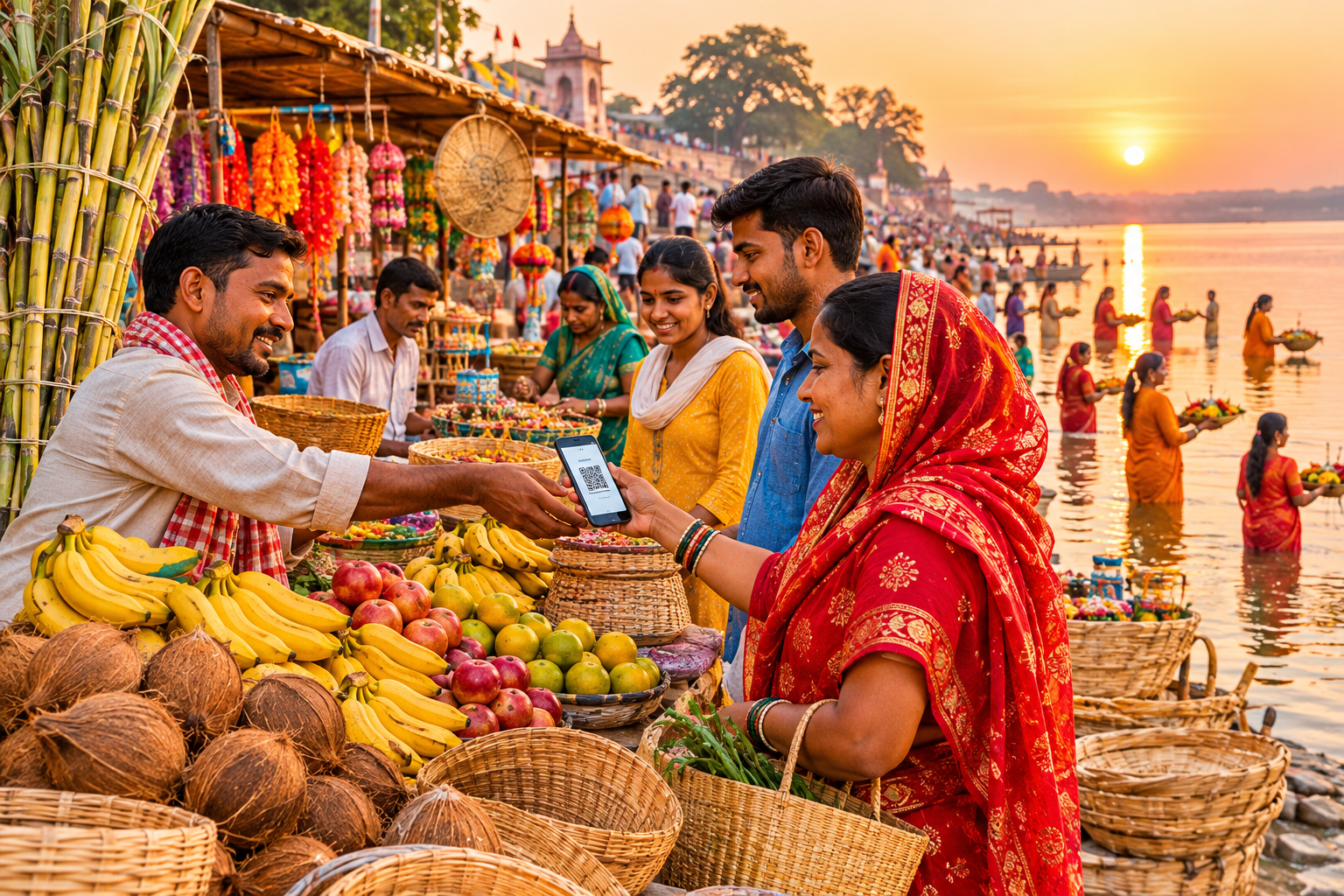
At the core of the Chhath Puja economy is an immediate and intense spike in business turnover that bypasses traditional corporate supply chains. The festival mandates a strict adherence to native, organic produce—specifically sugarcane, fresh turmeric, specific paddy varieties, coconuts, and seasonal riverbank fruits. Because these perishable commodities cannot be warehoused long-term or imported from distant industrial corridors without spoiling, intermediaries are largely bypassed.
The consumer rupee travels directly from households to local cultivators and rural weekly markets (haats). This localized velocity of money provides farmers with a crucial post-monsoon cash injection, funding their working capital needs for the rabi crop sowing season right as the festival concludes. For the agrarian sector, this acts as an informal, interest-free credit facility driven entirely by consumer demand.
2. The Contribution of MSMEs and Local Artisans
The ritualistic paraphernalia of Chhath—ranging from handmade bamboo baskets (soop), earthen stoves (chulha), and clay pots to ceremonial brassware and woven cotton garments—is largely produced by traditional artisans and cottage industries. For these MSMEs, potters, and bamboo weavers (often from marginalized communities), Chhath is their primary annual balance-sheet event.
Micro-enterprises that operate on thin margins throughout the year rely on this specific 96-hour window to achieve peak revenue realization. Unlike large corporates that rely on institutional credit lines and extended accounts receivable, these micro-enterprises depend heavily on cash-in-hand transactions. The massive surge in demand forces efficient inventory turnaround, allowing small business owners to clear supplier dues, restock raw materials, and stabilize their working capital cycles ahead of the winter lean period.
3. Seasonal Employment Generation and Informal Logistics
Chhath Puja triggers the world’s largest seasonal demographic movement, as millions of migrant workers employed in Maharashtra, Delhi, Gujarat, and southern industrial corridors return home to Bihar. This triggers an extraordinary surge in the transportation and informal logistics sectors.
While Indian Railways and domestic airlines experience peak capacity utilization, the true economic multiplier occurs at the grassroots level. Local auto-rickshaw drivers, e-rickshaw operators, rural cab aggregators, and coolies capture a significant portion of their annual earnings in less than a week. This localized velocity of money empowers daily-wage earners to build cash reserves, which are immediately ploughed back into household consumption, clearing local debt, and funding construction or home repairs—thereby stimulating rural retail demand and benefiting building material suppliers.
4. Migrant Remittances and the Cash vs. Digital Divide
The weeks leading up to Chhath witness a historic spike in inward domestic remittances into Bihar. Migrant workers dispatch substantial portions of their savings home to fund household preparations. While India has seen a massive adoption of the Unified Payments Interface (UPI), the Chhath economy remains heavily skewed towards cash transactions at the final point of sale.
Farmers selling sugarcane on the roadside and artisans selling earthen pots primarily deal in physical currency. However, the initial withdrawal of these remittances transforms dormant rural savings accounts into active transactional capital. Local banking channels and microfinance institutions register peak transaction volumes, optimizing their credit-deposit ratios and reinforcing financial inclusion in districts that otherwise exhibit low formal credit absorption.
5. The Financial Multiplier Effect on Bihar’s Economy
Analyzing Chhath Puja through a financial lens challenges traditional urban-centric paradigms of economic growth. It demonstrates that economic vibrancy is not solely generated by high-tech manufacturing or corporate capital expenditure. The Chhath economy acts as a powerful macroeconomic stabilizer for Bihar. By redistributing capital from urban industrial centers (via remittances) directly into rural agrarian pockets, the festival empowers micro-entrepreneurs, activates the informal economy, and establishes a resilient financial baseline that sustains local communities throughout the fiscal year.
Author Bio:
Vivek Kumar is a qualified Cost and Management Accountant (ACMA) and a B.Com (Accounting Honours) graduate with extensive experience in statutory and tax audits, direct and indirect taxation, and ROC/MCA corporate compliances. I specialize in financial statement finalization, GST advisory, and regulatory filings for diverse business entities. Beyond corporate practice, I actively mentor CA, CMA, and CS aspirants by providing structured academic guidance and conceptual clarity. I also design and conduct rigorous, exam-oriented test series and mock evaluations aligned with current statutory standards. Ultimately, I am dedicated to bridging practical industry expertise with focused exam preparation to empower future finance professionals.