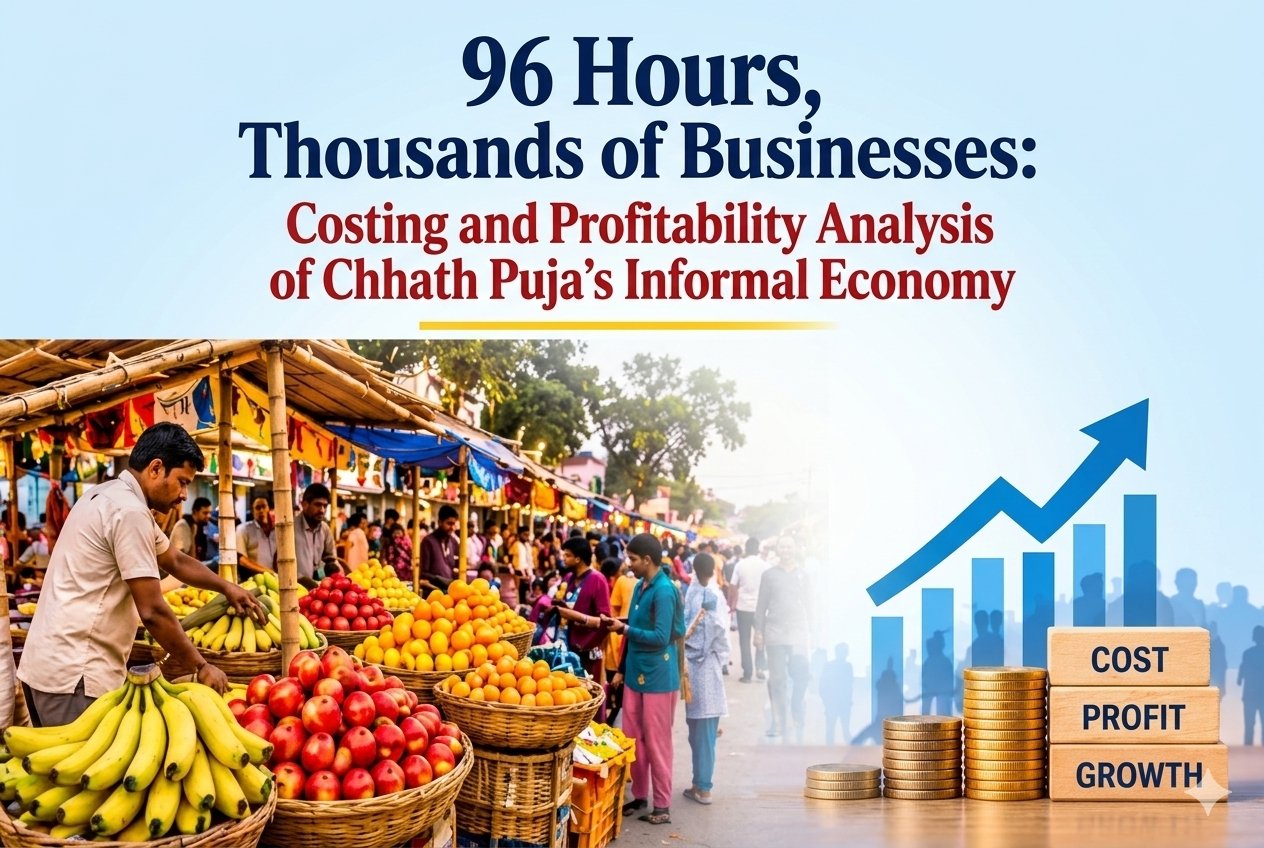
Chhath’s four ritual days sit on top of a business season that starts weeks earlier and ends in days. Fruit vendors, bamboo artisans, pop-up shopkeepers and bus operators earn a large part of their year in this window. This article builds four numerical case studies to show how thin, fast and fragile those profits are.
A note on method: prices quoted as “reported” come from news coverage in Patna and Kishanganj. Everything marked “assumed” is the author’s assumption. These are illustrative models, not survey results, and primary data from Patna and nearby districts would sharpen them.
Case 1: The fruit vendor
Reported inputs: a crate of apples at ₹2,200, apples retailing at ₹180 a kilo rising to ₹220 at Chhath, and bananas at about ₹600 a bunch. Assumed: ten apple crates of 20 kg each, 25 bunches of bananas bought at ₹450, wastage of 8% on apples and 6% on bananas, and an average apple price of ₹200.
| Item | ₹ |
|---|---|
| Purchases (apples 22,000 + bananas 11,250) | 33,250 |
| Sales (apples 36,800 + bananas 14,100) | 50,900 |
| Gross profit (34.7%) | 17,650 |
| Transport, market fee, two helpers, lighting, informal interest | 9,000 |
| Net profit | 8,650 |
That is a 17% net margin and a 26% return on ₹33,250 of working capital in roughly ten days. Operating costs of ₹9,000 mean the vendor breaks even at about 51% of projected sales.
The risk is sensitivity. If apples sell at ₹180 instead of ₹200 and wastage rises to 12% and 10%, sales fall to ₹45,180 and net profit to ₹2,930, a drop of 66% from a modest shock.
Case 2: The bamboo artisan
Reported in Kishanganj last season: over 500 artisans making about 5,000 baskets a day, each artisan making 10 to 15. One bamboo, which yields three baskets, cost ₹100, up from ₹60. Small baskets sold at ₹120 and large ones at ₹140, against ₹80 and ₹100 a year earlier. Assumed: ₹10 per basket for other materials and transport.
| Last year | This year | |
|---|---|---|
| Bamboo per basket | ₹20 | ₹33 |
| Selling price (small) | ₹80 | ₹120 |
| Margin per basket | ₹50 | ₹77 |
| Bamboo share of price | 25% | 28% |
At an average price of ₹130, the margin is about ₹87 a basket. Twelve baskets a day yields about ₹1,040 of labour income; over an assumed 25-day season, about ₹26,000 per artisan. The price rise outpaced the cost rise in rupees, but the bamboo share crept up, so the margin is exposed to the next shortage.
A caution on the cluster: 5,000 baskets a day over 25 days is about 1.25 lakh baskets, or roughly ₹1.6 crore, far below the 10 lakh baskets a local trader cited. The season may be longer, or the cluster wider, than reported.
Case 3: The temporary shop
Reported: soops at about ₹50 and coconuts at ₹80–100 in Patna. Assumed: a roadside pitch selling 600 coconuts (bought at ₹60, sold at ₹90), 300 soops (bought at ₹30, sold at ₹50) and 120 dauras (bought at ₹70, sold at ₹100).
| Item | ₹ |
|---|---|
| Stock purchased | 53,400 |
| Sales if everything sells | 81,000 |
| Gross profit (34%) | 27,600 |
| Pitch fee, helpers, lighting, transport | 7,900 |
| Net profit | 19,700 |
On paper this is a 24% net margin. The catch is unsold stock. If only 75% sells and the rest cannot be returned or resold, net profit slips to about –₹550. The shop must sell roughly 76% of what it bought just to break even. Coconuts can be held over, but soops and dauras have a short market.
Case 4: The bus operator
Reported by Business Standard in October: private Delhi–Bihar fares of ₹2,500–4,000, against usual fares of ₹840–2,000. Assumed: a 40-seat bus, a one-way cost of ₹46,000 (fuel, tolls, crew and permits), usual fare ₹1,420 and festival fare ₹3,250 (range midpoints), a 75% normal load, a full outbound festival load and a 30% load on the return.
| Round trip | Normal week | Festival week |
|---|---|---|
| Revenue | ₹85,200 | ₹147,040 |
| Cost | ₹92,000 | ₹92,000 |
| Profit | –₹6,800 | ₹55,040 |
A normal leg needs an 81% load to cover costs; in festival week the outbound leg needs only 35%. The profit is real, but it depends on a full outbound load and fares more than double the norm. An empty return leg, a late train or a regulatory cap would change that quickly.
What the cases show
- Profits are concentrated and short. Each model earns a year’s worth of margin in days, so cash flow matters more than annual profit.
- Working capital is the real cost. Vendors buy stock before sales and often borrow informally. Cheaper credit and UPI settlement would lift net margins.
- Small shocks matter. A ₹20 price drop and slightly higher wastage cut the vendor’s profit by two-thirds.
- Unsold stock is the hidden loss. Sell-through, not price, decides most pop-up shops.
These four cases are only a sample of the thousands of small businesses that Chhath sustains. Measured properly, with survey data from Patna and surrounding districts, they would show how much income this 96-hour economy puts into Bihar’s households.
Author Bio:
CMA Vivek Kumar is a associate Cost and Management Accountant (ACMA) and B.Com (Accounting Honours) graduate specializing in statutory and tax audits, direct and indirect taxation, and ROC/MCA corporate compliances. Alongside his active corporate finance practice, he mentors CA, CMA, and CS aspirants by designing exam-oriented test series that bridge practical industry expertise with academic preparation.