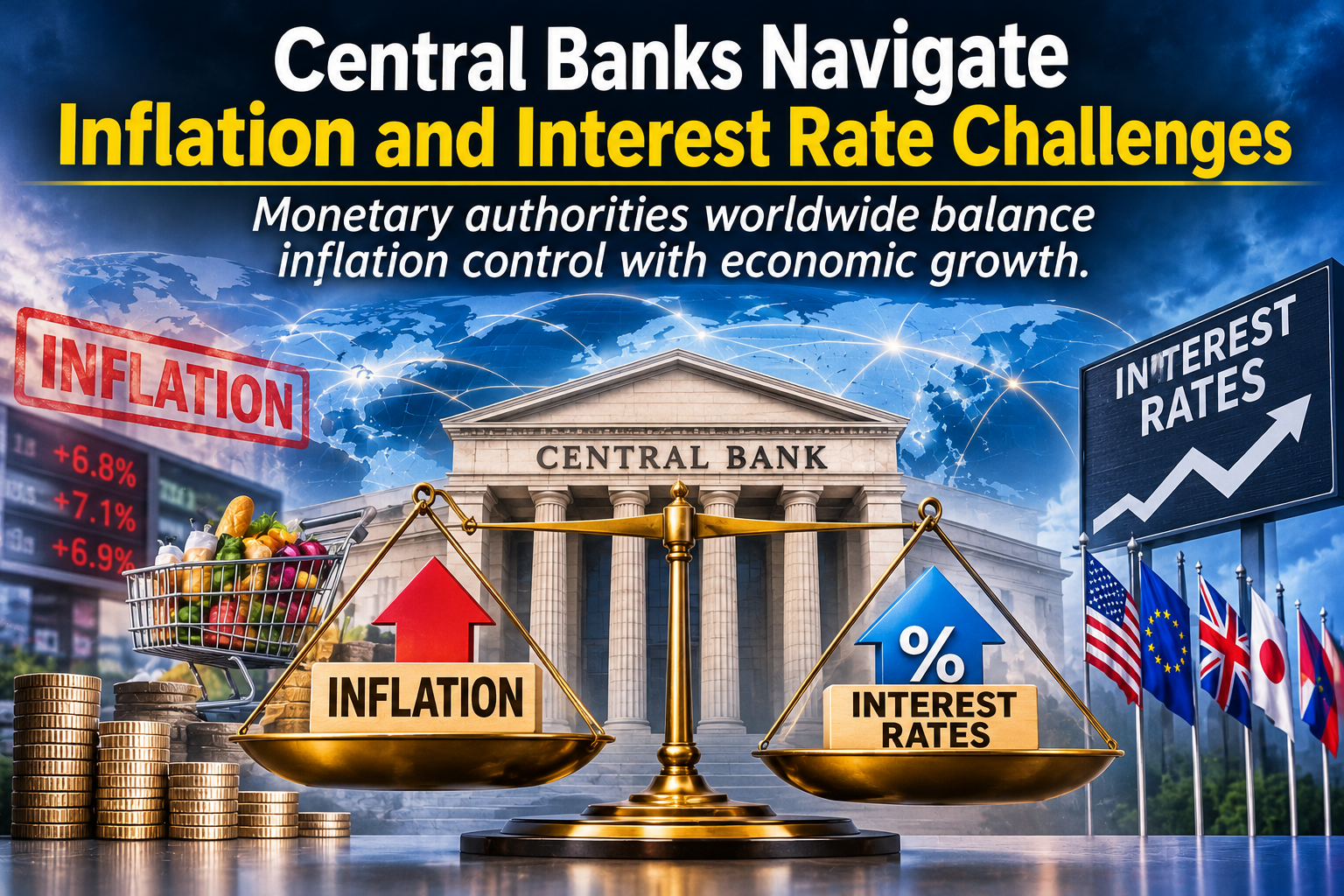
Monetary authorities worldwide face the difficult task of controlling inflation while supporting economic growth, financial stability and consumer confidence amid an evolving global economic environment.
The global economy continues to face a complex monetary policy environment as central banks navigate persistent inflationary pressures, fluctuating commodity prices, changing consumer demand and uncertain growth prospects. Monetary authorities across major economies are confronted with the challenge of maintaining price stability without weakening economic activity. Their decisions on interest rates, liquidity and monetary policy are becoming increasingly important in determining the direction of global financial markets and economic development.
Inflation remains a major concern for policymakers, particularly as the prices of essential goods, energy, housing and services continue to influence household budgets and business operating costs. While monetary tightening has helped moderate inflationary pressures in several economies, maintaining an appropriate balance between inflation control and sustainable growth remains a difficult task.
Inflation Control Remains a Major Priority
Central banks generally use monetary policy as their primary instrument to manage inflation. When inflation rises beyond acceptable levels, authorities may increase interest rates to make borrowing more expensive, moderate consumer spending and reduce excessive demand across the economy.
Higher interest rates can help slow price increases by encouraging households and businesses to save rather than borrow and spend. However, the impact of monetary tightening is not immediate. Changes in borrowing costs gradually influence mortgages, business loans, investment decisions and consumer expenditure.
Furthermore, inflation is not always driven by excessive demand. Supply-chain disruptions, geopolitical tensions, energy price fluctuations, extreme weather conditions and higher production costs can also contribute to rising prices. These supply-side pressures make inflation management particularly challenging because interest rate increases cannot directly resolve shortages or restore disrupted supply chains.
Consequently, central banks must carefully assess the underlying causes of inflation before making major monetary policy decisions.
Interest Rates and Economic Growth
Interest rates play a crucial role in determining the pace of economic activity. Lower borrowing costs generally encourage businesses to invest, expand operations and create employment opportunities. Consumers may also increase spending on housing, automobiles and other major purchases when financing becomes more affordable.
Conversely, higher interest rates can restrict borrowing, reduce investment and moderate consumption. While these measures may help control inflation, prolonged monetary tightening can also slow economic growth and increase financial pressure on households and businesses.
Small and medium-sized enterprises are particularly sensitive to changes in borrowing costs because they often depend on bank financing to manage working capital, purchase equipment and expand operations.
Central banks must therefore evaluate the broader economic consequences of their decisions rather than focusing exclusively on inflation indicators. The objective is to achieve price stability without unnecessarily restricting productive economic activity.
Global Monetary Policy Differences
Monetary policy decisions vary across countries depending on domestic economic conditions, inflation trends, employment levels and currency stability.
Advanced economies generally have greater flexibility in managing monetary conditions because of their developed financial markets and established institutions. Emerging economies, however, may face additional challenges, including currency depreciation, capital outflows, external debt obligations and dependence on imported energy and essential commodities.
Differences in interest rate policies among major central banks can also influence international capital movements. Investors may shift funds towards markets offering comparatively attractive returns, potentially putting pressure on currencies and financial stability in other economies.
For developing countries, maintaining monetary credibility while supporting domestic investment and employment remains an important policy consideration.
Impact on Businesses, Consumers and Financial Markets
Changes in interest rates affect almost every section of the economy. For businesses, higher financing costs can reduce profitability, delay expansion projects and increase the cost of managing debt. Companies operating in capital-intensive industries may face particularly significant challenges.
For consumers, higher interest rates can increase repayments on home loans, personal loans and other credit facilities. This may reduce disposable income and weaken demand for discretionary goods and services.
Financial markets also respond quickly to monetary policy announcements. Interest rate expectations influence bond yields, equity valuations, currency movements and investment strategies. Even the language used by central bank officials can influence investor sentiment, as markets closely examine policy statements for indications of future decisions.
Businesses and investors therefore increasingly rely on economic indicators, inflation reports and central bank communications to assess financial risks and plan accordingly.
The Role of Data-Driven Monetary Decisions
In an increasingly interconnected economy, central banks must adopt flexible and evidence-based policy approaches. Inflation figures, employment statistics, industrial production, consumer spending and international commodity prices provide important insights into economic conditions.
Policymakers must also recognise that economic indicators can sometimes send conflicting signals. Inflation may remain elevated even as employment growth weakens, creating difficult decisions regarding the appropriate direction of monetary policy.
Clear communication and transparency are equally important. When central banks explain their policy objectives and economic assessments effectively, they can reduce unnecessary market uncertainty and strengthen public confidence.
The Worldonomics Times View
The Worldonomics Times believes that central banks are operating in one of the most challenging monetary policy environments of recent decades. The responsibility of controlling inflation while protecting economic growth requires careful judgement, consistency and a long-term perspective.
Aggressive interest rate increases may control demand-driven inflation, but excessive tightening can weaken businesses, discourage investment and increase financial stress. Similarly, reducing interest rates prematurely may stimulate economic activity but risk allowing inflationary pressures to return.
The most effective monetary policy approach must therefore be balanced, transparent and responsive to changing economic realities. Governments must complement central bank efforts through responsible fiscal management, infrastructure investment, productivity improvements and policies that strengthen domestic supply chains.
Ultimately, sustainable economic growth cannot depend on monetary policy alone. Strong institutions, productive industries, technological innovation and stable financial systems are equally essential.
Central banks must look beyond the immediate battle against inflation and focus on building the foundations of long-term economic stability. The true measure of successful monetary policy will be its ability to preserve purchasing power while creating an environment in which businesses can invest, consumers can spend confidently and economies can grow sustainably.