RBI’s New “Stop Switch” and Government Bonds on Broker Apps: What Today’s Banking Changes Mean for You
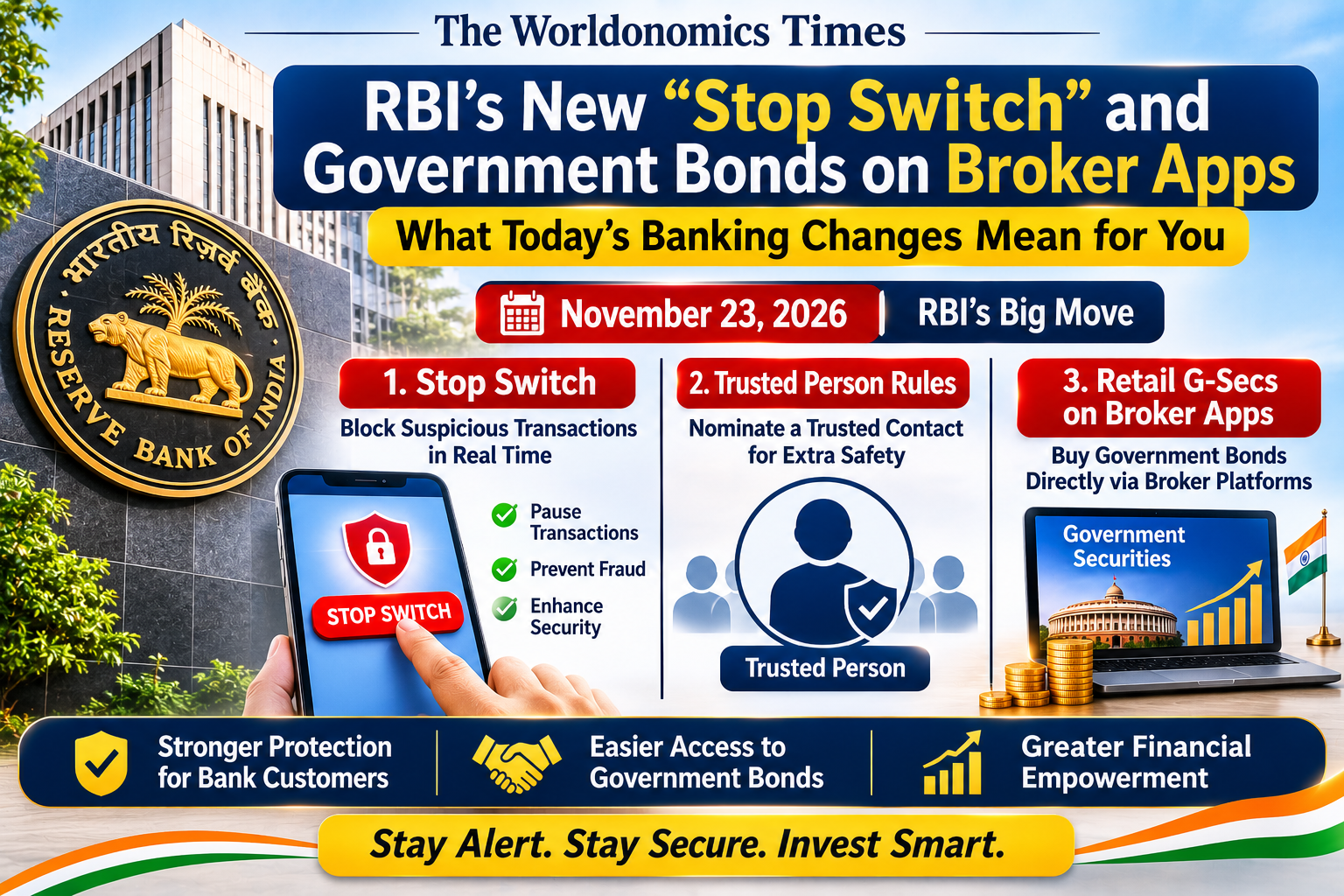
Online banking scams—from “digital arrest” calls to fake KYC links—have cost Indian bank customers crores of rupees over the last two years. At the same time, everyday retail investors still find it hard to buy safe government bonds compared to buying stocks or mutual funds. On November 23, 2026, the Reserve Bank of India (RBI) moved on both fronts with two major announcements that will change how ordinary Indians protect their bank accounts and invest their savings.
1. The One-Click “Stop Switch” for Your Bank Account
The RBI has released the draft Reserve Bank of India (Commercial Banks – Responsible Business Conduct) Fifth Amendment Directions, 2026, issued under Section 35A of the Banking Regulation Act, 1949. These rules are designed to apply across commercial banks, small finance banks, payments banks, regional rural banks, local area banks, and co-operative banks.
The headline feature is a customer-controlled “Stop Switch”. If you suspect your phone is hacked, your card is stolen, or someone is trying to scam you, you will be able to hit a single switch in your banking app or helpline to freeze all outgoing payments immediately.
Here is how the Stop Switch works in practice:
- Outgoing debits stop immediately: No transfers, card payments, or digital debits can leave the account once switched on.
- Incoming money keeps arriving: Your salary, dividends, or incoming transfers are not blocked.
- Existing EMIs stay safe: Standing instructions, recurring mandates, and bank-initiated debits like loan instalments stay outside the freeze so you do not accidentally default on a loan.
Earlier, in its April 2026 discussion paper (Exploring Safeguards in Digital Payments to Curb Frauds), the RBI had floated the idea of a mandatory one-hour cooling period on every large digital transfer. Many customers and businesses worried that a blanket delay would slow down genuine urgent payments. The RBI has now dropped that forced one-hour wait and replaced it with tools that customers can turn on and off themselves.
2. The “Trusted Person” Safety Check
To protect senior citizens and vulnerable customers from high-value scams, the draft directions introduce a voluntary Trusted Person Mechanism.
An account holder can nominate a family member or trusted contact. Both the customer and the trusted person must give clear consent. When a large transfer is initiated, the bank can route an alert or confirmation check through that trusted person.
- No account access: The trusted person cannot view your full balance or withdraw money.
- No legal liability: They are not held financially responsible for your account transactions.
- Everyday payments stay smooth: Routine UPI payments, merchant payments, and recurring NACH or e-mandates are kept out of this check so daily spending is not slowed down.
3. Default Off for New Accounts and Stricter Bank Accountability
The RBI has also proposed that when a customer opens a new bank account, digital payment channels should remain off by default. They will only turn on after the customer gives clear consent and completes authentication. Customers will also be able to set custom transaction limits, lock payments during night hours, and switch domestic or international card usage on or off across ATM, POS, online, and contactless modes.
More importantly, the RBI is widening the definition of bank negligence. A bank will be treated as negligent if it:
- Fails to send mandatory transaction alerts or provide 24×7 fraud-reporting channels.
- Delays acting after a customer reports a fraud or lost card.
- Fails to block a login channel after maximum failed password attempts.
- Ignores customer-set limits, the Stop Switch, or the Trusted Person rule.
These accountability rules build on the RBI’s June 2026 amendments on limiting customer liability in unauthorised electronic transactions. While the expanded bank negligence provisions are slated to take effect from January 1, 2027, the wider customer-control features are proposed to take effect by July 1, 2027 (or earlier if a bank is ready).
4. Buying Government Bonds on Your Stockbroker App in 2027
Alongside banking safety, the RBI is moving to make Government Securities (G-Secs) and Treasury Bills much easier for retail investors to buy. Right now, individual investors who want to buy G-Secs directly have to open a separate account on the RBI Retail Direct portal (rbiretaildirect.org.in). Because most retail investors already keep their money and portfolios on equity broker apps, Retail Direct adoption has grown slowly.
Under the RBI’s latest plan for 2027, online stockbrokers—such as Zerodha, Groww, Angel One, and others—will be able to connect directly to the RBI’s system and offer government bond buying and selling right inside their existing apps.
For a middle-class saver, this is a welcome shift:
- Sovereign safety: Government bonds carry zero default risk, backed by the Government of India.
- One portfolio view: You will be able to hold equities, mutual funds, and safe 91-day T-Bills or 10-year G-Secs in the same app without juggling multiple logins.
- Better liquidity: Bringing retail bond trading onto popular broker platforms should make it easier to exit a bond before maturity if you need cash.
Official References and Websites
- Draft Rules: Draft Reserve Bank of India (Commercial Banks – Responsible Business Conduct) Fifth Amendment Directions, 2026 (released Nov 23, 2026); earlier RBI Discussion Paper Exploring Safeguards in Digital Payments to Curb Frauds (April 2026).
- Official Portals: Reserve Bank of India — https://www.rbi.org.in | RBI Retail Direct Portal — https://rbiretaildirect.org.in
Author Bio :
CMA Vivek Kumar is a qualified Cost and Management Accountant (ACMA) and B.Com (Accounting Honours) graduate specializing in statutory and tax audits, direct and indirect taxation, and ROC/MCA corporate compliances. Alongside his active corporate finance practice, he mentors CA, CMA, and CS aspirants by designing exam-oriented test series that bridge practical industry expertise with academic preparation.