Published by: The Worldonomics Times
Date: 24 November 2026
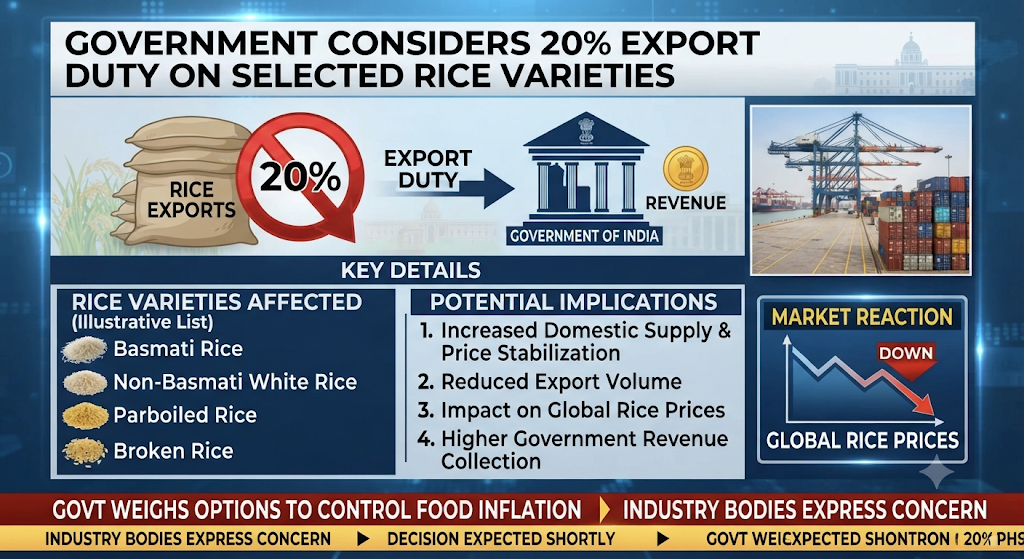
India, the world’s largest rice exporter, is considering imposing an export duty of approximately 20% on selected rice varieties to improve domestic availability and control rising prices. The proposed move could have significant implications for India’s agricultural trade, domestic food markets, rice exporters and international buyers.
According to a Reuters report dated November 23, 2026, the government is examining export restrictions on certain categories, particularly 100% broken rice and selected premium non-Basmati varieties. The discussions come amid increasing price pressures in the domestic market and concerns raised by industries dependent on rice as a key raw material. The proposal is still under consideration, with consultations involving relevant ministries expected before a final decision. <Cite refs={[“turn365555news15″,”turn365555search0”]}/>
Why Is the Government Considering Rice Export Restrictions?
Rice is one of India’s most important agricultural commodities, serving as a staple food for millions of households and contributing substantially to the country’s agricultural export earnings.
However, rising prices of certain rice varieties have created concerns about domestic affordability and supply availability. The poultry and cattle feed industries have reportedly faced considerable pressure due to increasing prices of broken rice, which is widely used in animal feed production.
The government is therefore examining whether imposing an export duty could encourage more domestic supply by making overseas shipments relatively less attractive.
By increasing the cost of exporting selected rice varieties, policymakers may be able to redirect a portion of available stocks towards domestic buyers. This could help moderate prices and improve access to essential agricultural inputs for industries.
Which Rice Varieties Could Be Affected?
The proposed restrictions are particularly focused on two categories:
1. 100% Broken Rice: Broken rice is widely used in poultry feed, cattle feed and certain industrial applications. Rising prices have affected businesses that depend on it as an affordable raw material. Restricting exports could improve domestic availability for these industries.
2. Premium Non-Basmati Rice: Certain premium non-Basmati varieties have reportedly experienced supply shortages and price increases, particularly in southern Indian states. Export restrictions could help improve domestic market availability.
Importantly, the proposal does not indicate a blanket restriction on all rice exports. The government is considering targeted measures based on specific varieties and price movements. <Cite refs={[“turn365555news15″,”turn365555search6”]}/>
Impact on India’s Rice Export Industry
India has developed a strong position in the international rice market through competitive pricing, established agricultural supply chains and a broad network of export destinations.
The introduction of a 20% export duty on selected varieties could increase the effective cost of Indian rice in international markets. This may influence purchasing decisions among overseas buyers, particularly those operating with limited profit margins.
Indian exporters could face several challenges, including:
- Higher export-related costs and reduced profit margins.
- Potential renegotiation of existing international supply contracts.
- Increased competition from alternative rice-producing countries.
- Uncertainty surrounding future export orders and pricing strategies.
Countries such as Thailand, Vietnam and Myanmar could benefit if international buyers shift some demand away from Indian suppliers. However, India’s competitive pricing advantage may allow its rice to remain attractive even after the introduction of an export duty. <Cite refs={[“turn365555news15″,”turn365555search1”]}/>
Domestic Consumers and Industries: What Could Change?
The primary objective of the proposed measure is to strengthen domestic availability and manage rising prices.
If export restrictions successfully redirect additional supplies towards domestic markets, consumers and businesses could benefit from improved access to selected rice varieties.
The poultry and livestock sectors may also gain from better availability of broken rice, potentially reducing pressure on feed manufacturers.
However, an export duty does not automatically guarantee lower retail prices. The final impact will depend on domestic production, transportation costs, procurement practices, wholesale distribution and the extent to which exporters redirect their supplies.
The government will therefore need to monitor the entire supply chain to ensure that any additional domestic availability translates into meaningful benefits for consumers and industries.
Record Rice Reserves Raise Questions About Supply Management
An important aspect of the current debate is India’s existing rice stock position. According to the Reuters report, state reserves, including unmilled paddy, stood at a record 55.3 million metric tonnes as of November 1, 2026, nearly four times the government’s target.
This has led to differing views within the agricultural trade industry.
While some industry participants support restrictions to address rising prices of specific varieties, exporters have argued that domestic supplies remain comfortable across several rice categories.
Exporters have also highlighted the importance of uninterrupted international shipments, particularly because exports help create storage capacity for incoming agricultural produce.
This difference in opinion highlights the challenge facing policymakers: balancing domestic price stability with the commercial interests of India’s agricultural export industry. <Cite refs={[“turn365555news15″,”turn365555search2”]}/>
Implications for India’s International Trade Relations
India’s rice export policies have considerable influence on international food markets because of the country’s position as a leading global supplier.
Any restrictions on selected rice varieties could influence international prices, sourcing decisions and trade relationships.
Import-dependent countries may need to explore alternative suppliers or reconsider their procurement strategies if Indian shipments become more expensive.
For India, maintaining the confidence of international buyers will remain important. Clear communication regarding the scope, duration and implementation of any proposed restrictions could help reduce uncertainty among exporters and overseas customers.
The government will also need to consider the long-term implications of export restrictions for agricultural competitiveness and India’s position in global food supply chains.
The Road Ahead: Balancing Domestic Priorities and Export Growth
The proposed 20% export duty reflects the government’s efforts to address domestic price pressures while maintaining an adequate supply of essential agricultural commodities.
However, the success of such a measure will depend on its implementation and the specific rice varieties covered.
Alongside export policy adjustments, improvements in agricultural productivity, storage infrastructure, transportation networks and market transparency could help address supply-related challenges more sustainably.
For exporters, the coming weeks will be important as they monitor government consultations and await clarity on the final policy decision.
The Worldonomics Times View
India’s consideration of a 20% rice export duty highlights an important economic challenge: balancing domestic food affordability with international trade competitiveness.
Ensuring adequate supplies of essential food commodities is a legitimate policy priority, particularly when rising prices affect consumers and industries. At the same time, India’s agricultural export sector supports farmers, businesses, employment and foreign exchange earnings.
The Worldonomics Times believes that any export restriction should be carefully targeted, transparent and responsive to actual domestic supply conditions. A blanket approach could create unnecessary uncertainty for exporters and international buyers, while a narrowly designed policy may address specific supply pressures.
More importantly, export restrictions should not become a substitute for long-term improvements in agricultural productivity, storage facilities and supply-chain efficiency.
India’s challenge is not simply to keep more rice within its borders, but to build an agricultural economy that can support domestic consumers while remaining a reliable supplier to global markets.