Bank of Korea adopts a cautious monetary policy approach as persistent inflation and strong domestic demand influence economic outlook.
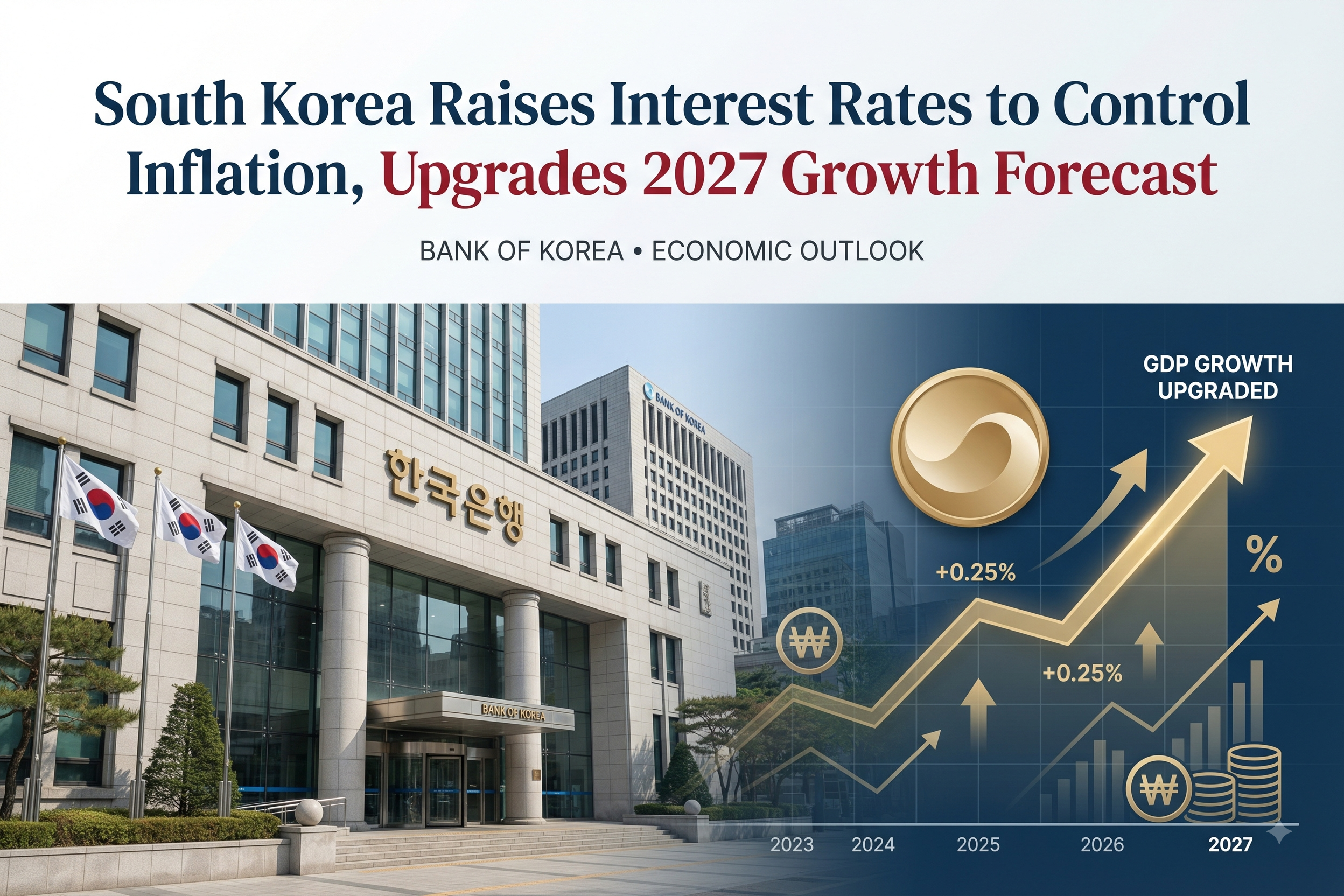
South Korea’s central bank has raised its benchmark interest rate to 3.25% in an effort to control persistent inflation and manage strong domestic demand. Alongside the monetary policy adjustment, the Bank of Korea has upgraded its economic growth forecast for 2027, signalling improved expectations for the country’s economic performance despite ongoing price pressures.
The decision highlights the challenges facing South Korea’s economy as policymakers attempt to balance price stability with sustainable economic growth. While stronger domestic demand can support businesses, employment and consumer spending, it can also increase inflationary pressure, making monetary policy decisions particularly important.
The latest move reflects the central bank’s cautious approach towards maintaining economic stability while responding to changing domestic and international conditions.
Bank of Korea Prioritises Inflation Control
Inflation remains one of the major concerns for South Korea’s economic policymakers. Rising consumer prices can reduce household purchasing power, increase business operating expenses and create uncertainty for investors.
By increasing its benchmark interest rate to 3.25%, the Bank of Korea aims to moderate excessive borrowing and spending across the economy. Higher interest rates generally make loans more expensive for households and businesses, potentially reducing demand for credit and helping ease inflationary pressures.
The central bank’s approach reflects the importance of controlling inflation before price increases become deeply embedded in consumer and business expectations.
However, monetary tightening requires careful consideration. Higher borrowing costs can also affect household consumption, corporate investment and the property market. Policymakers must therefore ensure that efforts to control inflation do not unnecessarily weaken economic activity.
Strong Domestic Demand Creates Policy Challenges
Strong domestic demand has emerged as an important factor influencing South Korea’s economic outlook.
Consumer spending, business investment and household borrowing play significant roles in determining the country’s economic momentum. When demand increases, businesses may experience higher sales, encouraging investment and supporting employment.
However, if demand grows faster than the economy’s ability to supply goods and services, prices can rise. This creates a difficult situation for central banks, which must balance economic expansion against inflation control.
South Korea’s interest rate increase suggests that policymakers are paying close attention to these demand-related pressures.
For households, higher interest rates could mean increased repayment costs on variable-rate loans and mortgages. Consumers may also become more cautious about major purchases, including homes, vehicles and other expensive products.
Businesses, particularly small and medium-sized enterprises, could face higher financing costs. Companies dependent on borrowed capital may reconsider expansion plans or delay investment decisions.
South Korea Upgrades Its 2027 Economic Growth Forecast
Despite inflation concerns, the Bank of Korea’s decision to upgrade its economic growth forecast for 2027 offers a positive signal about the country’s longer-term economic prospects.
An improved growth outlook can indicate stronger expectations for economic activity, investment and business performance. It may also strengthen confidence among domestic and international investors.
South Korea has a diversified economy supported by major industries, including semiconductors, automobiles, electronics, shipbuilding and advanced manufacturing.
The country’s technology and export sectors are particularly important to its economic performance. Global demand for semiconductors and advanced electronic products can influence industrial production, corporate earnings and overall economic growth.
A stronger economic outlook could create opportunities for businesses operating in these sectors, although international trade conditions, global demand and currency movements will continue to influence performance.
The upgraded forecast also presents a positive development for businesses planning long-term investments in South Korea.
Impact on Businesses, Consumers and Investors
The increase in interest rates is likely to have different implications for various parts of the South Korean economy.
For consumers: Higher borrowing costs may reduce disposable income for households with outstanding loans. Consumers could become more selective in their spending, particularly on non-essential goods and expensive purchases.
For businesses: Companies may experience increased financing expenses, making borrowing-dependent expansion more challenging. However, greater price stability could help businesses manage long-term operating costs.
For investors: Higher interest rates can influence equity valuations, bond yields and currency movements. Investors may reassess their portfolios as returns on fixed-income investments become more attractive relative to certain riskier assets.
For the banking sector: Higher interest rates can influence lending activity, deposit costs and bank profitability. However, the overall impact will depend on funding structures, credit quality and loan demand.
The interaction of these factors will determine how effectively the economy adjusts to tighter monetary conditions.
Global Economic Factors Remain Important
South Korea’s economy is closely connected to international markets. As a major exporter, the country is sensitive to changes in global demand, international trade policies and geopolitical developments.
Economic conditions in major trading partners, particularly the United States, China and European economies, can influence South Korean exports and industrial activity.
Currency fluctuations are another important consideration. Changes in the value of the South Korean won can affect import prices, export competitiveness and inflation.
Higher global energy prices could also create additional pressure on domestic inflation, particularly because South Korea depends significantly on imported energy resources.
Consequently, the Bank of Korea will need to monitor both domestic economic indicators and international developments when determining its future monetary policy direction.
What Lies Ahead for South Korea’s Economy?
The outlook for South Korea will depend on whether policymakers can successfully manage inflation without significantly slowing economic growth.
Investors and businesses will closely monitor upcoming inflation figures, consumer spending, industrial production, employment conditions and export performance.
The central bank’s future interest rate decisions will also remain important. If inflationary pressures begin to ease, policymakers may gain greater flexibility in adjusting monetary policy. However, persistent price increases could require a continued focus on controlling demand.
The upgraded 2027 growth forecast provides a constructive signal, but sustainable expansion will require stable prices, healthy consumer demand and continued competitiveness in international markets.
The Worldonomics Times View
South Korea’s decision to raise its benchmark interest rate to 3.25% reflects the difficult balance central banks face when inflation remains persistent despite encouraging economic growth prospects.
The upgrade to the 2027 growth forecast offers a positive indication of confidence in the country’s economic potential. Nevertheless, controlling inflation must remain a priority because prolonged price pressures can weaken household purchasing power and create uncertainty for businesses.
In our view, the success of South Korea’s monetary policy will depend on how effectively the Bank of Korea manages borrowing costs while protecting economic momentum.
For investors, the country’s strong manufacturing and technology sectors remain important areas to watch. However, investment decisions should also account for interest rate developments, currency movements and global trade conditions.
Ultimately, sustainable economic growth is not simply about achieving higher GDP figures. It also requires price stability, financial resilience and an economic environment in which households and businesses can plan confidently for the future.
South Korea’s next economic phase will therefore depend on maintaining this balance between inflation control and long-term growth.