Singapore’s labour market remained broadly resilient in 2026, but new government figures point to slower income growth and emerging employment challenges for certain groups of workers. The Ministry of Manpower (MOM), in its Labour Force in Singapore Advance Release 2026 published on November 27, reported that median gross monthly income among full-time employed residents increased to S$6,021, crossing the S$6,000 mark for the first time.
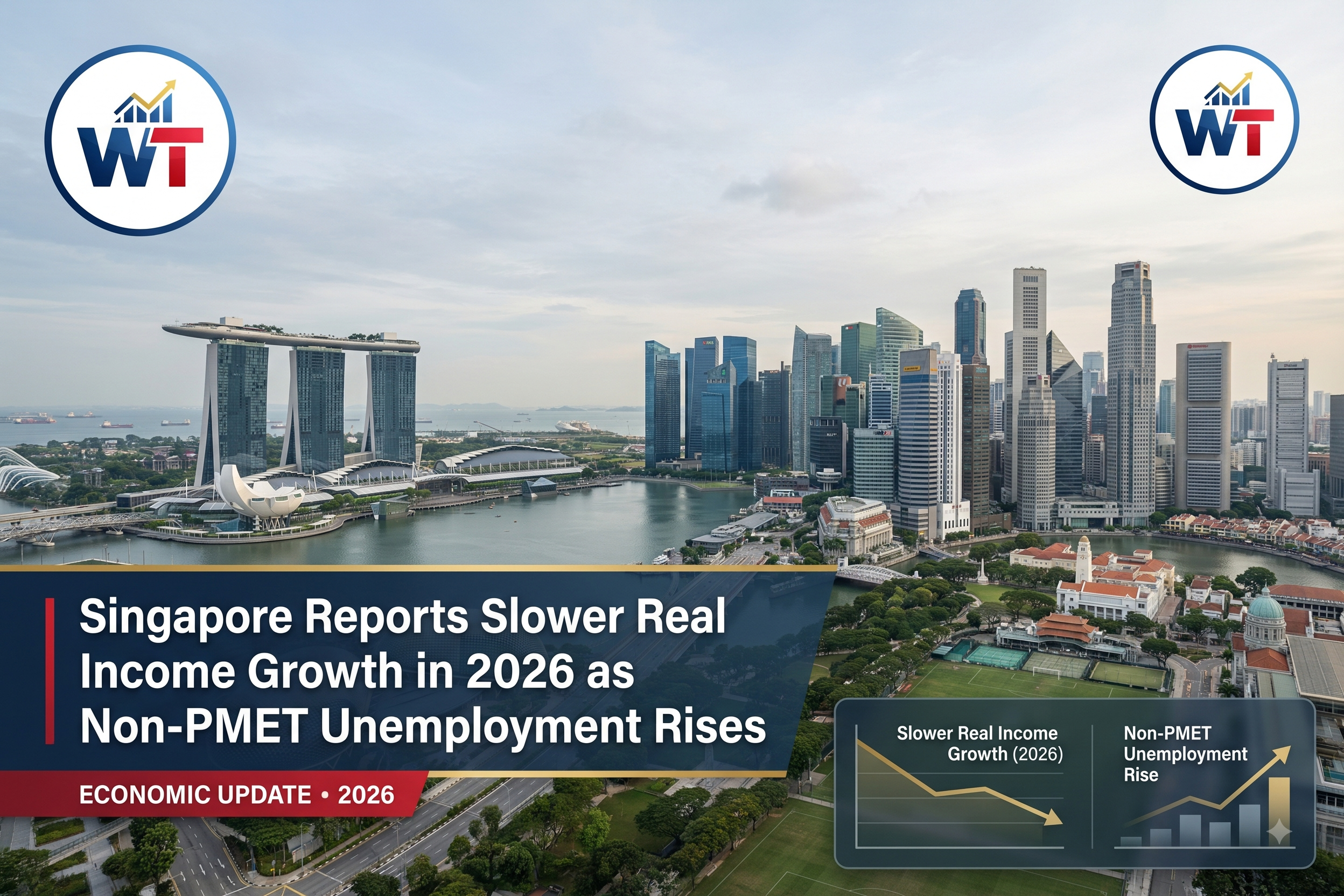
The figure represents an increase from S$5,775 in 2025. However, the improvement in nominal earnings did not translate into equally strong gains in purchasing power. After adjusting for inflation, median income growth slowed to 2.2% in 2026, compared with 4.1% in the previous year.
At the same time, unemployment among non-professionals, managers, executives and technicians (non-PMETs) increased to 3.5%, up from 2.8% in 2025. The findings highlight a labour market in which wages are still rising and overall employment remains stable, but businesses are becoming more cautious about recruitment and salary increases.
Median Monthly Income Crosses S$6,000
Singapore’s median gross monthly income for full-time employed residents rose by 4.3% in nominal terms during 2026, reaching S$6,021 from S$5,775 a year earlier.
The reported income measure includes employer or platform-operator Central Provident Fund (CPF) contributions and one-twelfth of annual bonuses. It is therefore important to distinguish this statistical measure from the take-home salary employees receive each month.
The increase reflects continued wage growth across the economy. Nevertheless, the pace of improvement moderated compared with 2025, when nominal median income increased by 5%.
For workers at the 20th percentile of the income distribution, gross monthly income increased from S$3,164 to S$3,270. This represented nominal growth of 3.4%, compared with 4.6% in the previous year.
The figures indicate that earnings continued to rise across income groups, although the pace of growth became more moderate.
Inflation Reduces the Pace of Real Income Growth
One of the most significant findings in the report is the slowdown in inflation-adjusted income growth.
Real median income increased by 2.2% in 2026, down from 4.1% in 2025. Among lower-wage workers at the 20th percentile, real income growth eased to 1.3% from 3.6%.
Real income measures the purchasing power of earnings after accounting for changes in consumer prices. When inflation rises, workers may experience a smaller improvement in their standard of living even when their nominal salaries increase.
MOM attributed the moderation partly to more cautious wage increases by employers and higher inflation.
However, the longer-term picture offers some perspective. Over the recent five- and ten-year periods, real income growth among lower-wage workers continued to outpace growth at the median. This suggests that longer-term wage improvements have helped narrow some income differences, even though annual progress varies.
The government has also indicated that Progressive Wage Measures will continue to support lower-income workers.
Non-PMET Unemployment Moves Higher
The rise in non-PMET unemployment is another important development in Singapore’s employment landscape.
The unemployment rate among non-PMET workers increased to 3.5% in 2026, compared with 2.8% in 2025. In contrast, unemployment among professionals, managers, executives and technicians remained relatively stable at 2.7%, compared with 2.8% a year earlier.
The increase among non-PMET workers was particularly evident among mature employees aged 50 and above, who may face additional challenges when seeking new employment or transitioning into different occupations.
This divergence suggests that employment conditions are not improving equally across all occupational groups.
Workers in operational, administrative, service and technical roles may experience different hiring conditions from those in specialised professional occupations. Skills requirements, business restructuring and changes in technology can also influence opportunities across sectors.
Nevertheless, the increase should be viewed in context. Non-PMET unemployment returned to levels seen during 2023 and 2024, remaining below the higher rates recorded during the pandemic period.
Employers Become More Cautious About Hiring
The report also highlighted softer hiring activity and lower job mobility during 2026.
Fewer residents changed jobs compared with the previous year, reflecting a more cautious employment environment. Businesses appeared less willing to expand their workforce or offer substantial wage increases amid economic uncertainty.
However, job mobility continued to provide opportunities for income improvement. Around seven in ten residents who changed jobs achieved real income gains, according to MOM.
Employment quality also remained broadly stable. Permanent employment accounted for approximately 91% of resident employment, while fixed-term and casual employment represented relatively smaller shares.
These indicators suggest that the labour market has not experienced a broad deterioration in job stability, even as recruitment and wage growth have moderated.
Ageing Population Influences Labour Force Participation
Singapore’s changing demographic structure is another factor shaping its employment outlook.
The resident labour force participation rate for people aged 15 and above edged down from 67.9% in 2025 to 67.8% in 2026. MOM attributed the decline mainly to population ageing.
As the proportion of older residents increases, labour force participation can moderate even when employment opportunities remain available.
The figures also highlight the importance of helping mature workers remain economically active through skills development, flexible employment arrangements and opportunities for career transitions.
Improving productivity and supporting workers in moving towards higher-value occupations will remain important for sustaining wage growth over the coming years.
The Worldonomics Times View
Singapore’s 2026 labour market figures present a balanced picture. The rise in median monthly income to S$6,021 demonstrates continued wage growth, but the slowdown in real earnings indicates that higher nominal salaries do not automatically translate into equally strong improvements in purchasing power.
The increase in non-PMET unemployment also deserves attention, particularly for mature workers and employees in occupations experiencing changing skill requirements.
Policymakers and employers will need to focus on workforce training, productivity improvements and practical opportunities for career transitions. Progressive Wage Measures can support lower-income workers, while businesses must continue adapting their workforce strategies to changing economic and technological conditions.
Ultimately, Singapore’s labour market challenge is not simply to increase average wages, but to ensure that economic growth creates sustainable employment opportunities and meaningful income improvements across different occupational and income groups.