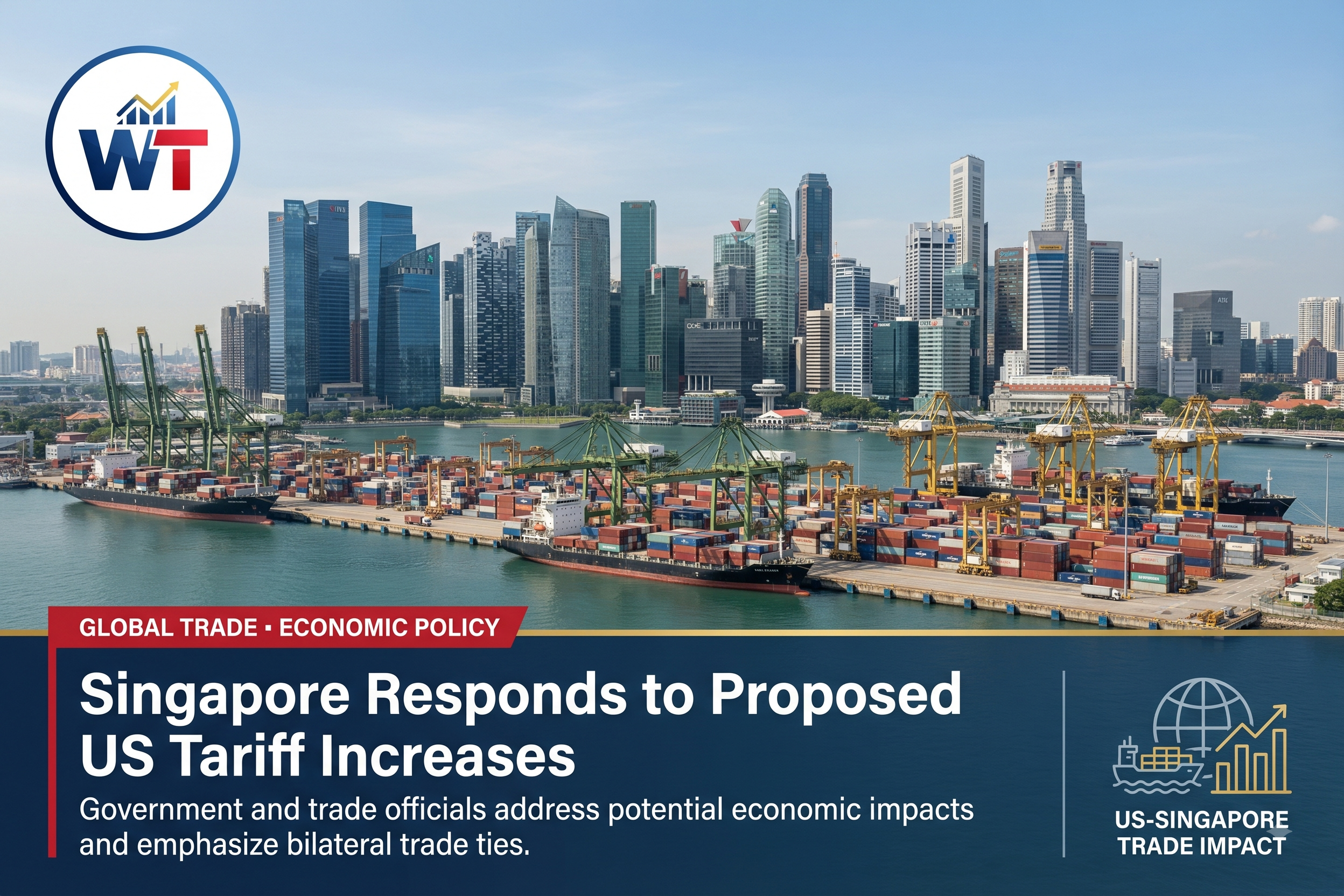
Singapore, November 27, 2026 — Singapore has urged the United States to reconsider its proposed tariff increases on Singaporean exports, expressing disappointment over Washington’s latest trade measures. Deputy Prime Minister Gan Kim Yong said the proposal came as a surprise and did not adequately account for the structure of Singapore’s economy or its longstanding trade relationship with the United States.
The development follows a report released by the Office of the United States Trade Representative (USTR) on November 25, proposing additional tariffs on 14 economies, including Singapore. The measures emerged from a Section 301 investigation into alleged structural excess capacity and production practices in selected manufacturing sectors.
Under the proposal, Singapore could face a maximum potential tariff rate of 20 per cent, in addition to existing Section 301 tariffs. The rate could be adjusted to 10 per cent if Singapore reaches an Agreement on Reciprocal Trade with Washington or concludes other negotiations addressing the findings of the investigation.
Singapore Expresses Disappointment Over US Proposal
Speaking to reporters on November 26, Gan said Singapore was disappointed and surprised by the proposed measures, particularly given the country’s established economic relationship with the United States.
He noted that Singapore and Washington already have a free trade agreement and that the two countries have maintained regular engagement on trade matters. Gan also said the issue of new tariffs had not been discussed during Prime Minister Lawrence Wong’s meeting with US President Donald Trump at the ASEAN summit in Manila earlier in November.
Singapore’s Ministry of Energy and Trade and Industry (METI) has disputed the findings of the USTR investigation. The ministry argued that the report does not sufficiently recognise Singapore’s outward-oriented, market-based economy and its position as an international business and trading hub.
Singapore also highlighted that the United States has maintained a trade surplus with the city-state for more than two decades, challenging the rationale behind the proposed action.
Billions of Dollars in Exports Could Be Affected
The proposed tariffs have raised concerns among Singaporean exporters, particularly companies with significant exposure to the American market.
Gan indicated that approximately S$9.4 billion worth of Singapore’s domestic exports to the United States are exposed to the proposed measures. If the updated tariff structure is implemented, the effective tariff burden on affected Singaporean goods could rise from 7.8 per cent to 10.3 per cent.
Potentially affected businesses may face higher costs when exporting to the US, making their products more expensive for American buyers. Companies could also encounter pressure on profit margins, pricing strategies and long-term supply arrangements.
Industries that rely on cross-border manufacturing networks may need to review sourcing decisions and contractual arrangements if the proposed measures become effective. Smaller exporters could be particularly sensitive to additional costs because they may have less flexibility to absorb higher duties.
However, the actual impact will depend on the final tariff arrangements, product coverage and any exemptions or adjustments introduced during negotiations.
Singapore Seeks Dialogue Rather Than Confrontation
Gan indicated that Singapore would continue engaging constructively with the USTR to explain its position and encourage Washington to reconsider the proposed tariffs.
Although negotiations on a new reciprocal trade agreement have not yet begun, Singapore remains open to discussions that could secure a lower tariff rate. Gan acknowledged that any agreement would likely involve give-and-take, compromises and policy trade-offs.
He stressed that Singapore would approach the discussions carefully, keeping national interests and the broader consequences for its economy at the centre of decision-making.
For a small, highly connected economy, trade policy decisions can have implications beyond individual export sectors. Singapore’s role as a regional logistics, financial and manufacturing hub means that changes to trade arrangements could influence investment decisions, supply-chain planning and its attractiveness as an international business base.
The government will therefore need to balance the immediate objective of reducing tariff exposure with the longer-term implications of any commitments made during negotiations.
Businesses Prepare for Possible Trade Disruptions
The uncertainty surrounding the proposal has prompted attention to how Singaporean businesses can manage potential changes in US trade policy.
Companies with significant American market exposure may need to examine their product classifications, export destinations and pricing arrangements. Businesses could also consider diversifying their customer base and strengthening commercial relationships in other markets to reduce dependence on a single destination.
The Singapore government has indicated that it will engage affected companies and explore ways to help businesses manage the impact of higher duties. Such support could become important if the proposed tariffs are implemented or negotiations take longer than expected.
Analysts have also noted that the immediate economic impact may be limited while the measures remain proposals. Certain products, including semiconductors and pharmaceuticals, have been subject to separate US tariff arrangements or investigations, while some other product categories have previously received exclusions. The precise exposure will depend on the final implementation details.
Wider Implications for Global Trade
The proposed US measures reflect continuing uncertainty in international trade relations, as governments reassess industrial policies, manufacturing capacity and the balance of global commerce.
For Singapore, the issue is particularly significant because its economic model depends heavily on international trade, foreign investment and reliable access to major consumer markets. Changes in tariff arrangements can influence where multinational companies manufacture goods, how supply chains are organised and where businesses choose to invest.
The dispute also highlights the importance of established trade agreements. Even countries with longstanding economic partnerships may face fresh trade barriers when governments adopt new approaches to industrial policy and market access.
Other economies affected by the USTR investigation will also be monitoring developments closely, as the outcome could influence their own trade negotiations with Washington.
The Worldonomics Times View
Singapore’s response to the proposed US tariffs illustrates the challenges facing smaller, globally connected economies in an increasingly uncertain trade environment. While the proposed measures have not yet become a final tariff arrangement, their potential effect on billions of dollars in exports makes the issue important for businesses and policymakers.
The government’s decision to pursue dialogue reflects the importance of maintaining stable economic relations with a major trading partner. At the same time, negotiations will require careful consideration of any commitments that could affect Singapore’s domestic policies, business environment and wider trade relationships.
For exporters, the immediate priority should be to assess potential exposure, monitor official announcements and prepare contingency plans without making premature decisions based on proposed measures.
The coming negotiations will be significant not only for tariff rates but also for the future direction of Singapore-US economic cooperation. A mutually acceptable outcome could help preserve trade confidence, while prolonged uncertainty may encourage businesses to reconsider their supply-chain strategies.
As discussions develop, Singapore will face the task of protecting its commercial interests while maintaining its position as a trusted international trading hub. The final outcome will offer an important indication of how smaller economies can navigate an increasingly complex global trade landscape.