By The Worldonomics Times
Investment in artificial intelligence infrastructure is emerging as an important contributor to economic activity in the United States. Technology companies are committing substantial resources to data centres, advanced semiconductors, computer equipment, cloud platforms and energy infrastructure to meet the rapidly growing demand for AI services. This spending is supporting construction, manufacturing, technology development and employment across several industries.
However, the expansion is also creating economic challenges. Rising construction costs, expensive computer components, electricity demand and pressure on existing power infrastructure are increasing the cost of developing and operating data centres. Policymakers and investors are therefore examining whether the current investment boom can deliver sustainable economic benefits over the longer term.
AI Infrastructure Drives Business Investment
The rapid development of generative AI and other advanced applications has encouraged major technology companies to expand their computing capacity. Large data centres require specialised servers, networking equipment, cooling systems, land and reliable electricity supplies.
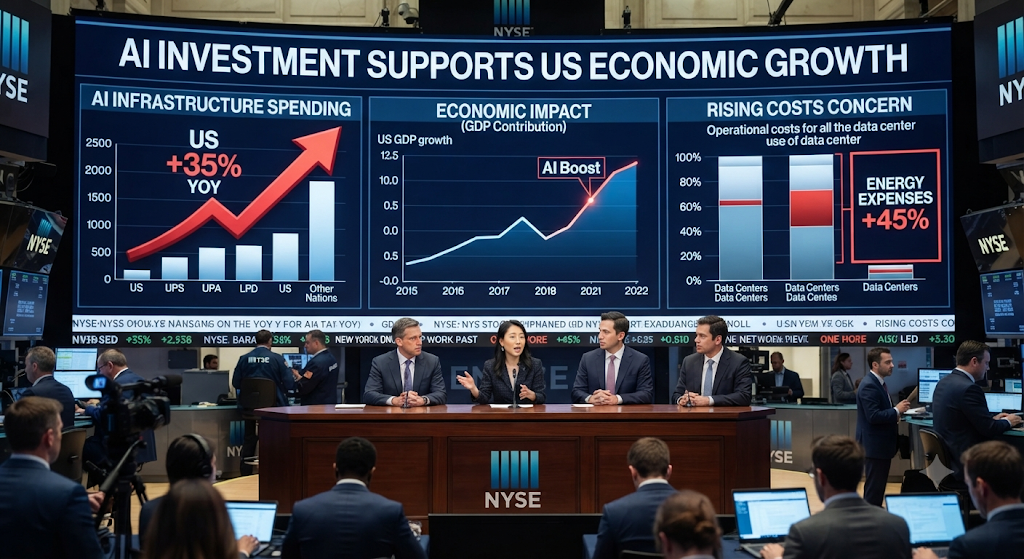
According to market research firm IDC, worldwide spending on AI infrastructure reached $121.4 billion in the second quarter of 2026, representing an increase of 53% compared with the same period a year earlier. The United States accounted for $92.8 billion, or approximately 76% of global spending. IDC also raised its forecast for worldwide AI infrastructure investment in 2026 to $521 billion.
This investment is creating demand across a broad range of industries. Semiconductor manufacturers are expanding production, construction companies are developing large facilities, and engineering businesses are supplying electrical systems, cooling equipment and other essential components.
The growth of AI infrastructure is therefore extending beyond the technology sector and becoming an important source of activity throughout the wider US economy.
Data Centre Construction Supports Economic Activity
Data centres are among the largest beneficiaries of the AI investment boom. Technology companies and cloud service providers are building new facilities to accommodate the computing requirements of AI models and digital services.
The construction sector is benefiting from demand for land development, building materials, electrical equipment, cooling systems and specialised engineering services. These projects also generate business for contractors, equipment suppliers and local service providers.
ConstructConnect reported that US data centre construction starts reached $135.8 billion across 178 projects during the first nine months of 2026. Its data also showed that the median construction cost reached $540.96 per square foot, approximately 31% higher than a year earlier.
Such investment can support employment and increase demand in regions attracting major technology projects. However, the scale and concentration of construction activity can also place pressure on local infrastructure, land availability and building resources.
AI Investment Contributes to US Economic Growth
Investment in AI infrastructure supports economic growth by increasing business spending on equipment, software, construction and research. These expenditures form part of the investment component of gross domestic product (GDP).
A November 2026 Congressional Research Service assessment identified AI-related investment as a significant source of US economic growth in recent quarters. It highlighted spending on data centres, semiconductors and other physical infrastructure as important contributors to economic activity.
Nevertheless, measuring AI’s precise contribution to GDP is difficult. Official national accounts do not provide a separate category for AI investment, so researchers rely on related measures such as computer equipment, software and data centre construction.
The impact on domestic output can also be smaller than the total investment expenditure suggests because some servers, chips and other equipment are imported. Imports are deducted when calculating GDP, meaning that gross spending does not translate directly into an equivalent increase in domestic economic production.
The Federal Reserve has similarly highlighted the importance of accounting for imported equipment when estimating the contribution of AI investment to economic growth.
Rising Electricity Demand Creates New Challenges
One of the biggest challenges associated with AI expansion is the amount of electricity required to operate data centres. Advanced computing systems need continuous power, while cooling equipment adds further demand.
The US Energy Information Administration expects national electricity consumption to reach record levels in both 2026 and 2027. According to its November outlook, consumption is projected to rise from 4,216 billion kilowatt-hours in 2025 to 4,306 billion in 2026 and 4,370 billion in 2027. Growing demand from AI data centres is among the factors contributing to this increase. <Cite refs={[“turn257342news11”]}/>
Meeting this demand requires investment in electricity generation, transmission networks, substations and grid connections. In some locations, limited power capacity is becoming a constraint on how quickly new data centres can become operational.
The expansion also raises questions about electricity affordability and the distribution of infrastructure costs. Utilities, regulators and technology companies must work together to ensure that additional demand does not place an unfair financial burden on households and other businesses.
Higher Costs and Investment Risks
Although AI investment is creating economic opportunities, the rapid expansion is increasing costs across the technology and construction sectors.
Prices of advanced semiconductors, memory components, specialised servers and electrical equipment can rise when demand exceeds available supply. Construction costs are also affected by competition for skilled labour, building materials, land and infrastructure.
IDC has identified component prices and electricity availability as important constraints on future infrastructure expansion. It expects elevated memory and component costs to remain a concern into 2027.
Another risk involves the financing of large infrastructure projects. Companies are making substantial capital commitments based on expectations that demand for AI services will continue to grow. If revenues or productivity improvements fail to meet expectations, some investments could generate lower returns than anticipated.
The Congressional Research Service has also warned that an abrupt reversal in AI investment could create wider economic difficulties, particularly if the expansion leads to excessive borrowing or financial market overvaluation. Opportunities for India
The expansion of AI infrastructure in the United States also has implications for India. Indian technology companies, software service providers and engineering businesses can benefit from increasing demand for AI development, cloud services, cybersecurity and digital transformation.
India may also attract investment in data centres and related infrastructure as international businesses seek to expand their digital capacity across different markets. Its growing technology workforce and established IT services industry provide a foundation for participating in this expansion.
However, the opportunity will depend on reliable electricity, modern telecommunications, skilled professionals and clear regulatory policies. Strengthening domestic semiconductor capabilities and supporting research in AI could also help India capture a greater share of the value created by the global technology industry.
The Worldonomics Times View
AI investment is becoming an important driver of economic activity in the United States. Spending on data centres, semiconductors, software and supporting infrastructure is creating opportunities for technology companies, construction businesses, manufacturers and energy providers.
However, the long-term benefits will depend on whether these investments generate sustainable productivity improvements and commercially viable applications. Rising construction costs, electricity demand, component shortages and financing risks must be managed carefully.
For the United States, the priority should be to expand AI infrastructure while strengthening energy capacity, improving grid efficiency and encouraging responsible investment. For India, the development offers opportunities to attract investment, expand technology services and strengthen its position in the global digital economy.
Ultimately, AI’s contribution to economic growth will be measured not only by the amount of money invested in infrastructure but also by how effectively businesses use the technology to improve productivity, create value and support long-term prosperity.