The Worldonomics Times
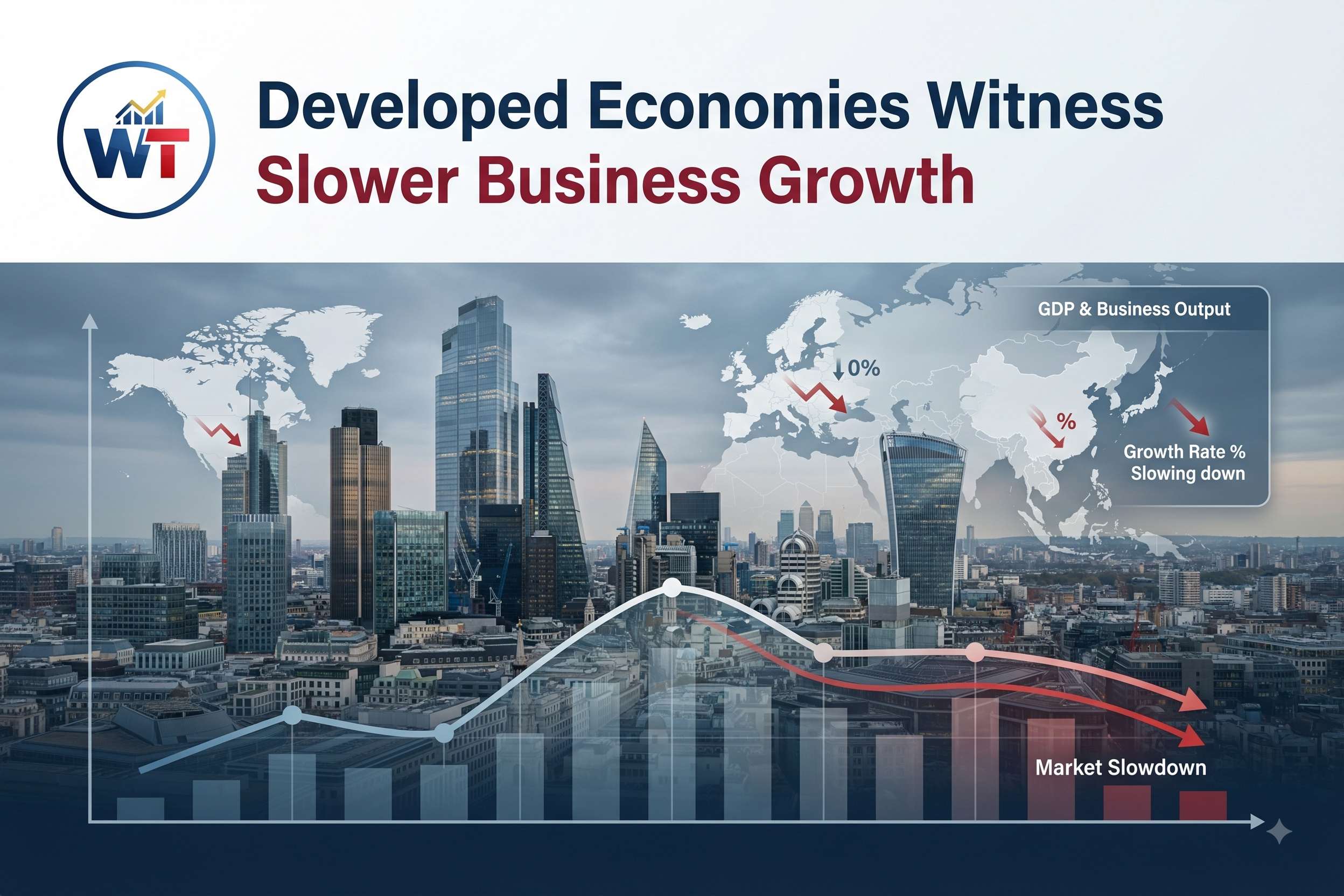
Business activity across several major developed economies is showing signs of losing momentum, as recent business surveys point to slower economic expansion in the United States, the United Kingdom, Japan, and the eurozone. Persistent inflation, elevated borrowing costs, geopolitical uncertainty, and cautious consumer spending are creating challenges for businesses across manufacturing and services.
The latest November 2026 flash Purchasing Managers’ Index (PMI) surveys published by S&P Global indicate that growth across these four major economies has slowed for a second consecutive month. Although all four continue to record overall business expansion, the pace has weakened, raising questions about the strength of the global economic outlook.
The development is particularly important because these economies represent a substantial share of global production, consumption, investment, and international trade.
Business Surveys Signal a Cooling Economic Environment
The Purchasing Managers’ Index is an important indicator of economic activity. It is based on surveys of business executives and provides insights into production, new orders, employment, supplier deliveries, and business confidence.
A PMI reading above 50 generally indicates expansion, while a reading below 50 suggests contraction compared with the previous month.
November’s flash survey results show that business growth has moderated across the major developed economies. The US composite PMI declined to 54.6 from 55.9 in October, indicating continued expansion but at a slower pace. The UK’s reading eased to 52.3 from 52.9, while Japan’s composite PMI fell to 51.5 from 52.1.
The eurozone remained unchanged at 51.7, indicating steady but relatively modest expansion. These figures suggest that economic activity remains positive, although the momentum seen in earlier months is becoming weaker. Source: S&P Global November 2026 surveys
United States Continues to Lead, but Growth Slows
The United States remains the strongest performer among the four major developed economies, supported by relatively resilient consumer demand, services activity, and business investment.
However, the latest survey indicates that American business expansion has lost some momentum. The November composite PMI declined to 54.6, its lowest level since July.
Services activity continued to outperform manufacturing, although both sectors recorded slower growth. Businesses reported that high prices, affordability concerns, supply disruptions, and uncertainty were affecting new orders.
Manufacturers also faced challenges involving input availability and longer supplier delivery times. These conditions can restrict production and increase operating costs.
Despite the slowdown, the survey continues to indicate a relatively strong US economic performance. The challenge will be whether businesses can maintain demand and investment levels while managing elevated costs and tighter financial conditions.
United Kingdom Faces Pressure from Costs and Weaker Hiring
The UK economy continues to expand, but November’s business survey indicates a modest slowdown in activity.
The composite PMI declined from 52.9 in October to 52.3 in November. Services continued to support overall growth, although the pace of expansion weakened.
One of the major concerns is the employment outlook. Businesses are facing pressure from higher operating expenses, including wages, energy, and other input costs. Some companies are responding by controlling recruitment and improving productivity rather than increasing their workforce.
Although business confidence has shown signs of improvement, persistent inflation and uncertainty surrounding future demand remain important challenges.
For the Bank of England, this creates a difficult policy environment. Slower economic growth may argue for caution, while continuing price pressures could make monetary easing more complicated.
Eurozone Growth Remains Uneven
The eurozone continues to experience a mixed economic environment, with significant differences between individual member economies.
The November composite PMI remained unchanged at 51.7, suggesting continued but modest expansion. However, the regional average hides considerable differences in national performance.
Germany recorded stronger manufacturing-led activity, while France continued to face contractionary pressures. Other parts of the region also experienced varying growth conditions.
Higher borrowing costs, weak demand in some sectors, political uncertainty, and elevated production expenses are affecting business confidence.
European manufacturers are particularly sensitive to energy prices, international competition, and changes in export demand. Businesses must also manage the cost of financing investment at a time when economic visibility remains limited.
The region’s ability to sustain growth will depend on industrial recovery, consumer spending, investment, and the stability of international trade. Source: S&P Global Eurozone November PMI
Japan Experiences a Further Loss of Momentum
Japan has also reported slower business activity, with its November composite PMI falling to 51.5 from 52.1 in October.
Although the reading remains above the 50-point threshold, the decline indicates that the pace of expansion has weakened.
Japanese businesses continue to navigate changing domestic price conditions, currency movements, labour-market challenges, and uncertainty in international demand.
Manufacturers are particularly exposed to fluctuations in global trade because Japan has a strong export-oriented industrial base. Changes in demand for automobiles, machinery, electronics, and industrial components can influence production and investment decisions.
Rising operating expenses and cautious consumer spending may also affect companies’ growth plans. Maintaining productivity and supporting domestic demand will therefore remain important priorities for the Japanese economy.
Inflation and Higher Borrowing Costs Affect Businesses
One common challenge across developed economies is the combination of persistent cost pressures and elevated financing expenses.
Although November’s surveys indicated some moderation in input-cost and selling-price inflation, prices continued to rise at relatively high rates.
Businesses facing higher wages, raw material expenses, energy bills, and transportation costs may find it difficult to maintain profit margins. Passing these costs on to customers can weaken demand, while absorbing them can reduce profitability.
Higher interest rates add another layer of pressure. Companies may delay expansion projects, reduce borrowing, or postpone recruitment because financing has become more expensive.
Small and medium-sized enterprises are particularly vulnerable because they often have fewer financial resources and less flexibility than large corporations.
Implications for Global Trade and Investment
Slower growth across major developed economies can have consequences for international markets.
When businesses in the US, UK, Japan, and eurozone become more cautious, demand for imported goods, industrial components, raw materials, and services may weaken.
Export-oriented economies could therefore face reduced orders, while international manufacturers may reconsider production and investment plans.
Emerging economies, including India, could experience indirect effects through changing export demand, capital flows, currency movements, and commodity prices. However, countries with strong domestic consumption and diversified production may be better positioned to manage external uncertainty.
Businesses will increasingly need to focus on cost efficiency, market diversification, supply-chain resilience, and productivity improvements.
What Lies Ahead for Developed Economies?
The coming months will be important in determining whether the current slowdown represents a temporary moderation or the beginning of a more sustained period of weaker economic activity.
Consumer spending, employment trends, inflation, interest rate decisions, and international trade developments will influence the direction of growth.
Central banks must carefully balance the need to control inflation against the risk of weakening economic activity. Governments, meanwhile, will need to encourage investment, improve productivity, and support businesses facing structural and financial challenges.
The Worldonomics Times View
The Worldonomics Times believes that the latest business surveys highlight a growing challenge for developed economies: maintaining economic expansion while managing persistent inflation, higher financing costs, and uncertain global conditions.
The slowdown should not automatically be interpreted as an economic contraction. The four major economies are still recording overall expansion, but the weakening pace of growth deserves close attention.
Policymakers should avoid relying exclusively on short-term monetary measures. Sustainable growth requires stronger productivity, investment in modern infrastructure, workforce development, technological innovation, and predictable business policies.
Businesses must also adapt by improving operational efficiency, diversifying suppliers, adopting digital technologies, and identifying new sources of demand.
For emerging economies such as India, the changing environment presents both risks and opportunities. Strong domestic demand, competitive manufacturing, and diversified export markets can help reduce dependence on slower-growing developed economies.
The Worldonomics Times believes that the real priority for developed economies should be to convert resilience into sustainable growth. A balanced combination of responsible economic policies, business investment, innovation, and international cooperation will be essential to maintaining global economic stability.