The Worldonomics Times | November 2026
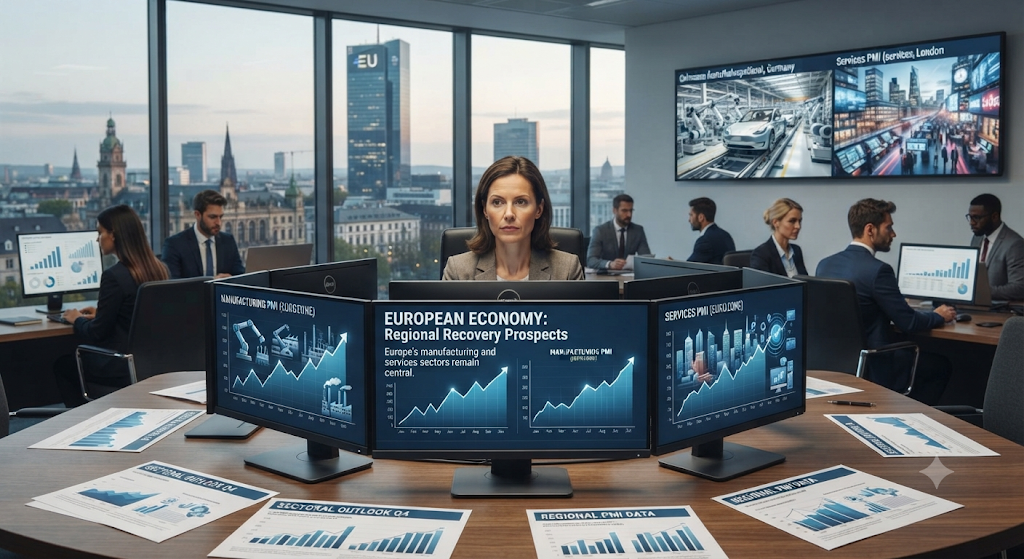
Europe’s economic recovery continues to depend heavily on the performance of its manufacturing and services sectors, two major pillars of regional economic activity. While the services industry has demonstrated resilience in several European economies, manufacturing continues to face challenges associated with weak external demand, elevated operating costs, global competition and changing trade conditions. The contrasting performance of these sectors is shaping the region’s growth outlook and influencing business confidence, investment decisions and employment prospects.
As European economies navigate an uncertain global environment, policymakers are focusing on strengthening industrial competitiveness, supporting domestic demand and encouraging investment in technology, infrastructure and sustainable production. The ability to balance industrial recovery with continued expansion in services will remain essential to achieving more stable and inclusive economic growth.
Manufacturing Sector Faces a Challenging Environment
Manufacturing remains a critical component of Europe’s economic structure, supporting exports, employment, industrial innovation and regional supply chains. Major economies such as Germany, France and Italy have traditionally relied on strong manufacturing capabilities, particularly in automobiles, machinery, chemicals, pharmaceuticals and advanced engineering.
However, European manufacturers continue to operate in a demanding environment. High energy and production costs, international competition and uncertain global demand have placed pressure on industrial activity. Companies in energy-intensive industries, including chemicals, metals and heavy manufacturing, have been particularly sensitive to changes in electricity and natural gas prices.
The automotive industry is also undergoing a significant transformation. The shift towards electric vehicles, battery technology and cleaner transportation systems is creating new investment opportunities while increasing competitive pressure. European manufacturers are working to modernise production facilities, strengthen battery supply chains and maintain their position in international markets.
Despite these challenges, investment in automation, artificial intelligence, advanced materials and digital manufacturing could improve productivity and support long-term industrial competitiveness.
Services Sector Provides Support to Economic Activity
The services sector has become an important source of stability for Europe’s economy. Industries such as tourism, hospitality, financial services, information technology, healthcare, education, logistics and professional consulting continue to contribute significantly to employment and economic output.
Tourism remains particularly important for countries such as Spain, Italy, France, Greece and Portugal. International visitors support businesses across accommodation, transportation, restaurants, retail and entertainment. Strong travel demand can also benefit smaller businesses and regional economies.
Financial and professional services remain central to major European business centres, including London, Paris, Frankfurt, Amsterdam and Zurich. Meanwhile, technology-related services are expanding as companies adopt cloud computing, cybersecurity solutions, artificial intelligence and digital payment systems.
However, the services sector is not immune to economic pressures. Higher household expenses can affect consumer spending on travel, leisure and discretionary services. Businesses are also facing wage pressures, labour shortages in selected industries and the need to invest in digital infrastructure.
Maintaining consumer confidence and improving workforce skills will therefore be important for sustaining services-sector growth.
Consumer Spending and Business Investment Shape Recovery
Domestic consumption remains a major factor influencing Europe’s economic performance. Household spending depends on employment conditions, wage growth, inflation and confidence about future financial stability.
When inflation moderates and real incomes improve, consumers may increase spending on retail, travel, restaurants and other services. This can support businesses, encourage hiring and strengthen demand across the regional economy.
Business investment is equally important. Manufacturers require capital to modernise equipment, improve energy efficiency and develop new products. Service companies are investing in technology, workforce training and infrastructure to improve productivity and remain competitive.
However, uncertainty surrounding interest rates, global trade conditions and future demand may lead some companies to postpone major investment decisions. Predictable economic policies and access to finance will be important in encouraging businesses to expand their operations.
Energy Costs and the Green Transition Remain Key Priorities
Energy security and affordability continue to influence Europe’s industrial outlook. Manufacturers require reliable and competitively priced energy to maintain production and compete with international producers.
The transition towards renewable energy is creating opportunities in solar power, wind energy, hydrogen, battery storage and electricity networks. These investments could reduce exposure to fossil-fuel price volatility while supporting the development of new industries.
Nevertheless, the transition requires substantial investment in infrastructure, technology and workforce capabilities. Policymakers must also ensure that environmental objectives are balanced with industrial competitiveness and affordable energy supplies.
For European businesses, improving energy efficiency and adopting cleaner production methods are increasingly important strategic priorities.
Trade, Competitiveness and Global Economic Conditions
Europe’s recovery is closely connected to international trade. Its manufacturers and service providers depend on access to global markets, reliable supply chains and stable commercial relationships.
Changes in trade policies, tariffs and geopolitical conditions can influence export demand and production costs. European companies are increasingly examining supply-chain diversification, regional sourcing and strategic partnerships to reduce exposure to external disruptions.
At the same time, competition from the United States and Asian economies is encouraging European policymakers to strengthen innovation, improve productivity and support investment in strategic industries.
The region’s ability to remain competitive will depend on its capacity to combine advanced manufacturing, high-value services, technological innovation and a skilled workforce.
The Worldonomics Times View
Europe’s economic recovery cannot depend on manufacturing or services alone. Both sectors are interconnected and contribute to the region’s overall economic resilience. Manufacturing creates demand for logistics, finance, engineering and professional services, while a strong services industry supports industrial investment, innovation and international business activity.
The priority for European policymakers should be to create an environment that encourages investment, supports industrial modernisation and strengthens consumer confidence. Reducing unnecessary regulatory complexity, improving energy infrastructure, expanding digital capabilities and developing skilled labour will be important steps towards sustainable growth.
Europe also needs to strengthen its position in emerging industries, including artificial intelligence, clean energy, advanced manufacturing and digital services. Strategic investment in these areas could help the region create new employment opportunities and improve its global competitiveness.
Outlook: Balanced Growth Will Determine Europe’s Economic Strength
Europe’s economic outlook will depend on how effectively its manufacturing and services sectors respond to changing market conditions. A recovery in industrial production, combined with resilient consumer demand and expanding technology-driven services, could provide a stronger foundation for regional growth.
Challenges remain, particularly around energy affordability, international competition, investment uncertainty and workforce development. However, Europe’s established industrial base, skilled labour force, developed financial markets and technological capabilities provide important advantages.
The coming period will test the region’s ability to turn economic challenges into opportunities for modernisation. A balanced recovery supported by competitive manufacturing and dynamic services will be essential to strengthening Europe’s position in the global economy.
The Worldonomics Times | Bringing global economic developments, financial insights and business perspectives into focus.