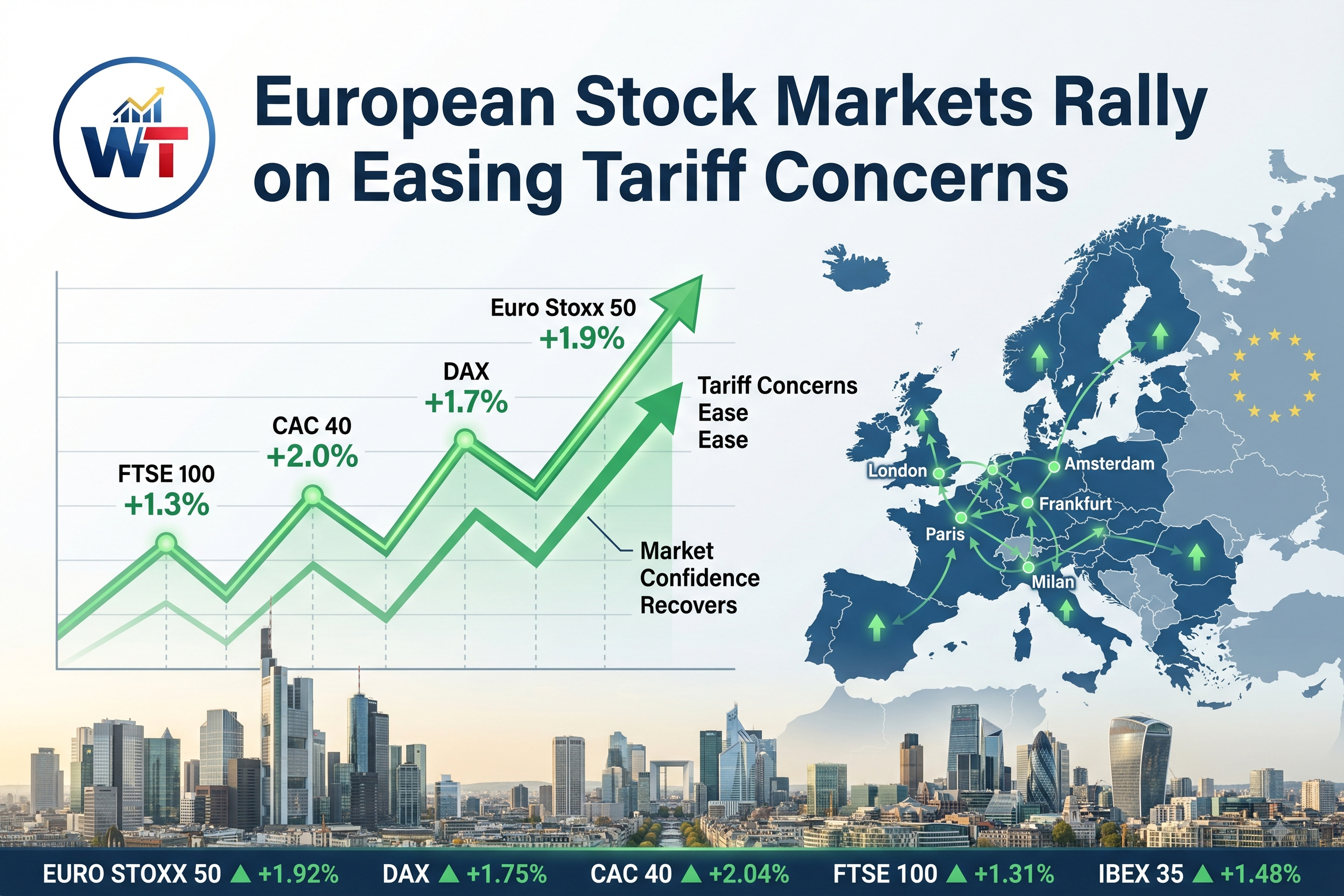
European stock markets staged a strong recovery on Thursday, November 26, as investors welcomed signs that proposed US tariffs on the European Union and other major trading partners could be less severe than initially feared. The easing of trade-related concerns encouraged buying across major European exchanges, with banking, technology, mining, automobile and defence stocks leading the advance.
The pan-European STOXX 600 index climbed 1.8% to close at 636.98 points, recovering from losses recorded earlier in the week. Germany, Spain and Italy recorded gains of more than 2%, reflecting a broad improvement in investor sentiment. The rally indicated that markets were responding positively to the possibility of a more measured approach to US trade restrictions.
The development provided relief to investors who had been concerned about the potential impact of higher import duties on European exporters, manufacturing companies and international supply chains. Although trade uncertainty remains, the latest signals reduced fears of an immediate escalation in transatlantic trade tensions.
Softer US Tariff Signals Boost Investor Confidence
The main driver behind Thursday’s rally was a change in expectations surrounding proposed US tariffs. The US Trade Representative’s office indicated that new duties could be capped at lower levels agreed under trade agreements that have been completed or remain under negotiation.
The United States and the European Union had previously agreed on a 15% tariff rate. Investors welcomed indications that proposed measures could remain within this framework rather than create an additional layer of duties.
Reports also suggested that the proposed tariffs would not simply be added on top of the duties introduced in July. Their implementation may be delayed until February or March 2027, giving businesses more time to assess potential changes and adjust their supply chains.
This helped reduce immediate concerns about a sudden increase in trade costs. However, the proposals still require further regulatory and policy developments, meaning businesses cannot yet consider the issue fully resolved.
Major European Indices Record Strong Gains
The improvement in sentiment was visible across major European markets.
The STOXX 600 advanced 1.8% to 636.98 points, while Germany’s DAX, Spain’s IBEX and Italy’s FTSE MIB each gained more than 2%. The broad-based movement indicated that investors were returning to several sectors rather than concentrating their purchases in a small group of companies.
The rally followed a difficult trading session earlier in the week, when concerns about tariffs, inflation, interest rates and artificial intelligence valuations had contributed to selling pressure.
Investors appeared more willing to take positions in European equities once the latest trade proposals looked less damaging than initially anticipated. The recovery also reflected improved confidence in the ability of businesses to manage potential changes in international trade policy.
Banking and Technology Stocks Lead the Advance
Banking and technology shares were among the important contributors to the market recovery.
Major banking stocks benefited from renewed buying interest after experiencing pressure during the previous session. Deutsche Bank and Standard Chartered were among the financial companies supporting the advance in early trading.
Technology shares also recovered, with semiconductor-related companies including Infineon Technologies and Soitec attracting investor attention. Their gains reflected improving confidence in the technology sector following recent volatility surrounding artificial intelligence investment and semiconductor valuations.
Other major sectors also participated in the rally. Mining, automobile and defence stocks recorded gains of more than 3% in the STOXX 600 during Thursday’s session.
The broad participation was encouraging for investors because it suggested that the improvement in sentiment extended beyond technology and financial companies.
Trade Uncertainty Remains a Risk for European Businesses
Despite the positive market response, trade uncertainty continues to represent a major challenge for Europe’s economy.
The European Union maintains extensive commercial relationships with the United States, making tariff developments particularly important for exporters. Automotive manufacturers, industrial equipment producers, pharmaceutical businesses and other internationally exposed companies could face higher costs if trade restrictions increase.
Tariffs can affect companies in several ways. They may increase the cost of exporting goods, reduce competitiveness in overseas markets and force businesses to reconsider production locations and supply-chain arrangements.
Smaller companies could face particular difficulties because they often have fewer resources to absorb higher costs or reorganise international operations.
The latest US signals have reduced immediate fears, but investors will continue monitoring negotiations and official announcements. Any renewed escalation could quickly affect European equities and business confidence.
ECB Leadership Developments Add to Market Attention
Investors were also monitoring developments surrounding the European Central Bank’s future leadership.
The nomination of Spanish central banking veteran Pablo Hernández de Cos to succeed Christine Lagarde as ECB president was viewed by market participants as a signal of potential policy continuity.
Central bank leadership matters because monetary policy decisions influence borrowing costs, inflation expectations, currency movements and investment conditions across the eurozone.
Markets will continue assessing the future direction of interest rates, particularly as policymakers balance inflation risks against the need to support economic activity.
The combination of easing tariff concerns and expectations of policy continuity helped create a more favourable environment for European equities during Thursday’s session.
Global Market Conditions Continue to Influence Europe
European markets are closely connected to developments in the United States and Asia. Changes in global interest-rate expectations, technology investment, commodity prices and geopolitical conditions can influence European corporate earnings and investor sentiment.
The US Thanksgiving holiday also contributed to lighter trading conditions on Thursday. With Wall Street closed, European investors had fewer fresh signals from the world’s largest equity market.
While reduced trading activity can sometimes amplify price movements, the broad-based nature of the European advance indicated that investors were responding to the improved tariff outlook.
Technology-sector volatility nevertheless remains an important concern. Investors are increasingly examining whether substantial artificial intelligence investments can generate sustainable profits and whether current technology valuations are justified by future earnings.
Outlook for European Stock Markets
The near-term outlook for European equities will depend on whether the improvement in trade sentiment continues and whether companies can maintain earnings growth amid uncertain economic conditions.
A more predictable tariff environment could support exporters, encourage investment and reduce pressure on businesses with international supply chains. Stronger performance from banking, industrial and technology companies could also help sustain market momentum.
However, risks remain. Inflation, interest-rate uncertainty, geopolitical tensions and possible changes in US trade policy could create further volatility.
Investors will also monitor upcoming economic indicators and corporate earnings for evidence that Europe’s business environment is improving.
Thursday’s rally provides an encouraging sign, but a sustained recovery will require greater clarity on trade policy and stronger confidence in the region’s economic outlook.
The Worldonomics Times View
The rally in European stock markets demonstrates how strongly investor sentiment responds to changes in international trade expectations. The possibility of less severe US tariffs helped restore confidence and encouraged buying across several major European sectors.
However, markets should not interpret softer tariff signals as the complete resolution of trade tensions. Businesses still face uncertainty over future duties, regulatory decisions and the potential impact on global supply chains.
Europe’s long-term competitiveness will depend on its ability to strengthen industrial capacity, encourage technological innovation and maintain stable international trading relationships.
The latest gains offer a positive development for investors, but the durability of the recovery will depend on policy clarity, corporate earnings and broader economic stability. A more predictable trade environment could provide valuable support to European businesses and financial markets in the months ahead.