Shares of BSE Ltd witnessed strong buying interest on Thursday, November 26, 2026, rising around 3% in early trading after global brokerage HSBC initiated coverage on India’s leading stock exchange operators. The positive brokerage assessment strengthened investor interest in BSE and added momentum to the broader financial market infrastructure sector.
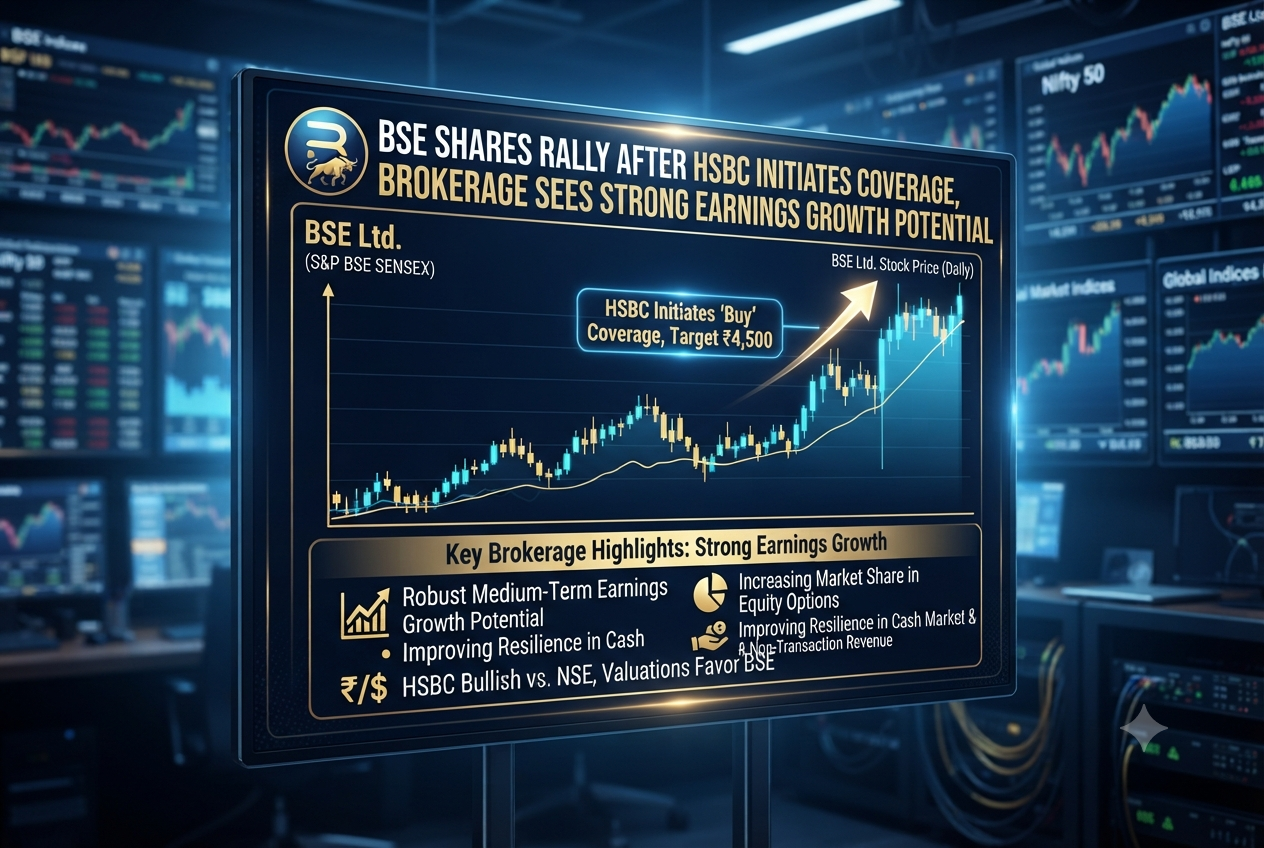
HSBC initiated coverage on BSE with a Buy rating and a target price of ₹4,500 per share, highlighting the exchange’s potential to gain market share in equity options, improve its cash-market performance and expand revenue from non-transaction businesses.
The brokerage also initiated coverage on the National Stock Exchange of India (NSE), assigning it a Hold rating with a target price of ₹2,300. The contrasting recommendations reflect HSBC’s assessment that BSE offers stronger incremental earnings growth potential, while much of NSE’s market leadership is already reflected in its valuation.
The development has brought renewed attention to India’s exchange operators and the investment opportunities emerging from the country’s expanding capital markets.
BSE Shares Gain Following HSBC’s Positive Assessment
BSE shares advanced approximately 3% in early trading on November 26, reaching around ₹3,888 per share. The stock subsequently touched higher intraday levels as buying interest continued.
The market reaction followed HSBC’s assessment of BSE’s medium-term business prospects. The brokerage believes the exchange has considerable room to expand its earnings through improvements in market share, trading activity and revenue diversification.
HSBC’s ₹4,500 target price represented an upside potential of more than 19% from the previous session’s closing price of ₹3,775.20.
The recommendation has added to the positive sentiment surrounding BSE shares, which have benefited from improving derivatives activity and a recovery in trading volumes.
However, brokerage targets represent analysts’ estimates rather than guaranteed future share prices. Actual performance will depend on business results, market conditions and regulatory developments.
Why HSBC Is Positive on BSE
HSBC’s positive outlook is based on three major growth opportunities.
1. Increasing market share in equity options
One of the most important factors supporting HSBC’s assessment is BSE’s growing presence in the equity derivatives market.
The exchange has been working to strengthen its position in index options, particularly through its Sensex derivatives products. Higher trading participation and improved market share can increase transaction-related revenues.
BSE’s ability to compete more effectively with NSE in this segment could become an important driver of future earnings growth.
2. Improving cash-market performance
HSBC also expects greater resilience in BSE’s cash-market operations.
The cash segment remains an important part of the exchange’s business ecosystem. Improved trading activity, wider participation and stronger market liquidity could contribute to more stable revenue generation.
Although BSE operates on a smaller scale than NSE in several market segments, improvements in its competitive position could create opportunities for faster growth.
3. Expansion of non-transaction revenue
Another important growth opportunity lies in diversifying revenue beyond trading-related charges.
Exchange operators can generate income through data services, technology solutions, listing services and other market infrastructure activities.
Expanding these revenue streams could make BSE’s business less dependent on fluctuations in daily trading activity and improve the resilience of its financial performance.
HSBC believes the combination of these factors could allow BSE to deliver faster earnings growth than its larger rival over the medium term.
HSBC’s View on NSE: Strong Franchise but Limited Valuation Upside
While HSBC remains positive about BSE, its assessment of NSE is more cautious.
The brokerage initiated coverage on NSE with a Hold recommendation and a target price of ₹2,300 per share.
HSBC recognises NSE’s dominant position in India’s securities market, its strong technology infrastructure and its substantial trading volumes across several financial products.
However, the brokerage believes these competitive advantages are already largely reflected in NSE’s current valuation.
Its estimates indicate that NSE’s profit after tax could grow at a compound annual growth rate of approximately 13% between FY2027 and FY2030.
The comparison highlights an important distinction between market leadership and investment potential. A company can have a stronger competitive position but offer less incremental valuation upside if investors have already priced in much of its expected growth.
For HSBC, BSE currently offers a more attractive combination of growth prospects and valuation potential.
Growing Investor Interest in India’s Market Infrastructure Sector
The positive response to HSBC’s coverage reflects broader investor interest in India’s financial market infrastructure companies.
Stock exchanges play a central role in the country’s capital-market ecosystem. They provide trading platforms, facilitate price discovery, support capital raising and enable participation from domestic and international investors.
As India’s equity investor base expands, exchanges and related institutions could benefit from higher trading activity, new listings and demand for financial data and technology services.
The recent growth of retail participation, mutual fund investments and derivatives trading has increased the importance of efficient market infrastructure.
BSE’s efforts to strengthen its position in the derivatives segment have therefore become an important part of its investment story.
The development also follows NSE’s recent stock market listing, which has brought greater attention to the relative valuations and growth prospects of India’s two leading exchange operators.
Risks Investors Should Monitor
Despite the positive brokerage outlook, BSE faces several business and regulatory risks.
A significant part of exchange revenue is influenced by trading activity, particularly in the derivatives market. Any regulatory changes affecting options trading, contract structures or participation could influence transaction volumes and profitability.
Competition from NSE also remains a major consideration. BSE will need to continue improving liquidity, product participation and market share to sustain its growth trajectory.
Valuation is another important factor. A strong brokerage recommendation does not eliminate the possibility of share-price corrections, particularly if earnings growth falls short of market expectations.
Investors should therefore assess the company’s financial performance, regulatory environment and valuation before making investment decisions.
The Worldonomics Times View
HSBC’s positive assessment of BSE highlights an important shift in how investors are evaluating India’s financial market infrastructure businesses. Market leadership remains valuable, but the potential for incremental earnings growth is becoming an equally important consideration.
BSE’s opportunity lies in strengthening its competitive position in equity derivatives while building more diversified revenue streams. If it can sustain market-share gains and improve the stability of its cash-market operations, the exchange could strengthen its long-term earnings profile.
However, the business remains exposed to regulatory changes and fluctuations in trading activity. Sustainable growth will require investment in technology, strong risk management and continued improvements in market liquidity.
For investors, the HSBC report provides a useful perspective on BSE’s growth potential, but it should be considered alongside independent financial analysis rather than treated as a standalone investment signal.
Conclusion
BSE shares gained around 3% in early trading on November 26 after HSBC initiated coverage with a Buy rating and a ₹4,500 target price. The brokerage expects market-share gains in equity options, improving cash-market activity and revenue diversification to support stronger medium-term earnings growth.
Its more cautious Hold recommendation on NSE reflects the view that the larger exchange’s competitive advantages are already substantially reflected in its valuation.
The contrasting assessments have renewed attention on India’s exchange operators and the wider financial market infrastructure sector. Whether BSE can translate its growth opportunities into sustained financial performance will remain a key factor for investors in the coming quarters.