By The Worldonomics Times | Global Economy
Date: 3 November 2026
Policymakers Adopt a Cautious Approach as Inflation Remains Elevated and Economic Uncertainty Continues
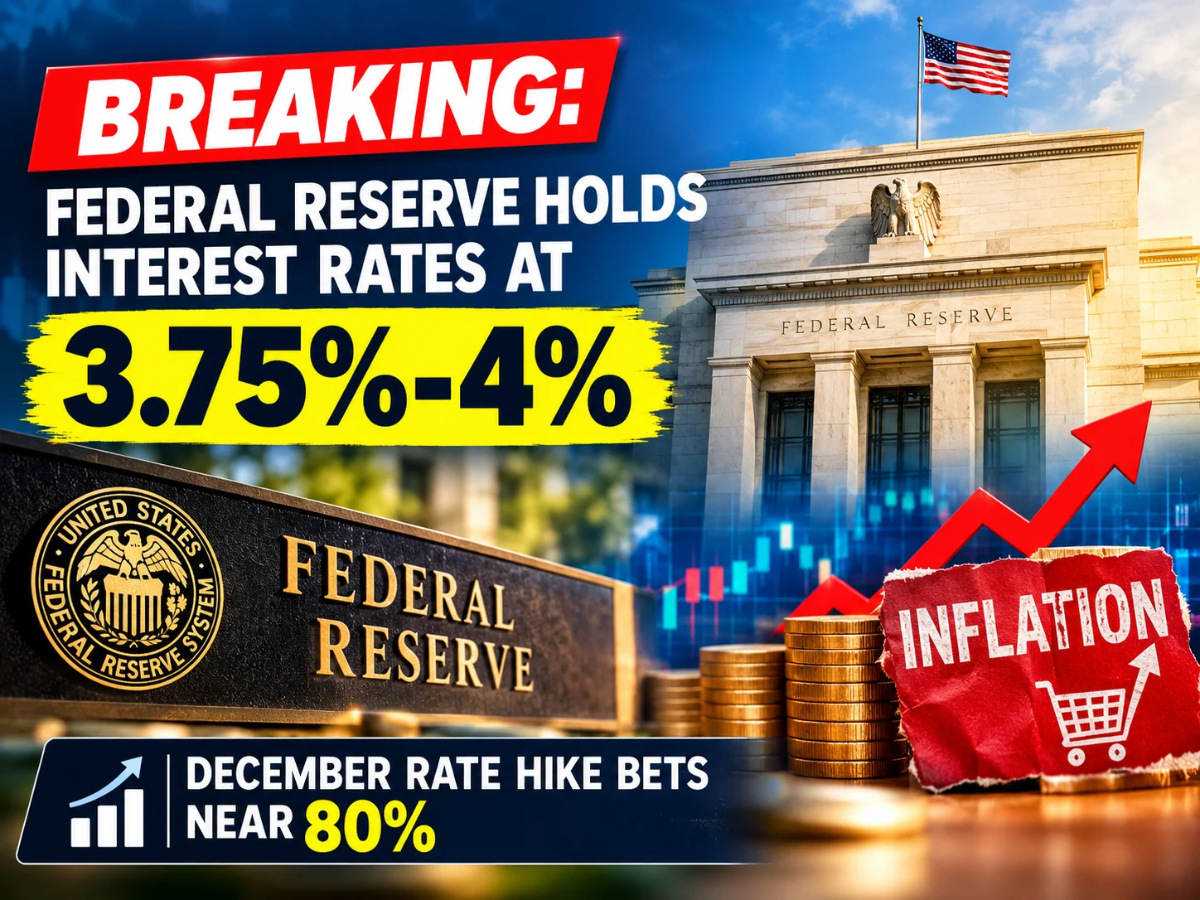
The United States Federal Reserve has decided to maintain its benchmark interest rates unchanged, reflecting continued concerns about inflation and uncertainty surrounding the global economic outlook. At its meeting on October 27–28, 2026, the Federal Open Market Committee (FOMC) voted 10–2 to keep the federal funds rate within the target range of 3.75% to 4.00%.
The decision comes after the Federal Reserve increased interest rates by 0.25 percentage points in September. By choosing to pause further adjustments in October, policymakers have signalled that they want additional economic information before deciding the next direction of monetary policy.
The central bank stated that US economic activity is expanding at a strong pace, supported by resilient domestic spending, robust capital investment and strong productivity growth. However, it also acknowledged that inflation remains elevated and that geopolitical developments continue to contribute to economic uncertainty.
Why Has the Federal Reserve Kept Rates Unchanged?
The Federal Reserve’s decision reflects the difficult balance between controlling inflation and supporting sustainable economic growth.
Interest rates are among the most important tools available to central banks. When inflation rises significantly, increasing borrowing costs can discourage excessive spending and investment, helping reduce demand-driven price pressures. However, higher rates can also make loans more expensive for households and businesses, potentially slowing economic activity.
The Fed’s latest decision suggests that policymakers are assessing whether previous rate increases are sufficiently restrictive to bring inflation back towards the central bank’s 2% target.
The October meeting also revealed differences within the FOMC. Two policymakers, Lisa D. Cook and Beth M. Hammack, voted against maintaining the existing rate and preferred an additional increase of 0.25 percentage points. Their dissent indicates that some officials believe stronger action may be necessary to prevent inflation from remaining elevated for an extended period.
Inflation Remains the Central Challenge
Inflation continues to be one of the most significant concerns influencing US monetary policy. Although the Federal Reserve aims to achieve price stability, rising energy costs, supply disruptions and geopolitical tensions have complicated the inflation outlook.
Higher fuel and electricity prices can increase transportation, manufacturing and distribution expenses. Businesses facing higher operating costs may eventually transfer part of the additional burden to consumers, keeping prices elevated across different sectors.
The challenge for policymakers is that supply-driven inflation cannot always be controlled effectively through interest rate increases alone. Higher borrowing costs may reduce consumer demand, but they cannot directly resolve international energy shortages or restore disrupted supply chains.
The Federal Reserve has therefore emphasised the importance of collecting additional economic information before determining its next policy move.
A Resilient Economy Offers Room for Caution
Despite inflation concerns, the Federal Reserve’s assessment of the US economy remains relatively positive. According to its October statement, domestic spending has remained resilient, productivity growth is strong and capital investment is robust.
The labour market has also shown signs of stability, with job gains keeping pace with workforce growth and the unemployment rate changing little.
These developments provide policymakers with some flexibility to maintain interest rates without immediately introducing further monetary tightening. However, a strong economy can also sustain consumer demand, potentially making inflation more difficult to control.
The Federal Reserve must therefore monitor both sides of its mandate: achieving maximum employment and maintaining stable prices. A policy decision that focuses too heavily on inflation could weaken employment and investment, while premature monetary easing could allow inflationary pressures to persist.
Impact on Global Financial Markets
The Federal Reserve’s decisions have consequences far beyond the United States because the US dollar plays a central role in international trade, investment and financial transactions.
When US interest rates remain relatively high, dollar-denominated investments can become attractive to international investors. This can influence global capital flows, currency valuations and borrowing costs in emerging markets.
Countries with significant dollar-denominated external debt may face higher debt-servicing expenses when global financing conditions remain tight. Businesses that depend on international borrowing could also experience increased financial pressure.
The decision to hold rates steady may provide some stability to financial markets in the short term. However, uncertainty about future rate increases could continue influencing investor sentiment, bond yields and currency movements.
Implications for India and Other Emerging Economies
For India, Federal Reserve policy is particularly important because changes in US interest rates can influence foreign investment flows, the rupee’s exchange rate and domestic financial conditions.
When US interest rates remain attractive, international investors may prefer dollar-based assets over investments in emerging markets. This can create pressure on currencies such as the Indian rupee and influence foreign portfolio investment.
A stronger dollar can also make imported commodities, particularly crude oil, more expensive for countries that purchase them using US dollars. For India, this could increase import costs and add pressure to domestic inflation.
However, a stable US interest rate environment can also reduce uncertainty for international investors and businesses. Indian policymakers will need to monitor global capital movements, currency trends and commodity prices while maintaining domestic economic stability.
What Could Happen in the Coming Months?
The Federal Reserve has indicated that future decisions will depend on incoming economic information, particularly developments in inflation and employment.
The possibility of another rate increase remains open if inflation fails to move towards the 2% target. Conversely, sustained moderation in price pressures could provide policymakers with greater flexibility in the future.
Financial markets are therefore likely to pay close attention to upcoming inflation reports, employment figures, consumer spending data and energy prices. These indicators will help determine whether the current pause represents a temporary stage before further tightening or the beginning of a more stable interest rate period.
The Worldonomics Times Views
The Federal Reserve’s latest decision highlights the complexity of managing monetary policy during a period of persistent inflation and global uncertainty. Maintaining interest rates unchanged may provide policymakers with time to evaluate economic developments, but it does not mean that inflation has been brought under control.
In our view, central banks must avoid making decisions based on short-term market expectations alone. A sustainable monetary policy requires careful assessment of inflation, employment, investment and household purchasing power.
We believe that governments should complement monetary policy with measures that strengthen energy security, improve supply chain efficiency and encourage productive investment. These steps can help address some of the structural factors contributing to rising prices.
For emerging economies such as India, maintaining financial stability, attracting long-term investment and strengthening domestic production will be essential as global interest rate conditions continue to evolve.
The Worldonomics Times believes that monetary stability is most effective when supported by responsible fiscal policies, resilient domestic industries and a clear long-term economic strategy.
Conclusion
The Federal Reserve’s decision to maintain interest rates within the 3.75%–4.00% range reflects a cautious approach towards persistent inflation and an uncertain global economic environment. Although US economic activity remains resilient, policymakers are not yet confident that inflation has returned to a sustainable path.
The coming months will be important in determining the direction of American monetary policy and its influence on international financial markets. For businesses, investors and governments worldwide, the key challenge will be adapting to changing borrowing costs while protecting economic growth and financial stability.