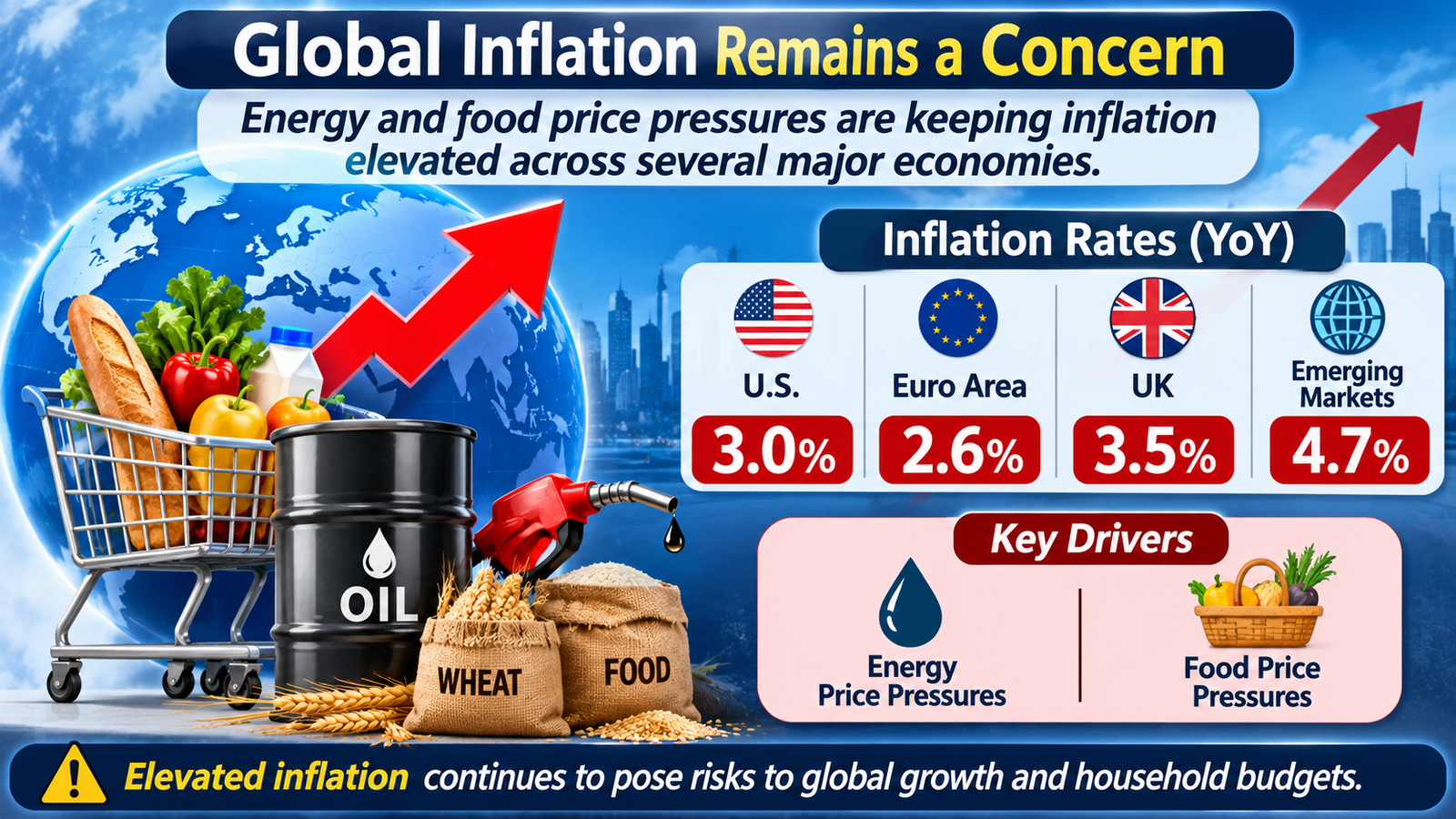
Persistent energy and food price pressures continue to complicate inflation management across major economies, testing policymakers, businesses and households amid an uncertain global economic environment.
Inflation remains one of the most significant challenges facing the global economy. Despite efforts by central banks to stabilise prices and bring inflation closer to their long-term targets, rising and volatile energy and food costs continue to put pressure on household budgets, business operations and economic growth.
Geopolitical tensions, supply-chain disruptions, changing trade policies and fluctuations in international commodity markets have made the inflation outlook increasingly complicated. While inflation levels differ across countries, the rising cost of essential goods and services remains a shared concern for both developed and developing economies.
Energy Prices: A Major Driver of Inflation
Energy prices continue to play a crucial role in shaping global inflation trends. Oil, natural gas and electricity are essential inputs for transportation, manufacturing, agriculture and industrial production. Any significant increase in energy costs can create inflationary pressure throughout the economy.
Geopolitical conflicts, disruptions to international shipping routes, production decisions by major energy exporters and changing global demand can contribute to volatility in energy markets. Such uncertainty makes it difficult for governments and businesses to forecast expenses and develop long-term investment strategies.
Higher fuel prices also increase transportation and logistics costs, affecting industries ranging from aviation and manufacturing to retail and construction. Businesses may eventually transfer these additional expenses to consumers, resulting in higher prices for everyday products and services.
For households, rising energy costs translate into increased electricity bills, transportation expenses and other essential expenditures, reducing disposable income and affecting purchasing power.
Food Inflation and the Growing Cost-of-Living Challenge
Food inflation remains another major concern for policymakers worldwide. Agricultural production is increasingly vulnerable to climate-related disruptions, including droughts, floods, extreme temperatures and unpredictable rainfall. These developments can reduce crop yields, disrupt agricultural supply chains and contribute to higher food prices.
Additional pressures arise from fertiliser costs, transportation expenses, labour shortages and international trade restrictions. Together, these factors can make food markets particularly vulnerable to supply-side shocks.
The impact is especially significant for lower- and middle-income households, which generally spend a larger proportion of their income on essential food products. Sustained increases in food prices can force families to reduce discretionary spending, alter consumption patterns and postpone important financial decisions.
For developing economies, food inflation also presents broader challenges related to poverty reduction, food security and social stability. Strengthening agricultural infrastructure, improving storage facilities, investing in irrigation and encouraging climate-resilient farming practices will be essential to addressing these challenges.
Central Banks Face Difficult Policy Decisions
Persistent inflation has placed central banks in a challenging position. Monetary authorities must strike a careful balance between controlling price increases and supporting economic growth.
Interest rates remain one of the primary tools available to policymakers. Higher borrowing costs can moderate consumer demand, discourage excessive credit expansion and help contain inflationary expectations. However, maintaining restrictive monetary policies for an extended period can also slow investment, increase business financing costs and weaken economic activity.
The situation becomes more complicated when inflation is driven by supply-side factors such as higher energy and food prices. Interest-rate increases cannot directly resolve supply shortages or reduce international commodity prices. Consequently, policymakers must combine monetary discipline with appropriate fiscal and structural measures.
Maintaining public confidence in monetary policy will remain essential to preventing temporary price shocks from becoming persistent inflationary pressures.
Implications for Businesses and Global Trade
Businesses across sectors are facing increased pressure from unpredictable input costs, transportation expenses and changing consumer demand. Companies with limited pricing flexibility may experience declining profit margins, while others may need to adjust prices to protect financial sustainability.
Small and medium-sized enterprises are particularly vulnerable because they often have limited financial resources and weaker bargaining power against suppliers.
To manage these challenges, businesses are increasingly focusing on operational efficiency, supply-chain diversification, inventory management and cost optimisation. Investments in automation, digital technology and energy efficiency can also help reduce long-term operating expenses.
International trade will remain an important factor in determining inflation trends. Stable trade relationships, efficient logistics networks and predictable economic policies can help reduce supply disruptions and improve market stability.
The Road Ahead: Building Economic Resilience
Addressing global inflation requires coordinated action from governments, central banks, businesses and international institutions. Governments must prioritise energy security, agricultural productivity and infrastructure development while ensuring that financial assistance reaches vulnerable households.
Investment in renewable energy, modern agricultural technologies and diversified supply chains can reduce exposure to external shocks. Similarly, responsible fiscal management and transparent monetary policies can strengthen investor confidence and support long-term economic stability.
Although inflationary pressures may gradually ease in some economies, the risks associated with energy markets, food security and geopolitical uncertainty are likely to remain important considerations for policymakers.
The Worldonomics Times View
Global inflation is no longer simply a monetary challenge; it is increasingly a reflection of interconnected vulnerabilities across energy markets, food systems, international trade and geopolitical relationships.
The continued pressure on essential commodities highlights the need for a broader and more sustainable approach to economic management. Central banks must remain committed to price stability, but monetary policy alone cannot solve supply-chain disruptions, agricultural challenges or energy insecurity.
Governments should accelerate investments in renewable energy, strengthen domestic food production and improve infrastructure to reduce dependence on volatile international markets. Businesses, meanwhile, must prioritise efficiency, innovation and resilient supply chains.
The Worldonomics Times believes that controlling inflation must go hand in hand with protecting purchasing power and sustaining economic growth. True economic stability will not be achieved merely by bringing inflation figures down, but by building stronger economic systems that can withstand global disruptions while ensuring affordable access to essential goods and services.
The ultimate priority must be to create an economy where stability, affordability and sustainable growth advance together.