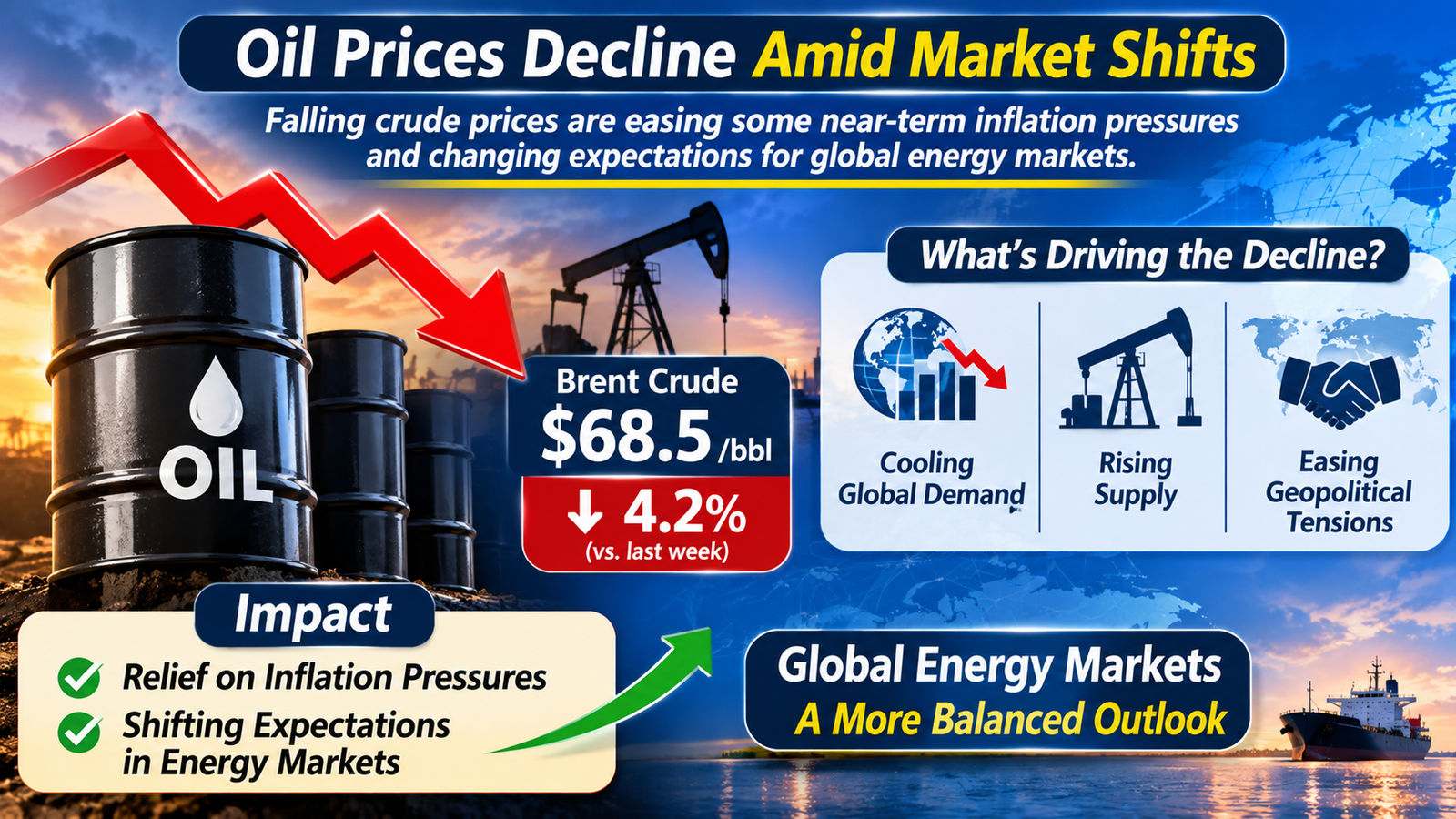
Falling crude oil prices are offering some relief to inflation-hit economies, easing energy costs and reshaping expectations for global markets. However, geopolitical uncertainty, changing demand patterns and production strategies continue to influence the future direction of oil prices.
Global oil markets are witnessing significant shifts as crude prices experience downward pressure amid changing supply-demand dynamics and evolving economic conditions. The decline in oil prices is providing some relief to countries struggling with inflation, particularly those heavily dependent on imported energy. Lower crude prices can reduce transportation expenses, moderate production costs and ease pressure on household budgets.
Oil remains one of the most strategically important commodities in the global economy. Its price movements influence everything from manufacturing and international trade to transportation, agriculture and government finances. Consequently, declining crude prices are not merely an energy-market development; they also carry important implications for global economic growth, inflation and investment decisions.
Understanding the Factors Behind Falling Oil Prices
Several interconnected factors are contributing to changing conditions in international oil markets. One of the most important is the balance between global supply and demand. When crude oil production exceeds consumption, inventories can increase, placing downward pressure on prices.
Economic uncertainty and concerns about slower industrial activity can also influence oil demand expectations. Major energy-consuming economies play a crucial role in determining global consumption. Any moderation in manufacturing, transportation or commercial activity can affect expectations for future crude requirements.
Production strategies adopted by major oil-producing nations also influence market movements. Decisions by the Organisation of the Petroleum Exporting Countries and its partners (OPEC+) regarding production levels can significantly affect global supply availability and price expectations.
Additionally, changes in non-OPEC production, including output from the United States and other major producers, can alter the competitive balance in international energy markets.
Relief for Inflation and Global Consumers
One of the most immediate benefits of declining crude prices is the potential reduction in inflationary pressure. Energy costs influence the prices of numerous goods and services, making oil an important component of the broader inflation landscape.
Lower crude prices can reduce fuel and transportation expenses, helping businesses manage operating costs. Industries such as aviation, logistics, manufacturing and shipping may benefit from cheaper energy inputs, depending on how quickly market price changes are passed through to end users.
For consumers, lower oil prices can create opportunities for reduced petrol, diesel and transportation costs. This may improve household purchasing power and leave more disposable income available for other expenditures.
However, the impact is not always immediate or uniform. Retail fuel prices are also influenced by taxes, refining margins, distribution costs, currency movements and government pricing policies. Therefore, a decline in international crude prices does not necessarily translate into an equivalent reduction in domestic fuel prices.
Implications for Major Oil-Importing Economies
Countries that depend heavily on imported crude oil could benefit considerably from sustained price declines. Lower import bills can improve trade balances, reduce pressure on foreign exchange reserves and provide governments with greater fiscal flexibility.
For emerging economies, cheaper oil can be particularly valuable because energy imports represent a significant component of external expenditure. Reduced energy costs may also support industrial competitiveness and help moderate inflation.
India, for example, is a major importer of crude oil and remains sensitive to international energy-price movements. A sustained decline in crude prices could help reduce its import bill, ease inflationary pressures and support economic stability. However, the actual benefits would depend on exchange-rate movements, domestic fuel taxation and the extent to which lower international prices are reflected in domestic markets.
Challenges for Oil-Producing Nations
While lower crude prices benefit importing economies and consumers, they can create challenges for oil-exporting countries. Nations that depend heavily on petroleum revenues may experience reduced government income, potentially affecting public spending, infrastructure investment and fiscal planning.
Oil companies may also reconsider exploration and production investments when prices remain below their expected profitability levels. Smaller producers with higher operating costs can face particular financial pressure.
At the same time, lower oil prices may encourage producing nations to review output strategies and strengthen cooperation to maintain market stability.
The challenge for oil-producing economies is to balance production, revenue generation and long-term economic diversification.
The Changing Global Energy Landscape
The global energy sector is undergoing a broader transformation as governments and businesses increasingly focus on renewable energy, sustainability and energy security.
Declining oil prices can influence investment decisions in both conventional and alternative energy sectors. Cheaper fossil fuels may temporarily reduce the financial attractiveness of certain renewable energy alternatives. Nevertheless, long-term investment in solar, wind, battery storage and other clean technologies continues to be driven by environmental commitments, technological progress and energy diversification strategies.
Energy security has also become a central priority following disruptions to international supply chains and geopolitical tensions. Countries are increasingly exploring diversified energy sources, strategic reserves and domestic production capabilities to reduce exposure to external shocks.
Outlook: Stability or Further Volatility?
The future direction of crude oil prices will depend on several factors, including global economic growth, industrial demand, production decisions, geopolitical developments and energy-transition policies.
A prolonged period of lower prices could support economic activity in oil-importing nations. However, unexpected supply disruptions or stronger-than-anticipated demand could quickly reverse the trend.
Market participants will therefore continue monitoring production announcements, inventory levels, economic indicators and developments across major energy-producing regions.
The Worldonomics Times View
The decline in global oil prices offers an important opportunity for the world economy, particularly at a time when inflation, high living costs and economic uncertainty remain significant concerns.
Lower crude prices can provide relief to consumers, reduce business operating expenses and improve the financial position of oil-importing economies. However, these benefits should not encourage governments to become complacent about long-term energy security.
The Worldonomics Times believes that policymakers must use periods of relatively affordable energy to strengthen economic resilience, diversify energy supplies and accelerate investments in sustainable infrastructure. Import-dependent countries should focus on reducing excessive exposure to international price fluctuations, while oil-producing nations must continue developing diversified sources of economic growth.
Ultimately, cheaper oil is a welcome economic advantage, but lasting energy security cannot depend on falling prices alone. The real opportunity lies in building an energy system that is affordable, reliable, diversified and sustainable enough to support future generations.