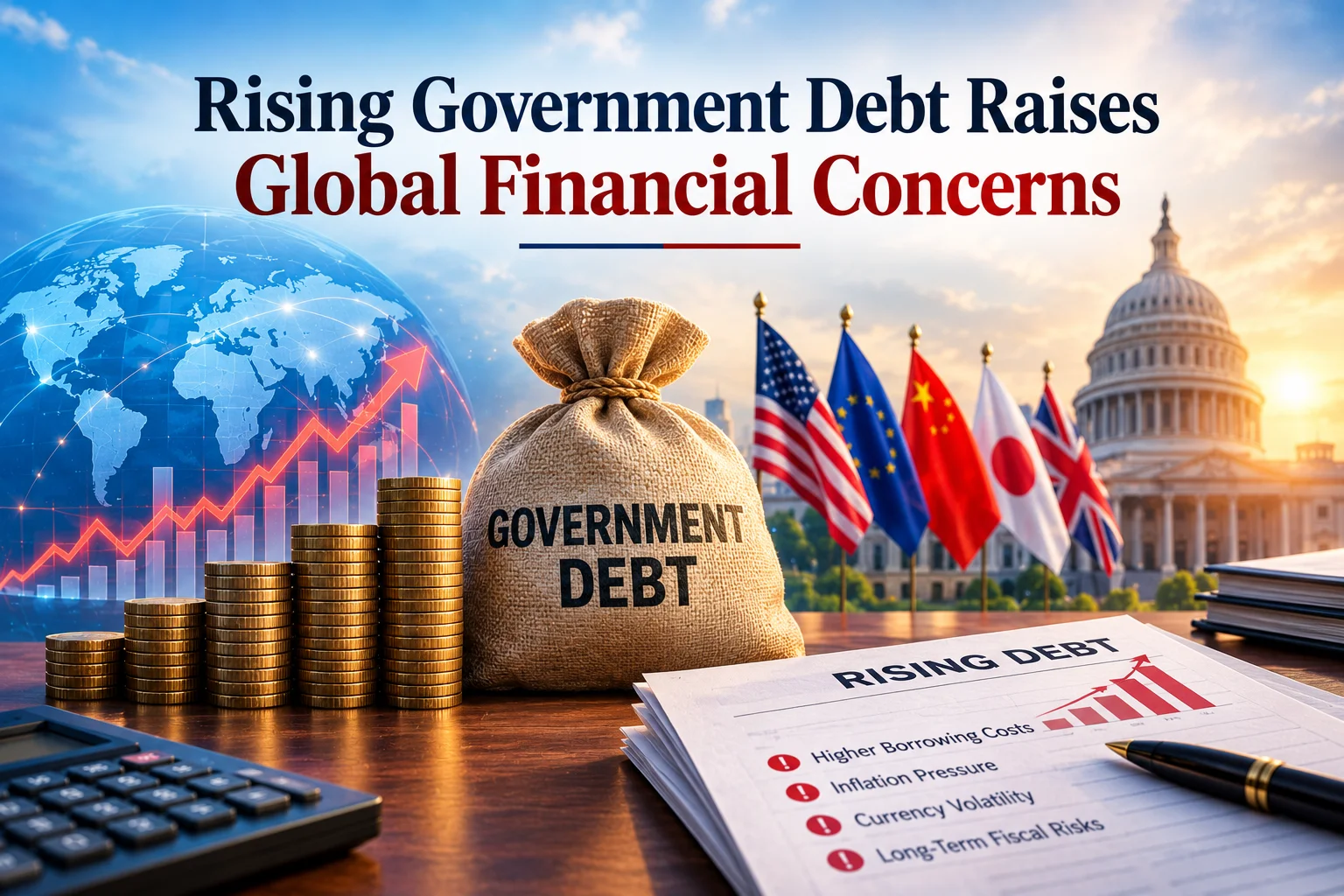
Rising sovereign debt, higher interest payments and growing fiscal deficits are putting pressure on governments worldwide, raising concerns about financial stability, public investment and the sustainability of global economic growth.
Global public debt is emerging as one of the most significant challenges confronting the world economy. Governments across advanced and developing economies are increasingly relying on borrowing to finance public expenditure, infrastructure projects, social welfare programmes and existing debt obligations. While borrowing can support economic activity during difficult periods, continuously increasing debt levels are creating concerns about fiscal sustainability and the ability of governments to respond to future economic shocks.
According to the International Monetary Fund’s October 2026 Fiscal Monitor, global public debt is projected to approach 100% of global GDP by 2029, reflecting persistent fiscal pressures and rising government financing requirements.
The growing debt burden comes at a time when several economies are already dealing with elevated borrowing costs, geopolitical uncertainty, inflationary pressures and slower economic growth. As governments allocate an increasing share of their budgets towards interest payments, fewer resources may remain available for infrastructure, education, healthcare and other development priorities.
Rising Government Borrowing Creates Fiscal Pressure
Public borrowing has become an important instrument of economic management. Governments issue bonds and raise funds through domestic and international financial markets to finance development projects, manage budget deficits and support economic activity.
However, the growing scale of government borrowing is creating long-term challenges.
Higher public debt means governments must dedicate larger portions of their revenue towards interest payments and debt repayments. When borrowing costs increase, refinancing existing debt becomes more expensive, placing additional pressure on national budgets.
Countries with high debt levels may also experience reduced fiscal flexibility. This can make it difficult for governments to introduce emergency spending measures during recessions, natural disasters or international economic crises.
The situation is particularly concerning for countries that depend heavily on external borrowing or have limited access to affordable international financing.
Higher Interest Rates Increase Debt-Servicing Costs
One of the major factors contributing to rising public debt concerns is the cost of borrowing.
Although several major central banks have maintained interest rates during recent policy decisions, borrowing costs remain elevated compared with the low-interest-rate environment experienced during much of the previous decade.
Governments refinancing older debt at higher interest rates may face substantially larger debt-servicing obligations.
This creates a difficult financial cycle. Higher interest expenses can increase budget deficits, forcing governments to borrow additional funds. Continued borrowing can subsequently increase debt levels and expose national finances to further interest rate fluctuations.
For developing economies, the challenge can be even greater because currency depreciation and changes in international investor sentiment may increase the cost of servicing foreign-currency debt.
Public Debt Can Restrict Economic Growth
Government borrowing can support economic development when funds are directed towards productive investments such as roads, railways, energy infrastructure, healthcare and education.
However, excessive borrowing can produce the opposite effect when debt-servicing costs begin to restrict development spending.
Higher government borrowing can also increase demand for available financial resources, potentially pushing up interest rates and making it more expensive for private businesses to access credit.
This phenomenon, commonly described as the crowding-out effect, can discourage private investment and limit business expansion.
When companies reduce investment because financing becomes expensive, economic productivity, employment generation and long-term growth may suffer.
The challenge for policymakers is therefore to ensure that borrowed funds generate sufficient economic and social returns to justify their costs.
Developing Economies Face Greater Vulnerability
Emerging and developing economies face particular difficulties in managing rising public debt.
Many of these countries require substantial financing for infrastructure, healthcare, education, energy security and industrial development. At the same time, they often operate with narrower tax bases and greater exposure to external financial shocks.
Currency depreciation can increase the domestic cost of repaying foreign-currency debt, while higher global interest rates can discourage international investors from financing emerging markets.
Countries with limited foreign exchange reserves may also face difficulties meeting external repayment obligations.
The growing debt burden can consequently affect development programmes, poverty reduction initiatives and essential public services.
International institutions, including the IMF and World Bank, continue to emphasise the importance of sustainable debt management, transparent fiscal policies and stronger domestic revenue mobilisation.
India’s Fiscal Position and Economic Priorities
India’s public debt position highlights the importance of balancing economic development with fiscal responsibility.
As one of the world’s major emerging economies, India requires substantial public investment in infrastructure, transportation, manufacturing, renewable energy and digital development.
Government borrowing can play an important role in financing these priorities and supporting long-term productivity.
However, maintaining fiscal discipline remains essential to ensuring that increasing debt does not create excessive pressure on public finances.
Improving tax collection, rationalising expenditure, strengthening public-sector efficiency and encouraging private investment can help create additional financial capacity for development.
India’s relatively strong domestic demand and expanding infrastructure investment provide important growth opportunities, but responsible debt management will remain necessary to maintain investor confidence and economic stability.
The Need for Sustainable Fiscal Policies
Addressing rising global public debt will require a combination of responsible fiscal management and long-term economic reforms.
Governments must improve the efficiency of public expenditure, strengthen revenue collection and prioritise projects that generate measurable economic returns.
Greater transparency in government borrowing and debt reporting can also help investors assess financial risks more accurately.
International cooperation will remain important, particularly in supporting countries facing debt distress and limited access to affordable financing.
Rather than relying entirely on spending cuts, governments should focus on improving productivity, encouraging investment and expanding their economic capacity to generate sustainable revenue.
The Worldonomics Times View
Rising global public debt should be treated as a long-term economic warning rather than simply a measure of government borrowing. Debt itself is not necessarily harmful; the real concern is whether governments can generate sufficient economic value and revenue to manage their financial obligations.
In our view, the distinction between productive borrowing and excessive borrowing is becoming increasingly important. Investments in infrastructure, education, healthcare, technology and energy security can strengthen economic capacity and generate future returns. However, borrowing to finance inefficient expenditure or continuously cover structural budget deficits can create financial vulnerabilities.
Governments must also recognise that higher debt-servicing costs reduce their ability to respond to future crises. Fiscal flexibility is essential in an increasingly unpredictable global environment.
For India and other developing economies, the priority should be to maintain a balanced approach between infrastructure-led growth and responsible fiscal management. Stronger domestic revenue collection, efficient public spending, private-sector participation and transparent debt policies can support sustainable development.
We believe policymakers should focus not only on reducing debt ratios but also on improving the quality of public borrowing. Economic growth must be supported by investments that increase productivity, strengthen employment and expand the national revenue base.
Our position is clear: borrowing should be a tool for building economic strength, not a permanent substitute for sustainable financial management.
The future stability of the global economy will depend on how effectively governments balance development ambitions with fiscal responsibility. Sustainable public finances are not merely a budgetary objective; they are a foundation for investor confidence, economic resilience and long-term prosperity.