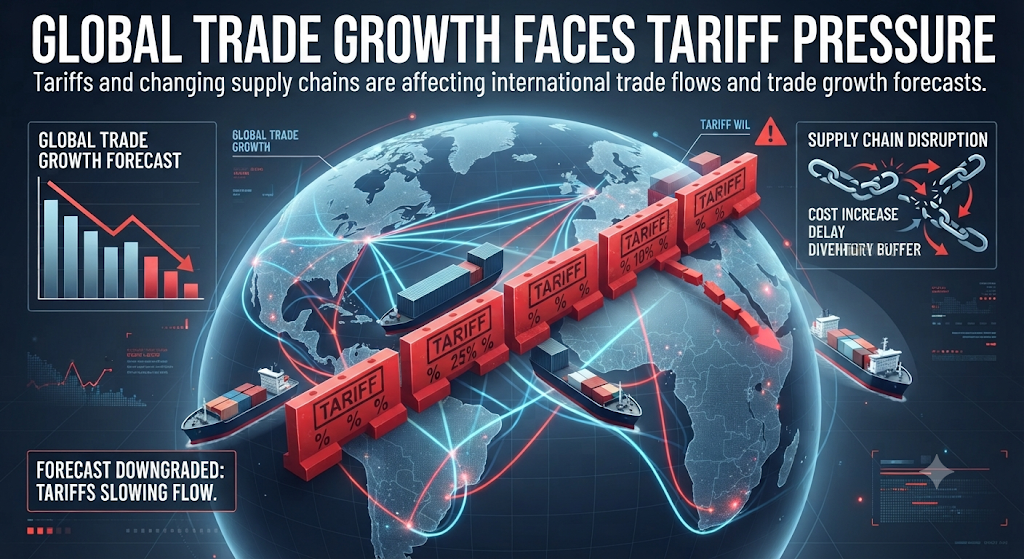
Tariffs and Changing Supply Chains Are Reshaping International Trade Flows and Global Economic Growth Forecasts
Introduction: Global Trade at a Defining Economic Crossroads
International trade has always been one of the strongest foundations of economic development. It connects countries, creates employment opportunities, encourages industrial expansion, supports technological progress and enables businesses to access customers beyond their domestic markets. From agricultural commodities and industrial machinery to pharmaceuticals, automobiles, electronics and digital services, international commerce has transformed the way economies function and businesses operate.
For decades, globalization encouraged countries to specialize in the production of goods and services in which they possessed a competitive advantage. Manufacturers established production facilities across different regions, companies sourced raw materials and components from international suppliers, and consumers benefited from a wide range of products at competitive prices. This interconnected system created a global economic structure in which the success of one industry frequently depended on the performance of several others located thousands of kilometres away.
However, the international trading environment is undergoing a significant transformation. Rising tariffs, geopolitical tensions, changing government policies, strategic competition and supply-chain vulnerabilities are reshaping the movement of goods and services across national borders. Countries are increasingly reconsidering their dependence on foreign suppliers, while businesses are examining whether their existing sourcing arrangements remain commercially sustainable.
The traditional principle of producing goods wherever costs are lowest is increasingly being balanced against economic security, political stability, supply-chain resilience and access to strategically important technologies.
Tariffs have returned to the centre of international economic discussions. Governments are using import duties not only to protect domestic industries but also to influence trade negotiations, encourage local manufacturing, address perceived unfair competition and strengthen national capabilities in strategically important sectors.
These developments are creating both opportunities and challenges for the global economy.
For some countries, changing trade relationships are opening new possibilities to attract international investment, expand exports and become alternative manufacturing destinations. For others, higher import costs, restricted market access and unpredictable regulations are creating additional economic pressure.
The World Trade Organization’s October 2026 assessment illustrates the complicated nature of the current environment. It revised its forecast for global merchandise trade volume growth in 2026 upwards to 3.9%, from the 1.9% baseline forecast issued in March. However, its forecast for commercial services trade volume growth was revised downwards to 3.3%, compared with the earlier projection of 4.8%.
The improvement in merchandise trade has been supported significantly by strong demand for artificial intelligence-related products, while geopolitical disruptions and higher energy costs have placed pressure on transportation, tourism and other service industries.
Meanwhile, UN Trade and Development reported that global trade reached a record value of approximately $35 trillion in 2025. Its 2026 assessment also highlighted the growing influence of geopolitical considerations, strategic industrial policies and changing international production networks.
These developments reveal an important reality: global trade continues to demonstrate resilience, but the foundations supporting its growth are changing.
The future of international commerce will depend on how effectively governments, businesses and international institutions manage this transition.
1. Understanding the Changing Global Trade Environment
International trade has evolved considerably over the past three decades. Improvements in transportation, communication technology, financial services and international logistics made it easier for businesses to operate across borders.
The expansion of container shipping, digital payments, electronic documentation and sophisticated supply-chain management systems reduced the cost and complexity of international transactions.
Companies began establishing production networks based on specialized capabilities available in different countries.
For example, an automobile manufacturer could source electronic systems from one country, specialized steel from another, tyres from a third and advanced machinery from several international suppliers. Final assembly could take place in a location offering competitive manufacturing costs and convenient access to major consumer markets.
This approach allowed companies to improve efficiency while increasing production capacity.
However, the same interconnected system created dependencies that became increasingly visible during periods of disruption.
The COVID-19 pandemic exposed the risks associated with excessive dependence on specific production locations. Factory closures, shipping delays and shortages of essential components affected industries across multiple continents.
Subsequent geopolitical tensions and changes in trade policies reinforced concerns about supply-chain security.
Governments began reconsidering whether strategic products should depend heavily on a small number of foreign suppliers.
Companies also recognized that the lowest-cost supplier was not necessarily the safest or most reliable choice.
Consequently, global trade is moving towards a more complex structure in which cost efficiency, diversification, strategic partnerships and political considerations influence international commercial decisions.
This transformation is sometimes described as the transition from traditional globalization towards selective globalization.
International trade remains important, but the conditions under which countries participate in it are changing.
2. The Return of Tariffs as a Major Instrument of Economic Policy
Tariffs are taxes imposed on imported goods. They increase the cost of bringing foreign products into a domestic market and can influence purchasing decisions, industrial competitiveness and international trade flows.
Historically, governments have used tariffs to generate revenue, protect domestic manufacturers and respond to unfair trade practices.
In recent years, however, tariffs have increasingly become part of broader economic and geopolitical strategies.
Major economies are using trade duties to support domestic manufacturing, encourage local investment, influence negotiations and protect industries considered strategically important.
The renewed importance of tariffs reflects a changing understanding of economic security.
Governments increasingly believe that excessive dependence on foreign production can create vulnerabilities during international crises.
For instance, dependence on a limited number of suppliers for semiconductor components, pharmaceutical ingredients, advanced batteries or critical minerals can create serious challenges if trade relationships deteriorate.
As a result, governments are adopting policies intended to strengthen domestic production and diversify international sourcing.
The United States, China, the European Union and several emerging economies have all become more active in using industrial and trade policies to support strategic economic objectives.
However, tariffs are not without consequences.
When import duties increase, businesses that rely on foreign materials and components may face higher production costs. These expenses can eventually influence product prices, consumer demand and investment decisions.
Tariffs can also trigger retaliatory measures, creating uncertainty for exporters and international manufacturers.
The challenge for policymakers is to ensure that trade measures achieve clearly defined objectives without unnecessarily disrupting international commerce.
3. Why Tariff Pressures Are Increasing Across the World
The growing use of tariffs is connected to several developments in the international economic environment.
A. Protection of domestic industries
Many governments are concerned about the decline of domestic manufacturing capabilities.
Industries exposed to intense international competition sometimes argue that cheaper imports threaten employment, investment and long-term industrial development.
Tariffs may provide temporary protection by increasing the relative price of foreign products.
However, protection does not automatically create competitive industries. Manufacturers also require access to technology, skilled labour, affordable finance, modern infrastructure and efficient management systems.
B. National economic security
The pandemic demonstrated how disruptions in international production could affect the availability of essential products.
Governments now place greater importance on maintaining domestic or diversified access to pharmaceuticals, medical equipment, energy resources, food supplies and advanced technologies.
This has encouraged the use of tariffs alongside investment incentives, export controls and domestic production programmes.
C. Strategic competition
Competition between major economies has expanded beyond traditional manufactured goods.
Semiconductors, artificial intelligence infrastructure, electric vehicles, advanced batteries, telecommunications equipment and renewable-energy technologies have become important areas of strategic competition.
Governments increasingly view leadership in these industries as essential for future economic and technological influence.
D. Trade imbalances
Persistent trade deficits have become an important political and economic issue.
Some governments believe that tariffs can encourage trading partners to negotiate improved market access or change their commercial policies.
However, trade balances depend on broader macroeconomic factors, including savings, investment, consumption, exchange rates and fiscal policy. Tariffs alone cannot guarantee a sustainable reduction in a country’s overall trade deficit.
E. Political and employment considerations
Domestic manufacturing is closely connected to employment, regional development and political priorities.
When industries face international competition, workers and businesses may demand government intervention.
Policymakers must therefore balance domestic employment concerns with the broader economic benefits of international trade.
4. How Tariffs Affect International Trade Flows
Tariffs influence international commerce through several channels.
The most immediate effect is an increase in the cost of imported goods.
When import duties rise, importers may reconsider their purchasing decisions. They may reduce orders, search for alternative suppliers or transfer some of the additional costs to customers.
The consequences can spread throughout international production networks.
Consider an electronics manufacturer that imports semiconductors, display panels, batteries and specialized components from several countries.
If tariffs increase on one of these products, the manufacturer may experience higher production expenses even if its final product is not directly subject to an additional duty.
The company may respond by changing suppliers, modifying its product design, relocating assembly operations or increasing selling prices.
Each decision can influence trade flows.
Importers may shift purchases towards countries offering more favourable tariff treatment. Exporters may redirect products towards alternative markets. Manufacturers may establish additional production facilities in locations with better market access.
Consequently, tariffs can change not only the volume of trade but also its geographical distribution.
Some countries may gain market share as alternative suppliers, while others may lose export opportunities.
However, trade diversion does not always create new economic value.
If a company replaces an efficient supplier with a significantly more expensive alternative solely to avoid tariffs, its production costs may increase.
The final result may be higher consumer prices, lower profit margins and reduced industrial efficiency.
5. The Difference Between Tariff Rates and the Real Cost of Trade
Understanding the impact of tariffs requires looking beyond the headline import duty.
The actual cost of international trade includes several components.
These include customs duties, transportation charges, insurance, port fees, documentation expenses, product testing, certification requirements and compliance costs.
A product with a relatively low tariff may still face substantial trade-related expenses if customs procedures are complicated or regulatory requirements differ between countries.
Similarly, a country offering preferential tariff rates through a trade agreement may require exporters to satisfy specific rules of origin.
These rules determine where a product is considered to have originated and whether it qualifies for preferential treatment.
For manufacturers using components from multiple countries, compliance can be complicated.
Companies must maintain accurate records of raw materials, processing activities, supplier documentation and production locations.
Failure to satisfy the applicable rules may result in the loss of preferential tariff benefits.
This is why businesses increasingly need specialized customs and international trade expertise.
Efficient customs administration, transparent regulations and predictable border procedures are essential for maintaining competitive international supply chains.
6. Supply Chains Under Pressure: A New Era of Diversification
Supply chains are the foundation of modern international manufacturing.
They connect raw-material producers, component manufacturers, industrial facilities, logistics providers, wholesalers and retailers.
A disruption at any stage can affect production and delivery across several markets.
The traditional supply-chain model prioritized efficiency and low operating costs.
Companies frequently concentrated production in locations offering large-scale manufacturing capabilities, competitive labour costs and established supplier ecosystems.
However, the increasing frequency of geopolitical and economic disruptions has encouraged a different approach.
Businesses are now placing greater emphasis on supply-chain resilience.
This means developing alternative suppliers, maintaining strategic inventories, diversifying production locations and improving visibility across international operations.
For example, a manufacturer that previously depended on one country for a critical component may now develop relationships with suppliers in two or three additional markets.
Although this approach may increase procurement and management expenses, it can reduce the risk of complete production interruptions.
The growing importance of resilience represents a major structural change in international business strategy.
Companies are no longer evaluating suppliers only on the basis of price and quality. They are also considering political stability, trade-policy exposure, transportation reliability and long-term availability.
7. The Shift Towards China Plus One Manufacturing Strategies
One of the most important developments in global supply-chain diversification is the China Plus One strategy.
For many years, China became a central manufacturing location because of its extensive industrial infrastructure, skilled production workforce, supplier networks and ability to manufacture at scale.
Its position in global manufacturing remains significant.
However, trade tensions, geopolitical uncertainty and the desire to diversify sourcing have encouraged some international companies to establish additional production facilities outside China.
Rather than completely abandoning Chinese manufacturing operations, businesses are developing alternative production arrangements in other countries.
Vietnam, India, Thailand, Malaysia and Indonesia have attracted attention as potential manufacturing and sourcing destinations.
The strategy offers several advantages.
Companies can reduce dependence on a single production location, improve access to alternative markets and create additional flexibility when trade conditions change.
However, establishing manufacturing operations in a new country is not a simple process.
Businesses require suitable industrial infrastructure, reliable electricity, skilled workers, efficient ports, established suppliers and predictable regulations.
Furthermore, the relocation of final assembly does not automatically eliminate dependence on the original supplier network.
A product assembled in Vietnam or India may still contain components manufactured in China.
Therefore, genuine supply-chain diversification requires development of broader domestic industrial ecosystems rather than simply moving assembly operations.
8. Friend-Shoring and Near-Shoring: The New Geography of Production
Two additional strategies are influencing international sourcing decisions.
Friend-shoring refers to the development of supply-chain relationships with countries considered politically and strategically reliable.
Companies and governments may prioritize suppliers located in countries with stable diplomatic and economic relationships.
This approach is particularly relevant to critical minerals, advanced technologies, defence-related products and essential industrial components.
Near-shoring involves moving production or sourcing activities closer to the principal consumer market.
For example, manufacturers serving North American customers may consider establishing additional operations in Mexico.
Near-shoring can reduce transportation distances, improve delivery times and make supply chains easier to manage.
It may also reduce exposure to certain international transportation disruptions.
However, both strategies have limitations.
Friend-shoring may restrict supplier choices and increase costs if commercial decisions become overly dependent on political relationships.
Near-shoring may also prove expensive when nearby locations have higher labour or infrastructure costs.
The most effective approach is likely to combine geographical diversification with commercial competitiveness.
Companies should maintain access to multiple suppliers while considering the reliability and strategic importance of their sourcing arrangements.
9. The United States: Tariff Policy and Its Global Economic Influence
The United States plays a major role in international commerce because of its large consumer market, technological capabilities, financial influence and extensive trade relationships.
Changes in American tariff policy can influence businesses and governments across the world.
The use of tariffs has become increasingly connected to domestic manufacturing, national security, technology competition and international negotiations.
The policy objective is often to encourage local production, strengthen domestic industrial capabilities and reduce dependence on foreign suppliers.
However, the American manufacturing sector also depends on international inputs.
Automobile manufacturers, electronics companies, machinery producers and technology businesses source substantial quantities of components and materials from overseas.
When import duties increase on these products, domestic producers may experience higher costs.
Some companies may pass the expenses to consumers, while others may reduce profit margins or reconsider investment plans.
The effect depends on the availability of alternative suppliers, the strength of domestic production and the competitive conditions in the relevant industry.
Tariff changes can also influence the decisions of international investors.
A company considering a new manufacturing facility must evaluate future import duties, export access, regulatory requirements and the stability of commercial policies.
Frequent policy changes may discourage long-term investment even when the domestic market remains attractive.
The broader lesson is that tariff policy must be supported by an effective industrial-development strategy.
Manufacturing competitiveness requires investment in research, infrastructure, technology, education and workforce productivity.
10. China: Maintaining Manufacturing Strength Amid Changing Trade Relationships
China remains one of the most important participants in the international trading system.
Its manufacturing capabilities, industrial infrastructure, export networks and supplier ecosystems have made it central to global production.
However, the relationship between China and several major trading partners has become increasingly complicated.
Trade restrictions, technology controls, industrial-policy competition and supply-chain diversification are influencing bilateral commercial relationships.
UNCTAD’s 2026 Trade and Development Report identifies a substantial decline in direct trade between the United States and China since 2024.
At the same time, trade relationships across East Asia have continued to evolve.
Businesses are adjusting sourcing arrangements while maintaining important commercial connections with established Chinese suppliers.
China’s influence extends beyond the export of finished products.
It remains deeply integrated into international networks supplying industrial machinery, electronics, batteries, chemicals, solar equipment and intermediate components.
This means that replacing direct imports from China does not necessarily eliminate dependence on Chinese production capabilities.
The international economy is therefore likely to experience gradual diversification rather than an immediate separation from Chinese manufacturing.
For China, the long-term challenge will be to maintain export competitiveness, strengthen domestic consumption, improve technological capabilities and adapt to changing international market conditions.
11. India: A Major Opportunity in the Changing Global Supply Chain
India has emerged as an important destination for companies considering supply-chain diversification.
Its large domestic market, expanding manufacturing capabilities, skilled workforce and growing digital economy provide significant opportunities for international businesses.
The country’s strategic location also creates opportunities to serve markets across Asia, the Middle East, Europe and Africa.
Several sectors could benefit from the changing global trade environment.
Electronics manufacturing
India’s electronics industry has expanded through increased investment in mobile-phone production, electronic components and related manufacturing activities.
International companies seeking diversified production locations may consider India as part of their long-term sourcing strategies.
However, the development of a complete electronics ecosystem requires investment in semiconductor capabilities, component manufacturing, technical skills, industrial research and reliable infrastructure.
Automobile and electric-vehicle manufacturing
India has an established automotive industry and a growing electric-vehicle ecosystem.
Automotive components, battery systems, electric motors, power electronics and vehicle manufacturing offer opportunities for greater participation in international markets.
Pharmaceuticals
India has an important position in the international pharmaceutical industry, particularly in generic medicines.
The sector can benefit from diversified sourcing requirements and demand for affordable healthcare products.
However, maintaining international competitiveness requires high manufacturing standards, quality assurance, regulatory compliance and reliable access to pharmaceutical ingredients.
Textiles and apparel
India’s textile industry has opportunities to attract international orders as global brands diversify sourcing arrangements.
The country possesses established manufacturing clusters, a large workforce and a broad textile value chain.
Further improvements in productivity, delivery reliability, quality and sustainability will be necessary to capture a larger share of international demand.
Engineering goods and industrial machinery
Engineering exports offer another significant opportunity.
Machinery, industrial components, electrical equipment, automotive parts and specialized engineering products can support India’s participation in global value chains.
Nevertheless, India must continue addressing challenges related to logistics costs, infrastructure, manufacturing productivity, regulatory complexity and access to advanced technology.
The opportunity is considerable, but international competitiveness must be built through sustained investment and industrial development.
12. Europe: Protecting Strategic Industries While Maintaining Open Markets
The European Union is an important participant in global trade.
Its industries are closely integrated into international production networks and depend on both export markets and imported resources.
European companies are internationally competitive in automobiles, machinery, pharmaceuticals, chemicals, aerospace, engineering and advanced technologies.
However, growing geopolitical uncertainty has encouraged European policymakers to place greater emphasis on strategic autonomy.
The objective is to strengthen domestic capabilities in critical industries while maintaining access to international suppliers and markets.
This has increased the importance of industrial subsidies, investment screening, environmental regulations and strategic trade policies.
European manufacturers must also respond to increasing competition in electric vehicles, batteries, renewable energy and advanced electronics.
Tariffs and other trade measures may provide temporary protection in selected sectors, but they can also increase the cost of imported inputs and provoke countermeasures.
For European businesses, the challenge is to maintain international competitiveness while adapting to a more complicated regulatory environment.
The long-term success of European industry will depend on technological innovation, productivity, investment and the ability to maintain reliable international partnerships.
13. Developing Economies: Opportunities and Challenges in a Fragmenting Trade System
Developing economies have an important role in the changing international trade landscape.
Several countries in Asia, Africa and Latin America are attempting to attract manufacturing investment, expand exports and increase their participation in global value chains.
Supply-chain diversification can create opportunities for these economies.
When companies search for alternative production locations, countries offering competitive manufacturing costs, reliable infrastructure and favourable market access may attract investment.
However, opportunities are not distributed equally.
Countries with limited infrastructure, inadequate electricity supply, weak institutions or insufficient technical skills may struggle to attract international manufacturers.
Developing economies also face risks associated with higher import costs.
Many depend on imported machinery, energy, fertilizers, industrial chemicals and intermediate components.
Tariffs and transportation disruptions can therefore increase production expenses.
UNCTAD’s 2026 assessment emphasizes that global economic resilience remains uneven and that many developing economies continue to face financial and technological constraints.
The challenge is to ensure that trade diversification contributes to long-term industrial development rather than creating only temporary assembly opportunities.
Governments should focus on infrastructure, education, technology, local supplier development and regulatory efficiency.
14. Africa: Transforming Natural Resources into Industrial Opportunities
Africa has significant potential in international trade because of its natural resources, agricultural production, young workforce and growing consumer markets.
The continent possesses important reserves of minerals used in batteries, renewable-energy technologies and advanced manufacturing.
These resources are becoming increasingly important as countries expand investment in clean energy and digital infrastructure.
However, exporting raw materials alone provides limited opportunities for industrial development.
Greater value can be created through mineral processing, manufacturing, technology development and the establishment of regional industrial networks.
The African Continental Free Trade Area offers an opportunity to strengthen trade among African economies.
Improved regional integration could create larger markets for manufacturers and encourage investment in infrastructure.
However, achieving these objectives requires reliable transportation networks, efficient customs systems, stable energy supplies and stronger industrial institutions.
Africa must also improve its participation in global value chains by moving beyond raw-material exports towards higher-value products and services.
15. Latin America: Near-Shoring, Minerals and New Trade Opportunities
Latin America has considerable potential to benefit from changing global sourcing patterns.
Its geographical proximity to North American markets creates opportunities for near-shoring, particularly in Mexico.
The region also has significant agricultural resources, industrial capabilities and reserves of important minerals.
Brazil, Chile, Argentina and other economies have important roles in international commodity and industrial markets.
Demand for lithium, copper and other critical minerals could create opportunities as countries expand electric-vehicle and renewable-energy production.
However, the development of competitive mineral and manufacturing industries requires long-term investment.
Countries must improve infrastructure, regulatory stability, technological capabilities and domestic processing capacity.
The region also needs to diversify its export markets to reduce excessive dependence on individual trading partners.
A more integrated regional trade system could improve industrial competitiveness and strengthen Latin America’s position in international commerce.
16. Small and Medium-Sized Enterprises: The Most Vulnerable Participants
Small and medium-sized enterprises form an essential part of the international business ecosystem.
They manufacture specialized products, supply components, provide logistics services and support larger exporters.
However, SMEs often face greater difficulties when trade conditions change.
Unlike multinational corporations, smaller businesses may not have access to extensive legal departments, international supplier networks or sophisticated financial resources.
An increase in import duties can significantly affect their production costs.
For example, a small engineering company importing specialized machinery components may face higher expenses following a tariff change.
If the company cannot pass these expenses to customers, its profit margins may decline.
Small exporters may also struggle with complicated documentation requirements, changing customs classifications and international product certifications.
Governments should therefore provide targeted assistance through:
- Export-credit and working-capital programmes.
- Information on international tariff changes.
- Digital customs and documentation systems.
- Support for international quality certifications.
- Access to alternative supplier markets.
- Export training and business-development services.
- Participation in international trade exhibitions.
- Affordable trade-finance solutions.
The future of international trade should not be determined exclusively by the capabilities of large multinational corporations.
SMEs must remain active participants in the global economy.
17. Services Trade: The Expanding Digital Dimension of Global Commerce
International trade increasingly involves services rather than only physical goods.
Information technology, financial services, consulting, engineering, education, tourism, transportation and professional services contribute substantially to cross-border commercial activity.
Digital technology has made it possible for companies to deliver many services internationally without requiring physical movement.
A software-development company can provide services to customers in Europe, North America or Asia from an office located in India.
Similarly, financial institutions, consultants and educational providers can serve international customers through digital platforms.
However, services trade faces its own regulatory and economic challenges.
Data-protection rules, licensing requirements, cybersecurity regulations, digital taxation and restrictions on cross-border data movement can affect international service providers.
The WTO’s October 2026 outlook revised its commercial services trade volume growth forecast for 2026 down to 3.3%.
This reflects pressures on transportation and travel services, including the impact of geopolitical disruptions and higher fuel costs.
Nevertheless, digital services remain an important source of long-term growth.
Countries investing in technological infrastructure and skilled workforces can strengthen their participation in international services markets.
18. Artificial Intelligence: A New Engine of International Trade Growth
Artificial intelligence is rapidly transforming the global economic landscape.
Its development has increased demand for semiconductors, servers, networking equipment, data-centre infrastructure, advanced electronics and specialized industrial components.
These products are now important contributors to international trade growth.
The WTO’s October 2026 assessment identified AI-enabling goods as a major driver of merchandise trade expansion.
Its analysis indicated that these goods accounted for 47% of the increase in global merchandise trade value during the first half of 2026.
This demonstrates how technological investment can support international commerce even when other sectors face significant challenges.
AI is also changing the way companies manage international supply chains.
Businesses can use advanced systems to forecast demand, evaluate supplier performance, optimize inventory and identify potential disruptions.
Artificial intelligence can also improve customs documentation, transportation planning and international customer service.
However, the benefits are concentrated among countries with strong technological capabilities.
Advanced semiconductor manufacturing, computing infrastructure and research investment require substantial financial resources.
Developing economies must therefore invest in digital skills, industrial research, technological education and infrastructure to participate effectively in the AI-driven economy.
19. Energy Markets and Their Impact on Global Trade
Energy is a fundamental input in almost every sector of the global economy.
Manufacturing, transportation, agriculture, mining and digital infrastructure all depend on reliable and affordable energy.
When energy prices rise, production and transportation expenses can increase across several industries.
Energy-importing economies are particularly vulnerable because higher oil and gas prices can increase import bills, weaken currencies and place pressure on domestic inflation.
The 2026 geopolitical environment has highlighted the importance of energy security.
Disruptions affecting major energy corridors, including the Strait of Hormuz, have increased concerns about the stability of international fuel supplies.
Higher fuel prices can influence shipping costs, aviation expenses, fertilizer production and industrial operating costs.
These increases may eventually affect the prices of imported products.
Countries with diversified energy sources and reliable electricity systems may enjoy an advantage in attracting manufacturing investment.
Renewable energy, energy storage, nuclear power and modern electricity networks are therefore becoming increasingly important components of industrial competitiveness.
The future of global trade will depend partly on the ability of countries to develop reliable and affordable energy systems.
20. Shipping and Logistics: The Physical Foundation of International Commerce
International trade depends on the efficient movement of products across borders.
Shipping companies, ports, airports, railway systems, warehouses and road networks form the physical infrastructure supporting global commerce.
Disruptions to transportation routes can affect delivery times, inventory levels and production schedules.
Geopolitical tensions can increase insurance premiums and force shipping companies to consider alternative routes.
Longer transportation distances may increase fuel consumption and operating expenses.
Companies may also need to maintain higher inventories to protect against delays.
However, additional inventory increases working-capital requirements and storage costs.
Businesses therefore face the challenge of balancing resilience with efficiency.
Investment in port modernization, digital logistics, railway connectivity and customs automation can help reduce these pressures.
Countries with efficient logistics systems may become more attractive destinations for international manufacturers.
For exporters, delivery reliability is becoming an important element of competitiveness.
A product’s price and quality may not be sufficient if it cannot reach customers on time.
21. Inflation and Consumer Prices: How Tariffs Reach Households
Tariffs can influence consumer prices through several stages of the supply chain.
When import duties increase, the cost of imported products may rise.
Importers may absorb part of the additional expense, but businesses frequently transfer at least some of the cost to distributors and consumers.
The final effect depends on competition, demand conditions, supplier alternatives and the ability of businesses to change production arrangements.
Imported consumer electronics, clothing, vehicles, household appliances and industrial goods may become more expensive when tariffs increase.
However, the impact can extend beyond finished products.
Tariffs on raw materials and intermediate components can increase domestic manufacturing costs.
For example, duties on imported steel may affect construction, automobiles, machinery and infrastructure projects.
Similarly, higher duties on electronic components may influence the cost of computers, telecommunications equipment and industrial automation systems.
The overall impact depends on the structure of the domestic economy.
Countries with strong local production capabilities may have more opportunities to substitute imported goods.
Countries heavily dependent on imports may face greater pressure on household purchasing power.
Governments must therefore consider the wider inflationary consequences of trade measures.
22. Currency Fluctuations and International Competitiveness
Exchange rates play an important role in determining the cost of international transactions.
A weaker domestic currency can make exports more affordable for foreign buyers.
However, it can also make imported machinery, raw materials and energy more expensive.
For countries that depend heavily on imported production inputs, currency depreciation may reduce the benefits of export competitiveness.
A stronger currency can lower import costs but may make exports relatively more expensive.
These developments influence international purchasing decisions, investment plans and profit margins.
Tariff uncertainty can increase currency volatility by affecting investor confidence and expectations about future trade relationships.
Businesses operating internationally may use currency hedging and financial planning to reduce exposure.
However, smaller companies may not have access to sophisticated financial instruments.
Improving access to trade finance and foreign-exchange risk-management services can help exporters and importers manage uncertainty.
23. Agriculture and Food Security in a Changing Trade Environment
Agricultural trade is essential for global food security.
Countries exchange grains, edible oils, fertilizers, fruits, vegetables, meat, dairy products and agricultural inputs through international markets.
However, agricultural trade is sensitive to tariffs, export restrictions, transportation costs and climate conditions.
Import duties on food products can protect domestic farmers, but they may also increase prices for consumers.
Export restrictions can create uncertainty for countries that depend on international food supplies.
Fertilizer markets are particularly important.
Agricultural production depends on internationally traded fertilizers, chemicals, machinery and energy resources.
Disruptions in these markets can increase farming expenses and reduce agricultural profitability.
Developing economies with limited domestic fertilizer production may face additional vulnerability.
Governments should maintain transparent and predictable agricultural trade policies.
Investment in domestic productivity, irrigation, storage infrastructure and agricultural technology can reduce dependence on emergency trade restrictions.
International cooperation remains essential to maintaining reliable food supplies.
24. Green Trade: Sustainability as a New Competitive Advantage
The global transition towards cleaner energy and environmentally responsible production is creating new opportunities for international trade.
Demand for solar panels, wind turbines, electric vehicles, batteries, energy-efficient machinery and sustainable industrial materials is increasing.
Countries that develop competitive capabilities in these sectors may gain access to expanding international markets.
However, green trade is also influenced by tariffs, domestic-content requirements, environmental regulations and industrial subsidies.
Exporters may need to demonstrate information about product emissions, material sourcing and manufacturing processes.
Smaller manufacturers may find these requirements expensive and complicated.
At the same time, environmental compliance can become a competitive advantage.
Companies that invest in energy efficiency, cleaner production and transparent supply chains may become more attractive to international customers.
The transition towards sustainable trade requires cooperation on technology, financing, certification and access to critical materials.
25. Free Trade Agreements: Creating Stability Amid Uncertainty
Free trade agreements can help reduce tariff barriers and establish predictable conditions for international commerce.
They may improve market access, simplify customs procedures, encourage investment and create opportunities for exporters.
For businesses, the benefits include greater certainty about applicable duties and the ability to plan long-term commercial relationships.
Regional agreements can also encourage countries to develop integrated production networks.
However, the effectiveness of these agreements depends on implementation.
Complicated rules of origin, inconsistent standards and administrative delays can reduce the benefits of preferential market access.
Companies must understand the specific conditions required to qualify for lower tariffs.
For developing economies, trade agreements can support export diversification and encourage foreign investment.
However, they should complement broader global cooperation rather than create isolated regional trading systems.
A balanced international trade structure requires both regional integration and effective multilateral rules.
26. The World Trade Organization and the Future of Global Trade Rules
The World Trade Organization plays a central role in maintaining the international trading system.
Its responsibilities include facilitating negotiations, monitoring trade policies, supporting transparency and providing a framework for resolving trade disputes.
However, increasing unilateral trade measures have created pressure on the multilateral system.
When countries rely excessively on separate trade restrictions and retaliatory policies, the predictability of international commerce can weaken.
This creates challenges for smaller economies and businesses that depend on stable access to foreign markets.
The WTO’s November 2026 trade-monitoring report highlighted the growing number of new trade-restrictive measures.
It recorded 1,048 new trade and trade-related measures during the first half of 2026, including 333 restrictive or other non-facilitating measures.
At the same time, the organization reported an increase in trade-facilitating measures, demonstrating that governments are pursuing both restrictive and supportive policies.
The challenge is to ensure that the international trading system remains transparent, predictable and capable of adapting to new economic realities.
Important priorities include:
- Greater transparency in tariff policies.
- More effective dispute-resolution mechanisms.
- Modern digital trade rules.
- Improved customs procedures.
- Fairer participation for developing economies.
- Cooperation on industrial subsidies.
- Clearer rules for technology-related trade.
- Stronger support for trade facilitation.
International cooperation does not require governments to abandon national economic priorities.
It requires those priorities to be pursued within a framework that preserves the benefits of international commerce.
27. Digital Trade and the Future of International Business
Digital technology is changing how businesses enter and operate in international markets.
E-commerce platforms, digital payment systems, cloud computing and electronic documentation have reduced several barriers to cross-border commercial activity.
Small businesses can now reach international customers without establishing physical offices in every destination market.
Online marketplaces provide opportunities for exporters of consumer goods, industrial products and specialized services.
Digital platforms can also improve access to international suppliers.
However, digital trade faces regulatory challenges.
Data protection, cybersecurity, electronic taxation, cross-border payments and digital-content regulations influence the ability of companies to operate internationally.
Governments must develop policies that protect consumers and businesses without unnecessarily restricting digital commerce.
Investment in digital infrastructure and technological education will be essential for developing economies seeking to expand their participation in international trade.
28. Trade Finance: Supporting Businesses Through Economic Uncertainty
International commerce requires reliable access to finance.
Exporters need working capital to purchase raw materials, manufacture goods and arrange transportation.
Importers need financing to purchase products and manage payment obligations.
Banks and financial institutions provide trade credit, letters of credit, guarantees and other financial services that support international transactions.
However, uncertainty can increase the perceived risks associated with cross-border business.
Changes in tariff policy, currency movements, transportation costs and regulatory requirements can influence lending decisions.
SMEs are particularly vulnerable because they may have limited access to affordable financing.
Governments and financial institutions should strengthen trade-finance programmes and improve access to digital financial services.
More efficient cross-border payment systems and electronic trade documentation can also reduce transaction costs.
A stable financial environment is essential for sustaining international trade growth.
29. How Businesses Can Adapt to Rising Tariffs
Businesses must develop more flexible strategies to operate successfully in the changing global economy.
The traditional approach of choosing suppliers exclusively on the basis of price is becoming increasingly risky.
Companies should consider several priorities.
Diversification of suppliers: Businesses should develop relationships with alternative suppliers for important raw materials and components.
Regular tariff monitoring: Companies must monitor changes in customs duties, product classifications and rules of origin.
Better inventory management: Strategic inventories can protect production against temporary disruptions, although excessive stock increases costs.
Technology investment: Digital systems can improve visibility across suppliers, shipments, inventory and customer demand.
Contractual protection: International agreements should clearly define responsibilities for tariffs, regulatory changes, transportation delays and unforeseen disruptions.
Financial planning: Companies should maintain adequate working capital and review currency and commodity-price exposure.
Export-market diversification: Businesses should avoid depending excessively on a single international destination.
Product innovation: Improving quality, productivity and technological capabilities can help businesses compete despite higher trade costs.
Companies that develop these capabilities will be better positioned to navigate uncertainty.
30. What Should Governments Do to Support Sustainable Trade Growth?
Governments have an important responsibility to create conditions in which domestic businesses can compete internationally.
Tariffs may be one element of economic policy, but they cannot replace structural improvements.
Several priorities deserve attention.
First, governments should invest in transportation infrastructure, ports, industrial corridors and reliable electricity.
Second, they should simplify customs procedures and improve regulatory transparency.
Third, they should encourage technological development and industrial research.
Fourth, they should strengthen vocational education and technical training.
Fifth, they should support SMEs through affordable finance and export-development programmes.
Sixth, they should negotiate trade agreements that improve market access and provide predictable rules.
Finally, governments should encourage domestic production without creating unnecessary barriers to international competition.
The objective should be to develop industries capable of competing globally rather than relying indefinitely on protection.
31. The Next Five Years: Emerging Trends That Could Shape Global Trade
The international trading system is likely to experience further structural changes over the coming years.
Artificial intelligence and advanced technology
Demand for semiconductors, computing equipment, advanced electronics and digital infrastructure is likely to remain an important source of trade activity.
Regional supply-chain development
Companies may continue strengthening production networks in Asia, Europe, North America and other regional markets.
Strategic industrial policies
Governments are likely to maintain an active role in sectors considered essential for economic security.
Energy diversification
Investment in renewable energy, battery storage and modern electricity infrastructure may influence manufacturing competitiveness.
Developing-country participation
Countries that improve infrastructure, workforce skills and industrial capabilities may attract a greater share of international investment.
Digital services
Cross-border services delivered through digital platforms are likely to remain an important area of economic opportunity.
Environmental compliance
Sustainability standards and carbon-related regulations may increasingly influence access to international markets.
The future will not necessarily involve the disappearance of globalization.
Instead, globalization may become more selective, diversified and technologically advanced.
32. Three Possible Scenarios for the Future of Global Trade
The future direction of international commerce can be understood through three broad scenarios.
Scenario One: Managed Trade Tensions
In this scenario, governments continue using tariffs selectively but avoid a major escalation of trade conflicts.
Businesses diversify suppliers, develop alternative production locations and maintain international commercial relationships.
Trade growth continues, although costs remain higher in certain industries.
This outcome would allow the global economy to adapt without experiencing major fragmentation.
Scenario Two: Accelerating Economic Fragmentation
In this scenario, geopolitical competition intensifies and major economies increasingly separate their strategic production networks.
Tariffs, export controls, investment restrictions and regulatory barriers become more widespread.
Businesses face higher operating costs as they establish alternative sourcing and manufacturing arrangements.
Smaller economies may struggle to navigate competing regulatory systems.
This scenario could reduce economic efficiency, discourage investment and weaken productivity growth.
Scenario Three: Renewed International Cooperation
In this scenario, governments recognize the long-term economic costs of excessive protectionism.
They negotiate more predictable trade arrangements, improve transparency and strengthen international institutions.
Businesses gain greater confidence in long-term investment decisions.
Developing economies receive stronger support for infrastructure, technology and industrial development.
This scenario offers the greatest potential for sustainable and inclusive international trade growth.
The actual outcome may combine elements of all three scenarios.
However, the willingness of governments to cooperate will be an important factor in determining the future direction of globalization.
33. Global Trade Forecasts: Why the Numbers Require Careful Interpretation
International trade forecasts are essential for governments, investors and businesses.
They provide information about expected demand, production, investment and international commercial activity.
However, trade forecasts can change significantly when geopolitical, financial or technological conditions evolve.
The WTO’s October 2026 update provides a useful example.
Its merchandise trade volume forecast for 2026 increased from 1.9% in the March baseline assessment to 3.9% in October.
The stronger performance reflects substantial demand for AI-enabling goods and the ability of international supply chains to adjust to changing conditions.
However, commercial services trade has faced different pressures.
The WTO reduced its 2026 services trade volume growth forecast from 4.8% to 3.3%, reflecting disruptions to travel and tourism and higher fuel-related costs.
The distinction demonstrates why headline trade growth figures must be interpreted carefully.
A strong performance in one category does not necessarily indicate equally strong growth across the entire international economy.
The difference between trade value and trade volume is also important.
During the first half of 2026, the US-dollar value of global merchandise trade increased by approximately 15% year-on-year, while merchandise trade volume increased by around 3.5%.
Higher fuel and electronic-component prices contributed to this gap.
This means that part of the increase in trade value reflected higher prices rather than an equivalent expansion in the physical quantity of goods exchanged.
Businesses and policymakers should therefore examine several indicators together.
These include merchandise trade volume, services trade, export prices, import prices, industrial production, freight costs, foreign investment and consumer demand.
A comprehensive assessment provides a more accurate understanding of the global economic situation.
34. The Relationship Between Trade Growth and Economic Growth
International trade and economic growth are closely connected, but they are not identical.
Trade allows countries to specialize in production, access international markets and benefit from economies of scale.
Exports can support employment, industrial investment and foreign-exchange earnings.
Imports provide access to machinery, technology, raw materials and products that may not be available domestically at competitive prices.
However, trade growth does not automatically guarantee stronger economic development.
A country may experience increasing exports without creating sufficient domestic value if it relies primarily on low-value assembly or unprocessed commodities.
Similarly, higher import values may reflect rising energy prices rather than stronger domestic investment.
The quality of trade matters.
Countries should aim to increase participation in higher-value activities, including advanced manufacturing, engineering, technology, pharmaceuticals and knowledge-based services.
Investment in education, research and infrastructure can help countries capture a larger share of the benefits generated by international commerce.
The long-term objective should be to translate trade growth into higher productivity, better employment opportunities and improved living standards.
35. The Risk of Excessive Economic Fragmentation
One of the most significant risks facing the global economy is excessive fragmentation.
When countries increasingly organize trade around political relationships rather than economic efficiency, international production can become more expensive.
Businesses may need to maintain separate supply chains for different markets.
Manufacturers may face multiple regulatory standards and additional compliance requirements.
Investors may become reluctant to commit capital to countries exposed to unpredictable trade restrictions.
Smaller economies may find it difficult to participate in competing international systems.
Fragmentation can also reduce the benefits of specialization.
A country that could efficiently produce a particular component may lose market access because of geopolitical considerations.
The result may be higher production costs without a corresponding improvement in economic security.
This does not mean that countries should ignore strategic vulnerabilities.
Rather, governments should seek diversified and reliable international relationships instead of replacing economic cooperation with unnecessary isolation.
36. The Importance of Long-Term Industrial Competitiveness
The changing global trade environment reinforces an important economic principle: sustainable competitiveness cannot depend exclusively on low prices or temporary trade protection.
Industries must continuously improve their productivity, quality, technological capabilities and operating efficiency.
Manufacturers need access to modern machinery, reliable energy, skilled workers and affordable financing.
Businesses must invest in research, product development and digital systems.
Governments must support infrastructure and predictable regulations.
Countries that successfully develop these capabilities are more likely to attract investment and maintain export competitiveness.
Tariffs may provide temporary support, but they cannot replace innovation.
A strong industrial economy is built through long-term investment and continuous improvement.
37. The Road Ahead: A More Balanced Model of Globalization
The global economy is unlikely to return to the exact trade structure that existed before the recent period of disruptions.
Businesses have learned the importance of supply-chain diversification.
Governments have recognized the strategic importance of critical industries.
Investors are increasingly considering geopolitical and regulatory risks.
Consumers are also becoming more aware of how international events influence product availability and prices.
The next phase of globalization will therefore be shaped by a more balanced model.
Companies will continue searching for competitive production locations, but they will also consider political stability and supplier reliability.
Governments will continue supporting domestic industries, but they will need to maintain international cooperation to preserve economic efficiency.
Developing economies will seek new investment opportunities, while established manufacturing centres will adapt to changing demand and competition.
Technological development will create new sources of trade growth, while environmental sustainability will influence production and market access.
The challenge is to make this transition inclusive.
Countries should avoid creating a global trading system in which only a small number of advanced economies benefit from technological development and strategic investment.
Access to finance, technology, education and international markets will be essential for broader economic participation.
Conclusion: The Future of Global Trade Depends on Adaptation and Cooperation
Global trade is experiencing a major transformation.
Rising tariffs, geopolitical tensions, strategic competition and changing supply chains are reshaping the movement of goods and services across international markets.
The traditional model of globalization, built largely around cost efficiency and specialized production networks, is evolving towards a system that places greater emphasis on resilience, diversification and economic security.
These developments create substantial challenges for governments and businesses.
Higher tariffs can increase production costs, affect consumer prices and encourage retaliatory trade measures. Supply-chain diversification can improve resilience but may also increase operating expenses. Geopolitical uncertainty can influence investment decisions and change the geographical distribution of international commerce.
At the same time, new opportunities are emerging.
India and other Asian economies may attract additional manufacturing investment. Africa and Latin America can strengthen their positions in critical minerals and regional production networks. Artificial intelligence and digital services are creating new sources of international demand. Green technologies are opening additional markets for innovative manufacturers.
The international economy has demonstrated that it can adapt to significant disruptions.
However, resilience should not be confused with the absence of risk.
The latest trade assessments show that global merchandise trade continues to expand, supported partly by technology-related investment. Nevertheless, services trade, energy-dependent economies and developing countries face considerable challenges.
The future of international commerce will depend on the ability of governments to balance national economic priorities with the advantages of global cooperation.
Countries must strengthen domestic industrial capabilities without unnecessarily restricting access to international markets.
Businesses must diversify supply chains without abandoning the efficiencies of international specialization.
International institutions must improve transparency, support predictable trade rules and provide a platform for resolving commercial disagreements.
For developing economies, the priority should be to use changing trade patterns to build stronger industrial capabilities and participate in higher-value global production.
For companies, the priority should be innovation, operational flexibility and strategic risk management.
For policymakers, the objective must be sustainable economic growth rather than short-term political gains.
Globalization is not ending. It is being reorganized.
The future of trade will be shaped by nations that can combine competitive production, technological advancement, reliable partnerships and effective economic policies.
Ultimately, international commerce is more than the exchange of goods and services. It represents cooperation between economies, opportunities for businesses and a pathway towards shared prosperity.
The future of global trade will not be determined by tariffs alone. It will be determined by how successfully the world balances competitiveness, resilience and cooperation.
THE WORLDONOMICS TIMES VIEWS
Global Trade Needs Stronger Partnerships, Not an Endless Tariff Battle
Our Editorial Perspective on the Changing International Economic Order
The changing global trade environment represents one of the most important economic developments of our time.
Rising tariffs, geopolitical competition and supply-chain diversification are challenging the traditional foundations of globalization. Governments are increasingly prioritizing domestic industries and strategic economic interests, while businesses are reconsidering international sourcing arrangements that were once considered commercially reliable.
At The Worldonomics Times, we believe that these developments require a balanced and forward-looking response.
International trade has contributed significantly to economic development by connecting producers and consumers, encouraging specialization, supporting industrial growth and creating employment.
The benefits of international commerce should not be underestimated.
At the same time, the recent period of disruptions has demonstrated that excessive dependence on a limited number of suppliers or production locations can create serious vulnerabilities.
The objective should therefore be to build a stronger and more resilient international trading system rather than abandon the principles of economic cooperation.
1. Protectionism Should Not Replace Competitiveness
We recognize that governments have legitimate reasons to protect strategic industries and address unfair trade practices.
However, tariffs should not become a permanent substitute for industrial development.
Long-term competitiveness comes from innovation, technology, skilled labour, productivity and efficient infrastructure.
Industries that depend indefinitely on protection may struggle to compete when exposed to international markets.
Governments should therefore use trade measures carefully, transparently and proportionately.
The ultimate objective should be to create industries capable of competing internationally rather than simply shielding them from competition.
2. Tariff Policies Must Be Predictable
Businesses require stability when making decisions about factories, machinery, employment and international sourcing.
Frequent changes in tariff rates create uncertainty and make long-term planning difficult.
A manufacturer cannot confidently establish a production facility if the future cost of imported machinery and components remains unpredictable.
We believe governments should provide clear trade-policy frameworks, adequate transition periods and transparent information about tariff changes.
Predictability is essential for investment confidence.
3. Supply-Chain Diversification Is a Necessity
The global economy has learned important lessons from the pandemic, geopolitical conflicts and transportation disruptions.
Excessive dependence on a single country or supplier can create significant operational risks.
We support diversified supply chains that combine commercial efficiency with strategic resilience.
Businesses should have access to alternative suppliers, reliable transportation networks and multiple international markets.
However, diversification should not be confused with economic isolation.
International specialization remains an important source of productivity and innovation.
The goal should be to strengthen global supply networks, not unnecessarily divide them.
4. India Must Move Beyond Manufacturing Assembly
India has a significant opportunity to benefit from the changing geography of global manufacturing.
However, attracting assembly operations should not be the final objective.
The country must strengthen its domestic component ecosystem, research capabilities, industrial technology, logistics infrastructure and technical workforce.
Investment in electronics, semiconductors, engineering goods, pharmaceuticals, automobiles, renewable energy and advanced manufacturing should receive continued attention.
India must aim to become a major producer of high-value industrial products rather than simply an alternative location for assembling goods designed and developed elsewhere.
Developing globally competitive domestic suppliers will be essential for achieving this ambition.
5. Small Businesses Must Have a Stronger Role in Global Trade
The benefits of international commerce should not be restricted to multinational corporations.
Small and medium-sized enterprises contribute significantly to manufacturing, employment, innovation and regional economic development.
However, they often face greater difficulties when tariffs, documentation requirements and compliance costs increase.
We believe governments should strengthen export-support programmes, simplify customs procedures, improve access to trade finance and provide practical assistance with international certifications.
Digital platforms should also be used to help smaller businesses reach customers across international markets.
A resilient trading system must provide opportunities for businesses of different sizes.
6. Developing Economies Need Fairer Access to Global Value Chains
Developing countries should have the opportunity to move beyond the export of raw materials and low-value products.
International trade should support the development of domestic industries, technological capabilities and skilled employment.
African countries should be able to create greater value from their natural resources.
Latin American economies should strengthen mineral processing and industrial production.
Asian developing economies should expand their participation in technology-intensive manufacturing and services.
International financial institutions and developed economies can contribute through investment, technical cooperation and improved market access.
Economic development should become a more inclusive outcome of globalization.
7. Technology Must Become a Shared Opportunity
Artificial intelligence, automation, semiconductor technology and digital services are reshaping international commerce.
These developments can increase productivity and create new sources of economic growth.
However, technological opportunities remain concentrated in a relatively small group of countries and companies.
We believe that wider access to digital infrastructure, technical education, research partnerships and affordable financing is essential.
Developing economies must have a realistic opportunity to participate in the next generation of global industries.
Technology should become a source of shared progress rather than another dividing line in the international economy.
8. Energy Security Is Essential for Trade Competitiveness
Affordable and reliable energy is a foundation of manufacturing and international logistics.
Energy-importing countries are particularly vulnerable to geopolitical disruptions and rising commodity prices.
We support investment in diversified energy systems, renewable technologies, modern electricity grids and energy-storage infrastructure.
Governments should recognize that energy security is not only an environmental or national-security issue. It is also a major determinant of industrial competitiveness.
A country cannot build a strong manufacturing economy without reliable access to affordable energy.
9. The WTO and International Institutions Must Strengthen Cooperation
The international trading system requires predictable rules and effective institutions.
The WTO has an important role in encouraging transparency, facilitating negotiations and addressing trade-related disagreements.
Governments should strengthen multilateral cooperation rather than rely excessively on unilateral restrictions and retaliatory measures.
Disagreements between major economies are inevitable, but they should not undermine the stability of international commerce.
A transparent,