Introduction: When Spending Becomes Effortless
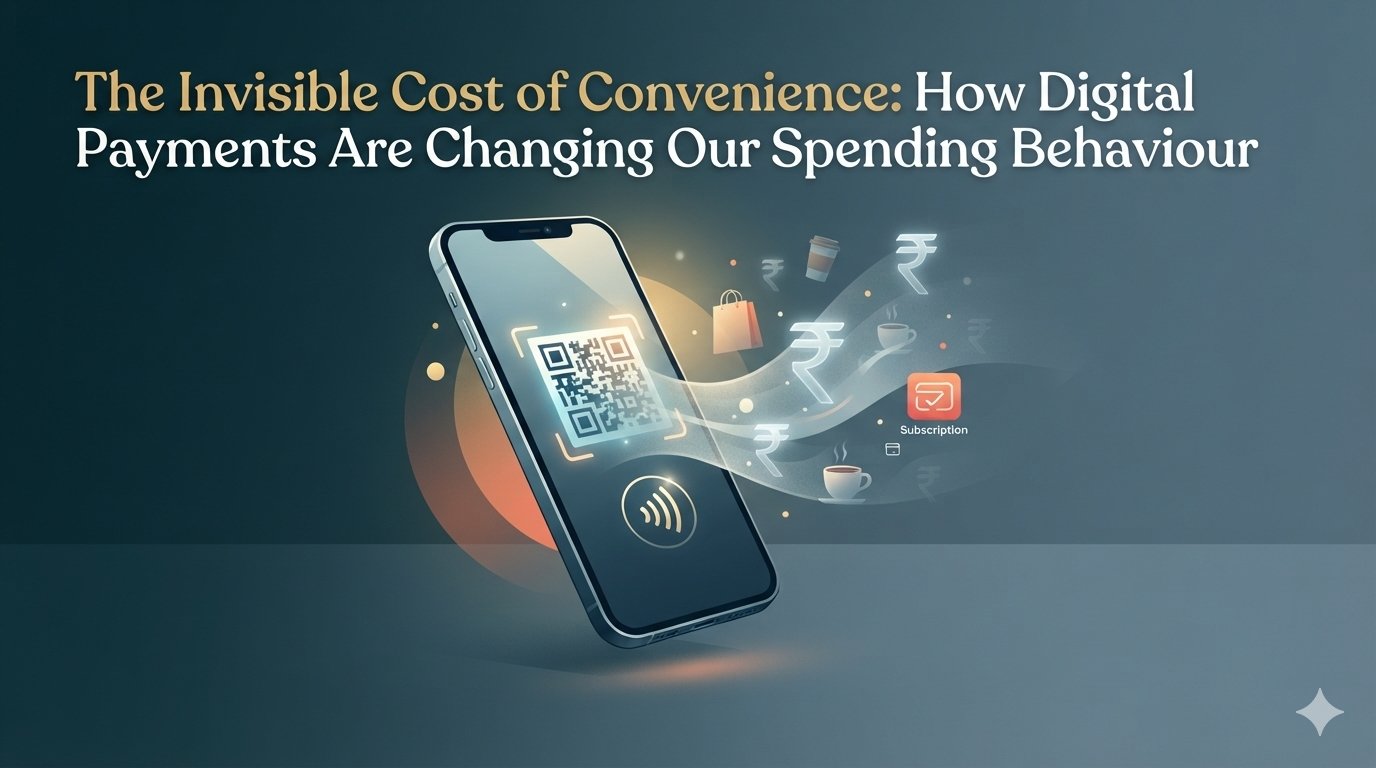
Imagine purchasing a cup of coffee, ordering food online, subscribing to a digital service or buying something from an e-commerce platform. A few years ago, such transactions might have required cash, a visit to an ATM or the physical use of a debit or credit card. Today, a simple scan of a QR code or a tap on a smartphone completes the transaction within seconds.
Digital payments have transformed the way individuals interact with money. Unified Payments Interface (UPI), mobile wallets, contactless cards and other digital payment platforms have made financial transactions faster, more accessible and increasingly convenient.
However, beneath this remarkable convenience lies an interesting behavioural question: When spending money becomes effortless, do individuals become less conscious of how much they are actually spending?
The transformation is not merely technological; it is psychological. Digital payments are changing our relationship with money, influencing purchasing decisions, spending habits and our perception of financial affordability. The convenience of cashless transactions may therefore carry an invisible cost that is reflected not in transaction charges, but in the gradual erosion of spending awareness.
1. The Psychology of Cashless Spending
Money is not merely an economic instrument; it also has a psychological dimension.
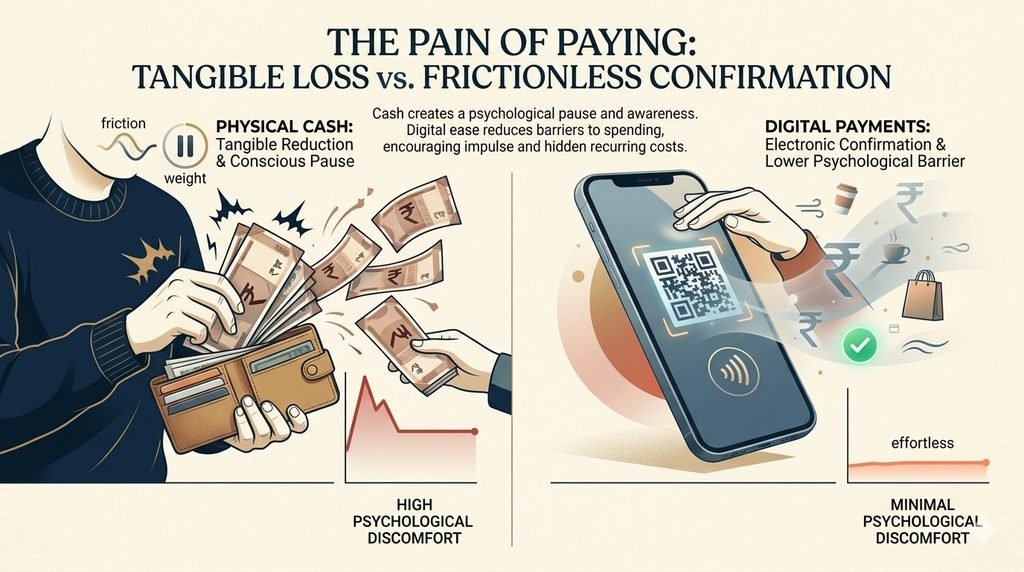
When individuals pay using physical cash, they experience a tangible reduction in their available money. Watching currency notes leave their wallets creates an immediate psychological connection between purchasing something and sacrificing financial resources.
Digital payments remove much of this physical experience.
A QR code scan, a PIN entry or a one-click payment does not necessarily create the same psychological response as handing over cash. The transaction becomes an electronic confirmation rather than a visible exchange of money.
Behavioural economics describes this phenomenon through the concept of pain of paying.
The pain of paying refers to the psychological discomfort associated with parting with money while making a purchase. When this discomfort becomes weaker, consumers may become more willing to spend.
Consequently, individuals might make purchases that they would otherwise reconsider if they had to pay in cash.
The important distinction is that digital payments do not automatically make people financially irresponsible. Rather, they reduce certain psychological barriers that traditionally encouraged individuals to pause and evaluate their spending decisions.
2. The Small-Transaction Trap: How Minor Expenses Become Major Outflows
One of the most overlooked consequences of digital payments is the accumulation of small, frequent transactions.
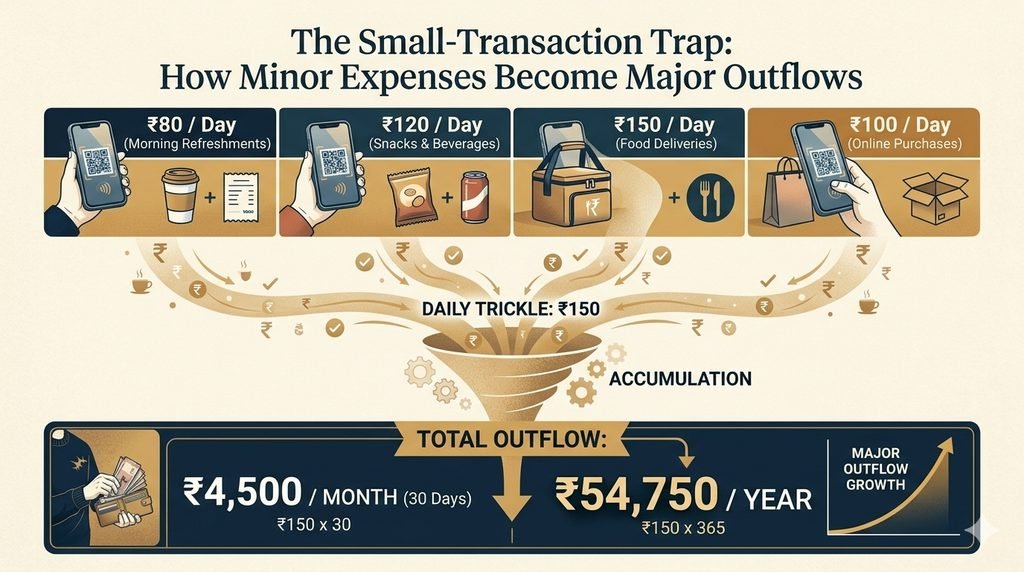
Consider an individual who spends:
- ₹80 on morning refreshments.
- ₹120 on snacks and beverages.
- ₹150 on occasional food deliveries.
- ₹100 on miscellaneous online purchases.
Individually, these transactions may appear insignificant. However, their cumulative impact can be substantial.
For illustrative purposes, if an individual spends ₹150 every day through small digital transactions, the total expenditure becomes ₹4,500 in a 30-day month and ₹54,750 over a year.
The problem is not necessarily the amount spent on any individual purchase. It is the failure to recognise the cumulative financial impact of repeated small expenditures.
Digital payment applications make these transactions convenient, but convenience can also encourage spending without adequate reflection.
This phenomenon demonstrates how seemingly harmless financial decisions can gradually influence household budgets.
3. The Rise of Impulse Buying in a One-Click Economy
The digital economy has significantly reduced the distance between wanting something and purchasing it.
E-commerce platforms, food delivery applications and online marketplaces frequently use features such as:
- One-click purchasing.
- Saved payment credentials.
- Limited-period discounts.
- Personalised product recommendations.
- Cashback offers and reward points.
- Instant payment confirmations.
These features are designed to reduce friction in the purchasing process.
From a commercial perspective, this improves customer experience and transaction conversion. From a behavioural perspective, however, it can encourage consumers to make purchasing decisions without sufficient consideration.
For example, an individual browsing an online shopping platform may initially have no intention of purchasing anything. However, personalised recommendations, attractive discounts and the availability of saved payment details may turn casual browsing into an unplanned purchase.
The convenience of digital payments therefore becomes an important component of the modern impulse-buying ecosystem.
4. Cashback, Rewards and the Illusion of Saving
The real question is not whether consumers should avoid digital payments, but whether they can maintain financial discipline in an environment designed to make spending effortless.
Another interesting behavioural dimension is the influence of cashback, reward points, discounts and promotional incentives.
Consumers often perceive cashback as an opportunity to save money. However, this perception can sometimes be misleading.
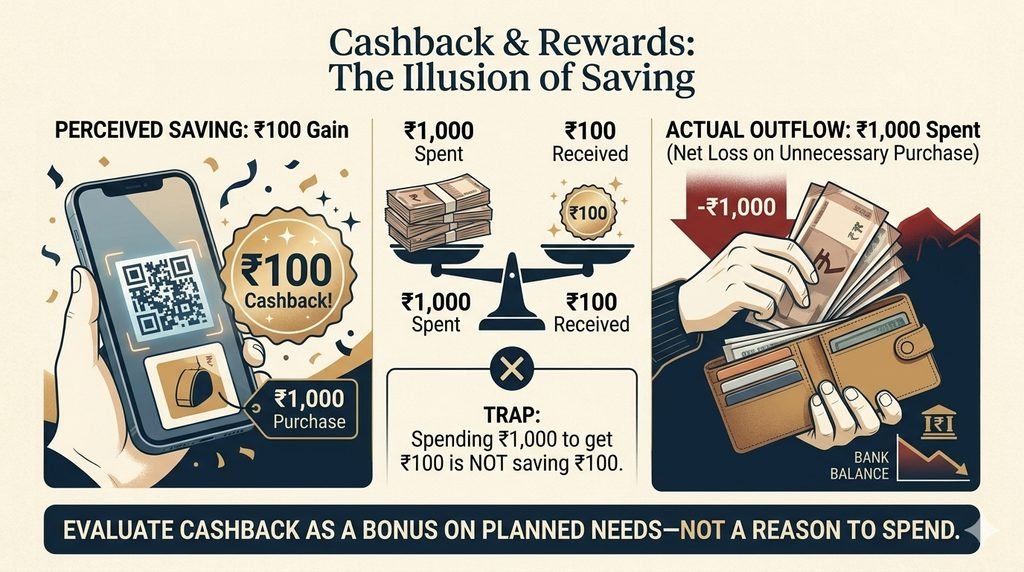
Consider an individual purchasing an unnecessary product worth ₹1,000 merely because the payment application offers ₹100 cashback.
Although the consumer receives a financial benefit of ₹100, the transaction still results in an expenditure of ₹1,000.
If the purchase was not required in the first place, the cashback has not necessarily generated a genuine saving. Instead, it may have encouraged additional consumption.
This reflects an important principle of behavioural finance: individuals do not always evaluate financial decisions solely on the basis of their actual economic consequences. The way an incentive is presented can influence their perception of value.
Cashback should therefore be evaluated as a benefit attached to a purchase, not as an independent reason to spend.
5. Subscription Economy: The Silent Drain on Monthly Income
Digital payments have also made recurring subscriptions remarkably convenient.
Entertainment platforms, cloud storage services, online learning applications, premium memberships and other digital services increasingly operate through automatic renewals.
While each subscription may involve a relatively small monthly payment, multiple subscriptions can collectively create a significant recurring financial obligation.
For instance, an individual maintaining five subscriptions at ₹199 each would incur a monthly expenditure of ₹995, amounting to ₹11,940 annually.
The challenge is that these payments may continue automatically even when the services are rarely used.
Unlike a conscious purchase made every month, automatic deductions can gradually become invisible within an individual’s financial routine.
This raises an important question of financial awareness: Are consumers paying for the value they actually receive, or simply continuing to pay because cancellation requires an additional effort?
Regular subscription reviews can help individuals identify unnecessary recurring expenditure and redirect those funds towards savings or investments.
6. India’s Digital Payment Revolution: Convenience Meets Financial Responsibility
India provides an interesting example of how technology can transform financial behaviour at a population level.
The expansion of UPI has made digital payments accessible across different income groups, geographical locations and business segments. Small retailers, street vendors, professionals and large businesses increasingly accept digital payments.
This transformation has supported financial inclusion, improved transaction efficiency and reduced dependence on physical currency.
However, the increasing use of digital payment systems also makes financial literacy more important.
Consumers must understand that the ease of transferring money does not change the fundamental economic reality of expenditure.
A payment made through UPI is still an expense. A purchase made using a credit card is still a financial obligation. A cashback reward does not automatically represent a saving.
Digital convenience should therefore be accompanied by digital financial discipline.
The objective should not be to discourage cashless transactions, but to ensure that technological convenience does not weaken responsible financial decision-making.
7. The Financial Discipline Framework: Making Convenience Work in Our Favour
Digital payments can become powerful financial management tools when used consciously.
Individuals can adopt a few practical measures to maintain control over their spending behaviour.
First, establish a monthly discretionary spending limit. Allocate a fixed amount for non-essential purchases and monitor expenditure against that limit.
Second, review digital transaction histories regularly. Weekly or monthly reviews can help identify unnecessary purchases, repetitive small expenses and spending patterns that may otherwise remain unnoticed.
Third, distinguish between needs and wants. Before making an unplanned purchase, consider whether the product or service is genuinely required.
Fourth, review recurring subscriptions. Cancel services that are no longer useful and periodically evaluate whether existing subscriptions justify their costs.
Fifth, avoid spending merely to earn rewards. Cashback and discounts should supplement planned purchases rather than motivate unnecessary expenditure.
Finally, automate savings before discretionary spending. Transferring a predetermined portion of income into savings or investment accounts can help establish financial priorities before money is spent on consumption.
The objective is to introduce conscious decision-making into an increasingly automated financial environment.
Conclusion: The True Price of a Cashless Lifestyle
Digital payments represent one of the most significant developments in modern financial transactions. They have improved accessibility, reduced transaction friction and transformed the consumer experience.
Nevertheless, the convenience of cashless transactions should not come at the cost of financial awareness.
The invisible cost of convenience is not necessarily reflected in bank charges, transaction fees or service costs. It may instead appear through impulsive purchases, unnoticed recurring payments, unnecessary subscriptions and the accumulation of small expenses.
Technology has made spending easier, but it has not made money unlimited.
Ultimately, financial well-being depends not on how quickly an individual can complete a transaction, but on how thoughtfully that individual makes the decision to spend.
In an economy where money can move with a single tap, the ability to pause before making a payment may become one of the most valuable financial skills of all.