Manufacturing, Infrastructure and Services Sectors Drive India’s Economic Ambitions
India is steadily strengthening its position in the global economy, emerging as an important destination for international investment, manufacturing expansion and business innovation. With a large domestic market, a growing workforce, expanding digital capabilities and ambitious infrastructure development, the country is positioning itself as a significant contributor to global economic growth.
As international businesses reassess their supply chains and explore new investment destinations, India is gaining attention as a competitive manufacturing and services hub. Government initiatives, improving connectivity, technological advancement and rising entrepreneurial activity are supporting the country’s ambition to become one of the world’s leading economic powers.
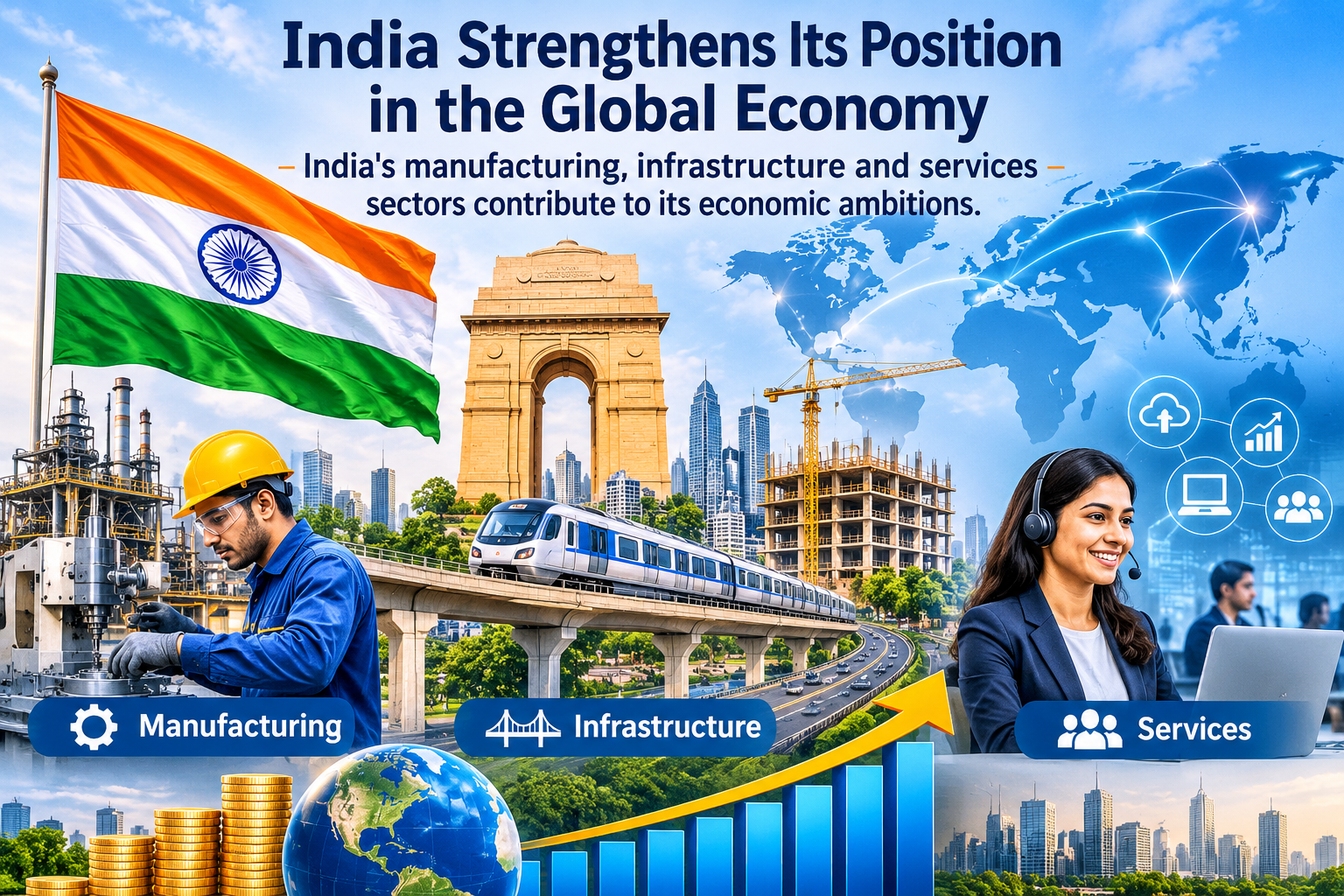
India’s economic progress is increasingly being driven by three major pillars: manufacturing, infrastructure and services. Together, these sectors are creating employment opportunities, attracting domestic and foreign investment, strengthening industrial capabilities and expanding India’s participation in international trade.
Manufacturing Sector Strengthens Industrial Growth
Manufacturing is playing an increasingly important role in India’s economic development. The government has introduced several initiatives to encourage domestic production, attract international manufacturers and reduce dependence on imported goods.
The Production Linked Incentive (PLI) scheme is one of the key initiatives designed to strengthen manufacturing capabilities across sectors such as electronics, pharmaceuticals, automobiles, telecommunications, textiles and renewable energy equipment.
India’s electronics manufacturing industry has attracted considerable attention, particularly in mobile phone production and semiconductor-related investments. Global companies are increasingly exploring opportunities to diversify their manufacturing operations, creating opportunities for Indian suppliers, component manufacturers and industrial service providers.
The automobile sector is also undergoing significant transformation, supported by electric vehicle development, battery technology and advanced manufacturing systems.
Furthermore, the expansion of domestic pharmaceutical production, engineering goods, defence manufacturing and industrial machinery is strengthening India’s industrial ecosystem.
However, improving manufacturing competitiveness will require continued investment in research and development, skilled labour, technology adoption, quality standards and efficient supply chains.
Infrastructure Development Accelerates Economic Activity
Infrastructure development remains one of the most important drivers of India’s long-term economic ambitions. Investments in highways, railways, airports, ports, logistics networks, power generation and urban development are improving connectivity and supporting industrial expansion.
Major infrastructure programmes, including Bharatmala Pariyojana, Sagarmala and the PM Gati Shakti National Master Plan, are aimed at improving transportation efficiency and strengthening integrated infrastructure planning.
The expansion of national highways and expressways is reducing transportation barriers between industrial centres, commercial markets and ports. Modernisation of railway infrastructure and the development of dedicated freight corridors are also expected to improve logistics efficiency.
India’s growing airport network, port capacity and multimodal transportation systems are creating opportunities for businesses involved in manufacturing, exports and international trade.
Infrastructure investment also generates significant demand for construction materials, steel, cement, electrical equipment, engineering services and industrial machinery.
Reliable electricity, digital connectivity and modern logistics infrastructure will remain essential for supporting India’s next phase of economic expansion.
Services Sector Remains a Major Economic Strength
India’s services sector continues to be a major contributor to economic activity and international competitiveness. Information technology, business process management, financial services, telecommunications, consulting, healthcare, education and tourism are among the important segments supporting growth.
The country’s IT industry has established a strong international presence by providing software development, cloud computing, cybersecurity, artificial intelligence, engineering services and digital transformation solutions.
Indian technology companies serve clients across major international markets, contributing to foreign exchange earnings and creating high-skilled employment opportunities.
The growth of digital financial services has also transformed India’s domestic economy. Digital payment platforms, fintech companies and technology-enabled banking services are expanding financial accessibility and supporting business transactions.
Healthcare and pharmaceutical services provide additional opportunities for India to strengthen its international presence. Medical tourism, pharmaceutical exports, research services and healthcare technology are creating new avenues for growth.
As global demand for digital and professional services increases, India is well positioned to expand its role in the international services economy.
Digital Transformation and Technological Innovation
Technology is becoming an important foundation of India’s economic transformation. The expansion of digital infrastructure, artificial intelligence, cloud computing, semiconductor technology and digital public platforms is creating new opportunities across industries.
Digital India has supported the expansion of digital connectivity and technology-based public services. Platforms such as Aadhaar, Unified Payments Interface (UPI) and other digital public infrastructure systems have contributed to the development of a more connected economic ecosystem.
Artificial intelligence is also creating opportunities in manufacturing, agriculture, healthcare, financial services and education. Businesses are increasingly adopting automation, data analytics and intelligent software to improve productivity and operational efficiency.
India’s startup ecosystem is another important contributor to innovation. Entrepreneurs are developing solutions across fintech, e-commerce, logistics, healthcare, education and clean energy.
Continued investment in research, innovation and technology development will be essential for improving India’s global competitiveness.
Foreign Investment and India’s Global Trade Opportunities
India’s growing economic importance is attracting interest from international investors seeking access to its domestic market, industrial capabilities and skilled workforce.
Foreign direct investment can support manufacturing expansion, technology transfer, employment generation and infrastructure development. International partnerships are also creating opportunities for Indian businesses to participate in global supply chains.
India’s trade relationships with major economies and its participation in international economic forums are strengthening its position in global commerce.
However, increasing export competitiveness will require improvements in product quality, logistics efficiency, trade facilitation and manufacturing productivity.
India must also navigate international uncertainties, including geopolitical tensions, changing trade policies, commodity price fluctuations and global supply chain disruptions.
Challenges on the Path to Becoming a Global Economic Leader
Despite its considerable opportunities, India faces several challenges in achieving its long-term economic ambitions.
Employment generation, skill development, income inequality, infrastructure gaps and regional economic disparities remain important areas requiring attention.
Manufacturing businesses need easier access to finance, modern technology and efficient logistics. Small and medium-sized enterprises must also receive greater support to participate in domestic and international supply chains.
Improving education, vocational training and workforce productivity will be essential to ensure that economic growth creates meaningful employment opportunities.
Furthermore, sustainable development, energy security and environmental protection must remain integral to India’s industrial and infrastructure expansion.
The Worldonomics Times View
The Worldonomics Times believes that India is entering an important phase of its economic development, with manufacturing, infrastructure and services collectively strengthening its position in the global marketplace.
The country’s economic ambitions are supported by a combination of domestic consumption, technological advancement, infrastructure investment, entrepreneurial activity and growing international business partnerships.
However, becoming a leading global economic power will require more than strong economic growth figures. India must focus on improving productivity, strengthening manufacturing capabilities, expanding exports, developing skilled human capital and encouraging innovation across industries.
Particular attention should be given to small and medium-sized enterprises, which play a vital role in employment generation, industrial supply chains and regional economic development. Greater access to finance, technology and international markets can help these businesses become important contributors to India’s global ambitions.
The next stage of India’s growth will depend on how effectively the country converts its demographic advantages, domestic market potential and investment opportunities into sustainable economic outcomes.
India has the potential to emerge as a major global manufacturing hub, a leader in digital services and an important destination for international capital. Achieving this vision will require consistent policymaking, strong institutions, infrastructure modern