Artificial Intelligence is transforming the way businesses operate, financial institutions deliver services and economies compete globally. But behind every AI-powered application, digital payment, cloud service and online transaction lies an essential infrastructure that often goes unnoticed: data centres.
As India accelerates its digital transformation, data centres are becoming the backbone of its emerging digital economy.
However, this growth comes with a critical challenge. Can India build the digital infrastructure required for an AI-driven future without putting excessive pressure on its energy and water resources?
1. India’s Growing Data Centre Economy
India’s data centre industry is witnessing rapid expansion, driven by cloud computing, artificial intelligence, digital banking, e-commerce and increasing data consumption.
According to the Government of India, installed data centre capacity has increased from approximately 375 MW in 2020 to around 1.57 GW as of August 2026.
The government expects this capacity to approach 8 GW by 2030.
The investment opportunity is equally significant. India’s data centre sector has attracted strong interest from domestic and international investors, with the government highlighting a potential investment opportunity of approximately USD 200 billion.
This is no longer just an IT infrastructure story. It is becoming a major investment and economic development opportunity.
2. The Hidden Cost of the AI Revolution
AI requires enormous computing power. High-performance servers and specialised processors generate substantial heat and require sophisticated cooling systems.
This creates three major challenges:
Energy Consumption: Data centres require reliable, uninterrupted electricity. As AI workloads increase, power requirements will become a major consideration for infrastructure developers.
Water Consumption: Traditional cooling technologies can place pressure on local water resources, particularly in water-stressed regions.
Environmental Impact: Increasing electricity demand can create additional carbon emissions if energy requirements are met primarily through fossil fuels.
Therefore, digital growth must be supported by sustainable infrastructure rather than simply expanding computing capacity.
3. Green Data Centres: A New Investment Opportunity
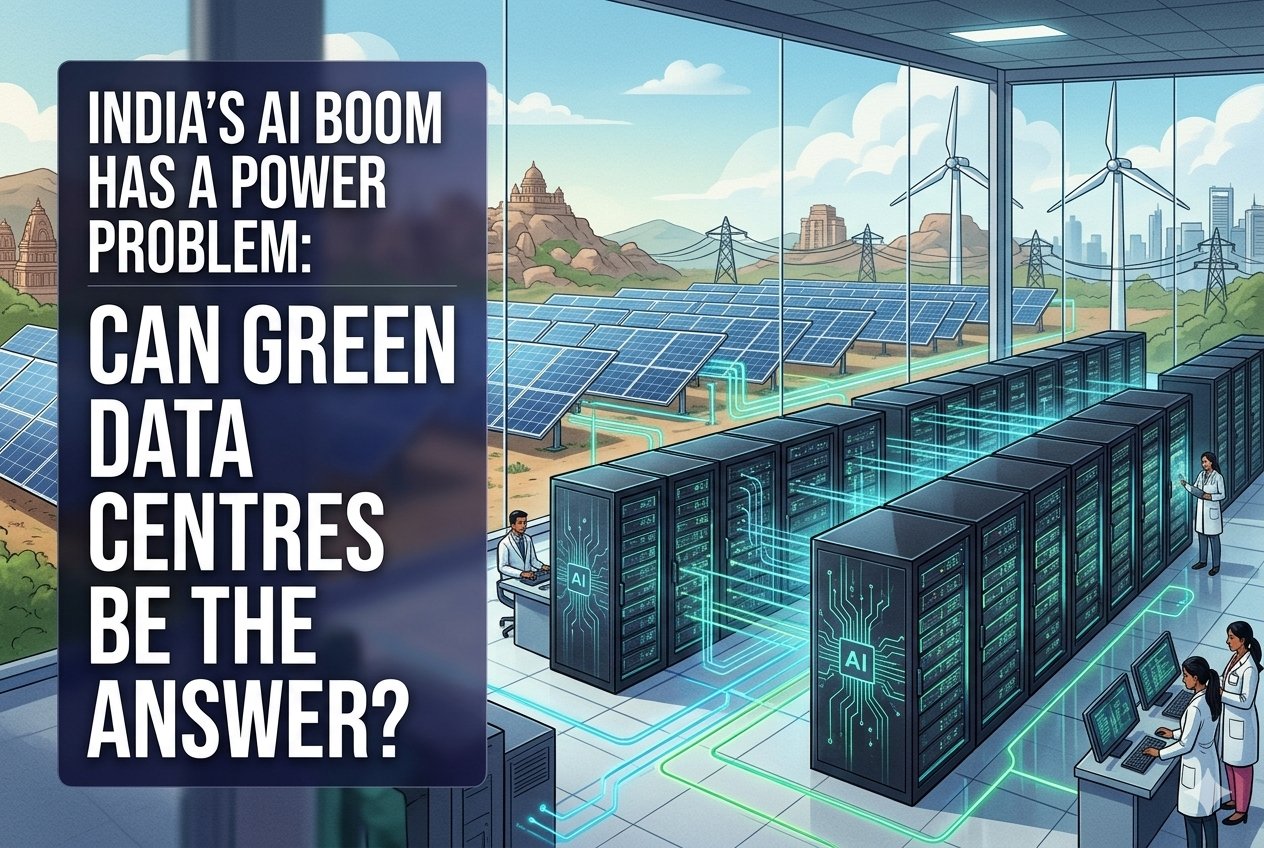
Green data centres aim to reduce environmental impact while maintaining operational efficiency.
Some of the emerging solutions include:
- Renewable energy integration through solar and wind power.
- Advanced liquid-cooling technologies.
- Energy-efficient servers and high-density computing.
- Battery storage and intelligent power management.
- Water recycling and closed-loop cooling systems.
- Efficient waste management and equipment recycling.
These technologies can help businesses reduce operational costs while improving environmental performance.
For investors, this creates opportunities in renewable energy, battery storage, cooling technologies, electrical equipment and sustainable infrastructure.
4. Government Policy: Moving Towards Sustainable Infrastructure
India’s policy environment is evolving to encourage digital infrastructure investment.
Some important developments include:
Infrastructure Status: Data centres have been included in the Harmonised List of Infrastructure, supporting access to infrastructure financing.
Budget 2026–27: The government introduced a tax holiday until 2047 for eligible foreign cloud service providers using India-based data centre infrastructure for global operations, subject to prescribed conditions.
NITI Aayog’s Data Centre Evaluation Framework: Released in October 2026, this framework encourages states to evaluate projects on five important pillars:
- Power and energy.
- Water and cooling.
- Siting and environmental sustainability.
- Economic and strategic value.
- Policy, governance and implementation.
The direction is significant: attracting investment is important, but ensuring that investment creates sustainable economic value is even more important.
5. The Corporate Finance Perspective
For finance professionals, data centre expansion presents an interesting case study in capital-intensive investment.
These projects require substantial initial capital expenditure, long-term financing arrangements and careful evaluation of future cash flows.
Businesses must consider:
- Capital budgeting and project feasibility.
- Return on investment and payback periods.
- Cost of capital and financing structure.
- Energy costs and operational efficiency.
- Environmental, Social and Governance (ESG) reporting.
- Risk management and long-term asset utilisation.
A data centre may represent a promising investment opportunity, but its financial viability ultimately depends on demand, infrastructure costs, technology and operational efficiency.
6. The Road Ahead: Growth Must Be Sustainable
India has an opportunity to become an important global destination for cloud computing, AI infrastructure and digital services.
However, the next phase of growth will require coordination between policymakers, power companies, technology providers, investors and infrastructure developers.
The focus must shift from simply building more data centres to building smarter, more energy-efficient and resource-conscious facilities.
The success of India’s digital economy will depend not only on computing capacity but also on the reliability and sustainability of the infrastructure supporting it.
Conclusion: The Future of AI Depends on More Than Technology
Artificial Intelligence may be the face of the digital revolution, but energy, infrastructure and sustainability will determine how far that revolution can go.
India’s ambition to become a global digital infrastructure hub must be supported by responsible investment, technological innovation and efficient resource management.
The real question is no longer just how much computing power India can build, but how sustainably it can power the future.
Because the future of technology must be intelligent, not just powerful — it must also be sustainable.